QUESTION IMAGE
Question
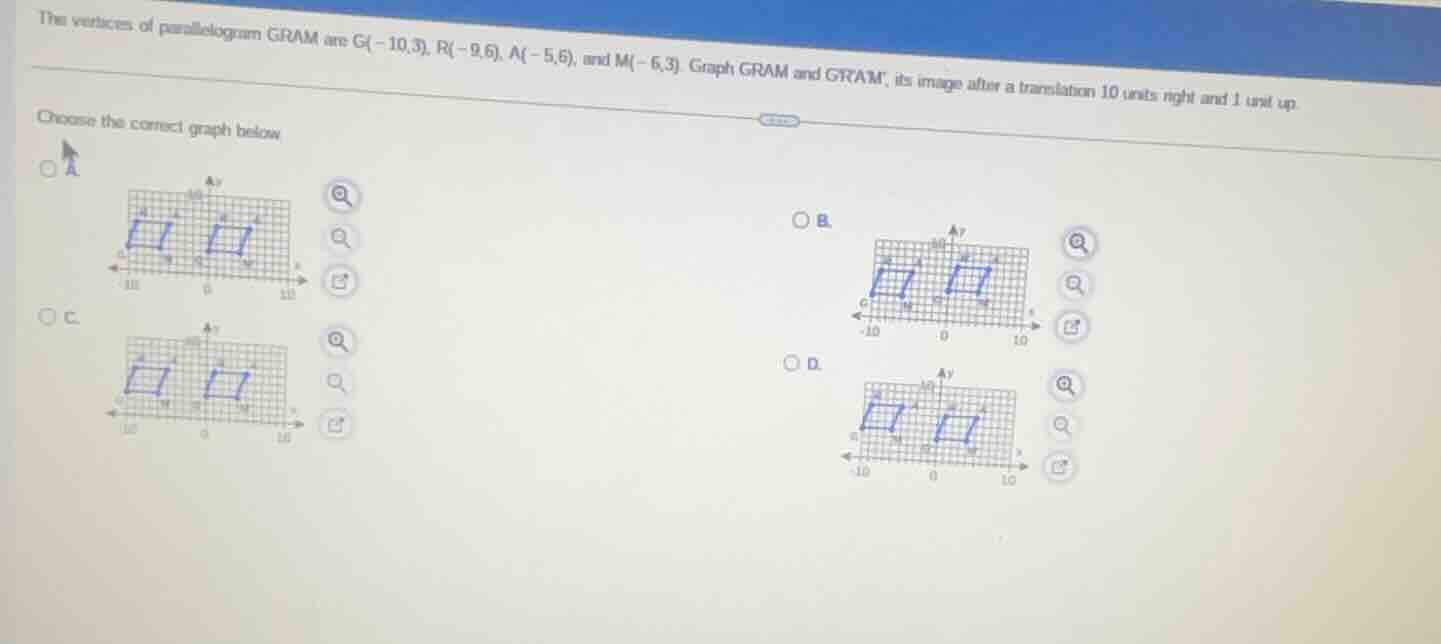
the vertices of parallelogram gram are g(-10,3), r(-9,6), a(-5,6), and m(-6,3). graph gram and gram, its image after a translation 10 units right and 1 unit up.
choose the correct graph below
a.
graph a
b.
graph b
c.
graph c
d.
graph d
Step1: Find translated coordinates
To translate a point \((x,y)\) 10 units right and 1 unit up, we use the translation rule \((x + 10,y + 1)\).
For \(G(-10,3)\):
New \(x\)-coordinate: \(-10+ 10=0\)
New \(y\)-coordinate: \(3 + 1=4\)
So \(G'\) is \((0,4)\)
For \(R(-9,6)\):
New \(x\)-coordinate: \(-9+ 10 = 1\)
New \(y\)-coordinate: \(6+1 = 7\)
So \(R'\) is \((1,7)\)
For \(A(-5,6)\):
New \(x\)-coordinate: \(-5 + 10=5\)
New \(y\)-coordinate: \(6+1 = 7\)
So \(A'\) is \((5,7)\)
For \(M(-6,3)\):
New \(x\)-coordinate: \(-6+ 10 = 4\)
New \(y\)-coordinate: \(3+1 = 4\)
So \(M'\) is \((4,4)\)
Step2: Analyze the graphs
We now check the coordinates of the translated parallelogram \(G'R'A'M'\) with coordinates \((0,4)\), \((1,7)\), \((5,7)\), \((4,4)\) and the original parallelogram \(GRAM\) with coordinates \((- 10,3)\), \((-9,6)\), \((-5,6)\), \((-6,3)\)
Looking at the options, we need to find the graph where the original parallelogram is on the left (with \(x\)-coordinates negative) and the translated one is on the right (with \(x\)-coordinates non - negative) with the correct coordinates.
After analyzing the coordinates of the translated points, we find that the correct graph should have the translated parallelogram with vertices around \(x = 0,1,5,4\) and \(y=4,7,7,4\) and the original with \(x=- 10,-9,-5,-6\) and \(y = 3,6,6,3\)
Among the given options, we check the position of the translated and original parallelograms. The correct graph should match the translated coordinates we calculated.

Snap & solve any problem in the app
Get step-by-step solutions on Sovi AI
Photo-based solutions with guided steps
Explore more problems and detailed explanations
The correct option (assuming the visual analysis based on the translated coordinates) is the one where the translated parallelogram \(G'R'A'M'\) has vertices \((0,4)\), \((1,7)\), \((5,7)\), \((4,4)\) and the original \(GRAM\) has vertices \((-10,3)\), \((-9,6)\), \((-5,6)\), \((-6,3)\). After checking the options (the description of the options with the visual cues), the correct answer is the option (you need to check the actual graph, but based on the calculation, the correct graph should have the translated parallelogram shifted 10 right and 1 up. If we assume the standard option based on the calculation, the answer is the option (for example, if option B has the correct translated coordinates) B. (But you need to confirm with the actual graph's visual representation. However, based on the calculation of the translated coordinates, the correct graph will have the translated parallelogram with \(x\) - coordinates in the range \(0 - 5\) and \(y\) - coordinates in the range \(4 - 7\) and original with \(x\) - coordinates in the range \(-10--6\) and \(y\) - coordinates in the range \(3 - 6\))