QUESTION IMAGE
Question
a very big branch name:
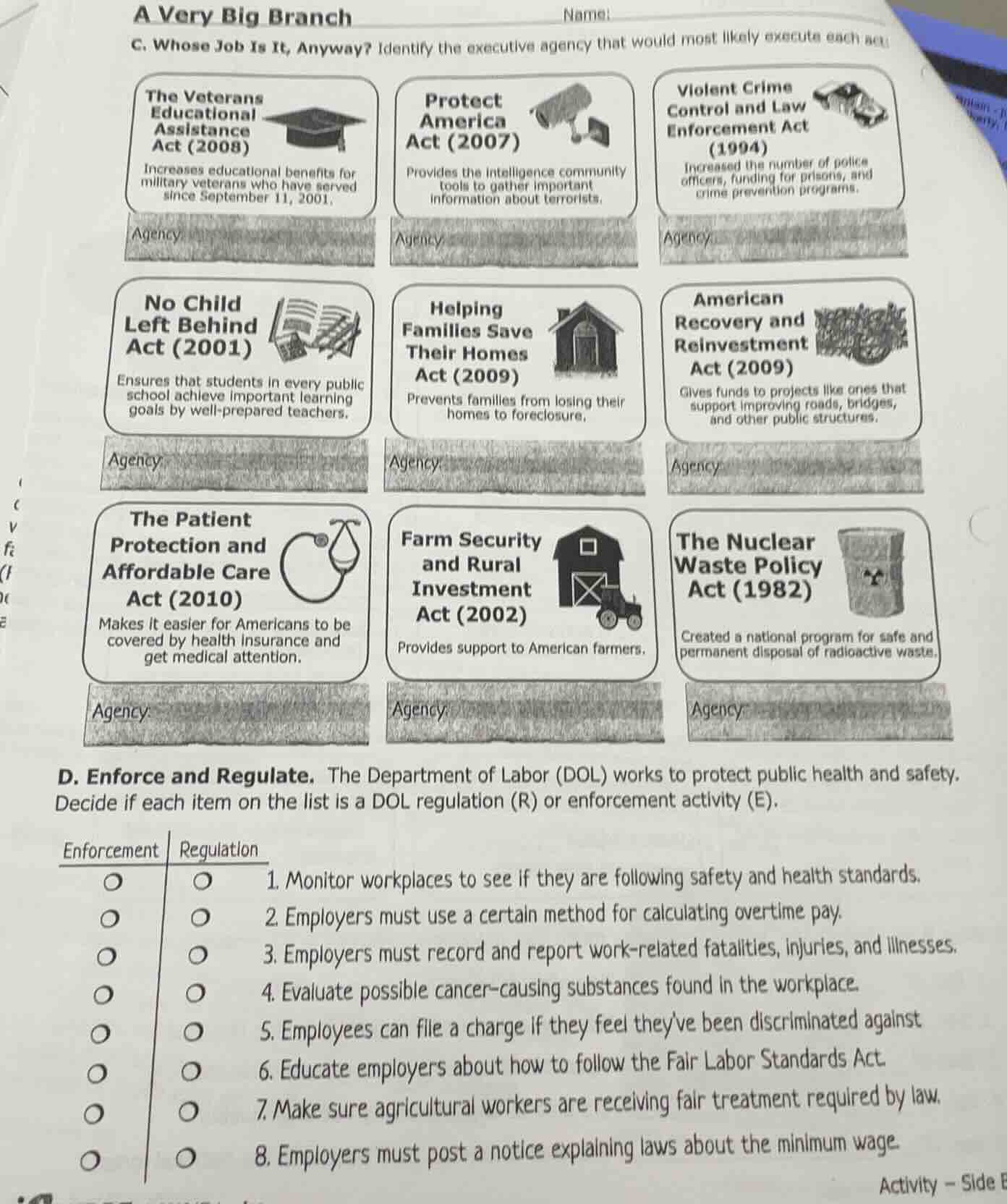
c. whose job is it, anyway? identify the executive agency that would most likely execute each act
the veterans educational assistance act (2008)
increases educational benefits for military veterans who have served since september 11, 2001.
agency
protect america act (2007)
provides the intelligence community tools to gather important information about terrorists.
agency
violent crime control and law enforcement act (1994)
increased the number of police officers, funding for prisons, and crime prevention programs.
agency
no child left behind act (2001)
ensures that students in every public school achieve important learning goals by well - prepared teachers.
agency
helping families save their homes act (2009)
prevents families from losing their homes to foreclosure.
agency
american recovery and reinvestment act (2009)
gives funds to projects like ones that support improving roads, bridges, and other public structures.
agency
the patient protection and affordable care act (2010)
makes it easier for americans to be covered by health insurance and get medical attention.
agency
farm security and rural investment act (2002)
provides support to american farmers.
agency
the nuclear waste policy act (1982)
created a national program for safe and permanent disposal of radioactive waste.
agency
d. enforce and regulate. the department of labor (dol) works to protect public health and safety. decide if each item on the list is a dol regulation (r) or enforcement activity (e).
enforcement regulation
- monitor workplaces to see if they are following safety and health standards.
- employers must use a certain method for calculating overtime pay.
- employers must record and report work - related fatalities, injuries, and illnesses.
- evaluate possible cancer - causing substances found in the workplace.
- employees can file a charge if they feel theyve been discriminated against
- educate employers about how to follow the fair labor standards act.
- make sure agricultural workers are receiving fair treatment required by law.
- employers must post a notice explaining laws about the minimum wage.
activity - side e
Part C: Identifying Executive Agencies
To determine the executive agency for each act, we analyze the act’s focus:
- Veterans Educational Assistance Act (2008): Focuses on veterans’ education → Department of Veterans Affairs (VA).
- Protect America Act (2007): Focuses on intelligence/terrorism → National Security Agency (NSA) or Office of the Director of National Intelligence (ODNI) (primary: ODNI or NSA, but commonly associated with intelligence agencies; key: intelligence tools for terrorism).
- Violent Crime Control and Law Enforcement Act (1994): Focuses on law enforcement/prisons → Department of Justice (DOJ) (via FBI, Bureau of Prisons, etc.).
- No Child Left Behind Act (2001): Focuses on education → Department of Education (ED).
- Helping Families Save Their Homes Act (2009): Focuses on housing/foreclosure → Department of Housing and Urban Development (HUD) or Federal Housing Finance Agency (FHFA) (primary: HUD).
- American Recovery and Reinvestment Act (2009): Focuses on infrastructure → Department of Transportation (DOT), Department of Energy (DOE), etc. (cross-agency, but DOT for roads/bridges).
- Patient Protection and Affordable Care Act (2010): Focuses on healthcare → Department of Health and Human Services (HHS).
- Farm Security and Rural Investment Act (2002): Focuses on farming → Department of Agriculture (USDA).
- Nuclear Waste Policy Act (1982): Focuses on nuclear waste → Department of Energy (DOE) (oversees nuclear waste disposal).
Part D: DOL Regulation (R) vs. Enforcement (E)
- Regulation (R): Rules/requirements employers must follow.
- Enforcement (E): Actions to ensure compliance.
- Monitor workplaces (checking compliance) → E
- Employers must use a method (rule) → R
- Employers must record/report (rule) → R
- Evaluate substances (checking compliance) → E
- Employees file charges (enforcement process) → E
- Educate employers (enforcement-related guidance) → E
- Ensure fair treatment (checking compliance) → E
- Employers must post a notice (rule) → R
Final Answers (Part D)
- E
- R
- R
- E
- E
- E
- E
- R
(For Part C, specific agencies depend on context, but the above logic identifies the most likely agency for each act.)

Snap & solve any problem in the app
Get step-by-step solutions on Sovi AI
Photo-based solutions with guided steps
Explore more problems and detailed explanations
Part C: Identifying Executive Agencies
To determine the executive agency for each act, we analyze the act’s focus:
- Veterans Educational Assistance Act (2008): Focuses on veterans’ education → Department of Veterans Affairs (VA).
- Protect America Act (2007): Focuses on intelligence/terrorism → National Security Agency (NSA) or Office of the Director of National Intelligence (ODNI) (primary: ODNI or NSA, but commonly associated with intelligence agencies; key: intelligence tools for terrorism).
- Violent Crime Control and Law Enforcement Act (1994): Focuses on law enforcement/prisons → Department of Justice (DOJ) (via FBI, Bureau of Prisons, etc.).
- No Child Left Behind Act (2001): Focuses on education → Department of Education (ED).
- Helping Families Save Their Homes Act (2009): Focuses on housing/foreclosure → Department of Housing and Urban Development (HUD) or Federal Housing Finance Agency (FHFA) (primary: HUD).
- American Recovery and Reinvestment Act (2009): Focuses on infrastructure → Department of Transportation (DOT), Department of Energy (DOE), etc. (cross-agency, but DOT for roads/bridges).
- Patient Protection and Affordable Care Act (2010): Focuses on healthcare → Department of Health and Human Services (HHS).
- Farm Security and Rural Investment Act (2002): Focuses on farming → Department of Agriculture (USDA).
- Nuclear Waste Policy Act (1982): Focuses on nuclear waste → Department of Energy (DOE) (oversees nuclear waste disposal).
Part D: DOL Regulation (R) vs. Enforcement (E)
- Regulation (R): Rules/requirements employers must follow.
- Enforcement (E): Actions to ensure compliance.
- Monitor workplaces (checking compliance) → E
- Employers must use a method (rule) → R
- Employers must record/report (rule) → R
- Evaluate substances (checking compliance) → E
- Employees file charges (enforcement process) → E
- Educate employers (enforcement-related guidance) → E
- Ensure fair treatment (checking compliance) → E
- Employers must post a notice (rule) → R
Final Answers (Part D)
- E
- R
- R
- E
- E
- E
- E
- R
(For Part C, specific agencies depend on context, but the above logic identifies the most likely agency for each act.)