QUESTION IMAGE
Question
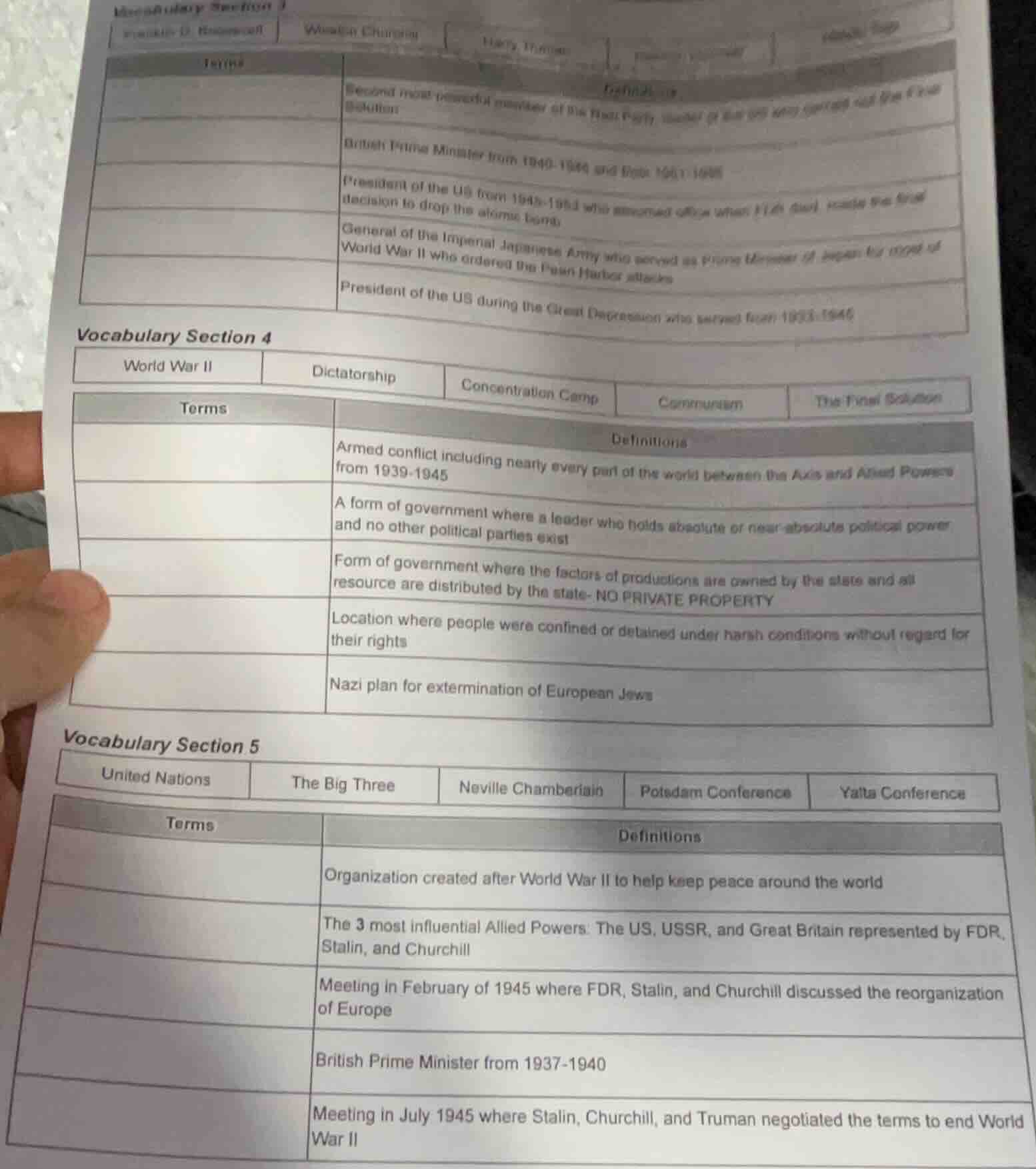
vocabulary section 4
world war ii dictatorship concentration camp communism the final solution
terms definitions
armed conflict including nearly every part of the world between the axis and allied powers from 1939-1945
a form of government where a leader who holds absolute or near-absolute political power and no other political parties exist
form of government where the factors of productions are owned by the state and all resource are distributed by the state- no private property
location where people were confined or detained under harsh conditions without regard for their rights
nazi plan for extermination of european jews
vocabulary section 5
united nations the big three neville chamberlain potsdam conference yalta conference
terms definitions
organization created after world war ii to help keep peace around the world
the 3 most influential allied powers: the us, ussr, and great britain represented by fdr, stalin, and churchill
meeting in february of 1945 where fdr, stalin, and churchill discussed the reorganization of europe
british prime minister from 1937-1940
meeting in july 1945 where stalin, churchill, and truman negotiated the terms to end world war ii
Vocabulary Section (Top, partially visible)
Matches historical figures to their descriptions:
- The description about the Nazi Party member behind the Final Solution refers to Heinrich Himmler (or more accurately, Adolf Eichmann/Heinrich Himmler; the core term tied to the Final Solution leadership is the Nazi hierarchy, but the key match is the term linked to this policy).
- British Prime Minister 1940-1945 and 1951-1955 = Winston Churchill
- US President 1945-1953 who dropped the atomic bomb = Harry S. Truman
- Imperial Japanese Army General/Prime Minister who ordered Pearl Harbor = Hideki Tojo
- US President 1933-1945 during the Great Depression = Franklin D. Roosevelt
Vocabulary Section 4
Matches WWII-era terms to their definitions:
- "Armed conflict 1939-1945 between Axis/Allies" → World War II
- "Absolute power, no other political parties" → Dictatorship
- "State-owned production, no private property" → Communism
- "Harsh detention without regard for rights" → Concentration Camp
- "Nazi plan to exterminate European Jews" → The Final Solution
Vocabulary Section 5
Matches post/pre-WWII terms to their definitions:
- "Post-WWII peacekeeping organization" → United Nations
- "Top 3 Allied Powers (US, USSR, UK)" → The Big Three
- "February 1945 meeting to reorganize Europe" → Yalta Conference
- "British Prime Minister 1937-1940" → Neville Chamberlain
- "July 1945 meeting to end WWII" → Potsdam Conference

Snap & solve any problem in the app
Get step-by-step solutions on Sovi AI
Photo-based solutions with guided steps
Explore more problems and detailed explanations
Top Vocabulary Section (Historical Figures):
- Heinrich Himmler (or term linked to Final Solution)
- Winston Churchill
- Harry S. Truman
- Hideki Tojo
- Franklin D. Roosevelt
Vocabulary Section 4:
- World War II
- Dictatorship
- Communism
- Concentration Camp
- The Final Solution
Vocabulary Section 5:
- United Nations
- The Big Three
- Yalta Conference
- Neville Chamberlain
- Potsdam Conference