QUESTION IMAGE
Question
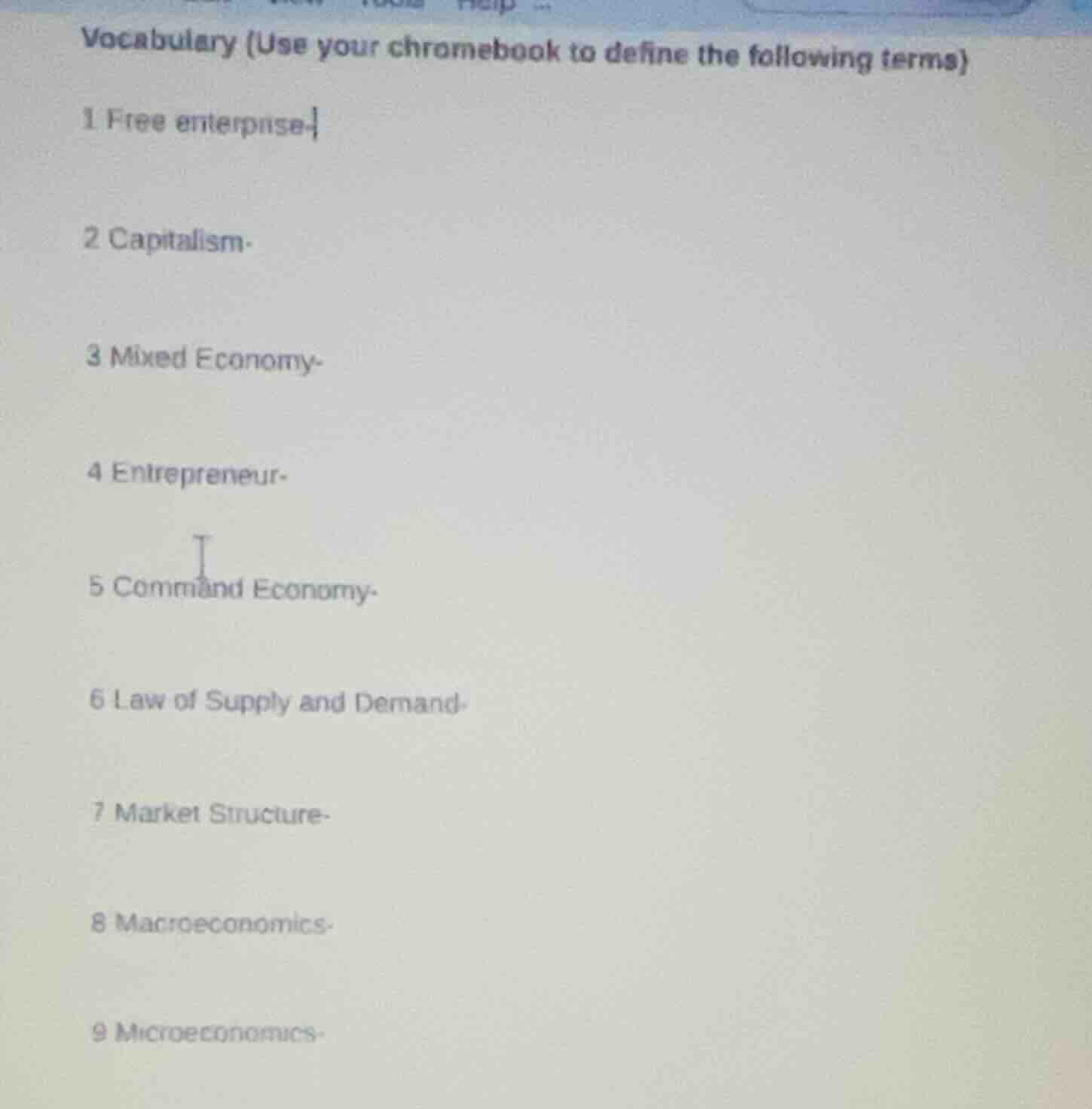
vocabulary (use your chromebook to define the following terms)
1 free enterprise
2 capitalism
3 mixed economy
4 entrepreneur
5 command economy
6 law of supply and demand
7 market structure
8 macroeconomics
9 microeconomics
Brief Explanations
Each term is defined with core economic characteristics:
- Free enterprise: An economic system with minimal government control, where individuals own businesses and make most economic choices.
- Capitalism: An economic system centered on private ownership of capital goods, profit-driven production, and competitive markets.
- Mixed Economy: An economic system that combines private enterprise with government intervention and public ownership of some industries.
- Entrepreneur: An individual who creates, organizes, and manages a business venture, taking on financial risk to pursue profit.
- Command Economy: An economic system where a central authority (government) controls all major economic decisions, production, and resource allocation.
- Law of Supply and Demand: A core economic principle stating that price adjusts to balance the quantity of a good suppliers want to sell and consumers want to buy; higher demand raises price, higher supply lowers price (and vice versa).
- Market Structure: The organizational and competitive characteristics of a market, including the number of firms, barriers to entry, and product differentiation.
- Macroeconomics: The branch of economics that studies large-scale economic factors, such as inflation, unemployment, national income, and overall economic growth.
- Microeconomics: The branch of economics that studies the behavior of individual economic agents (consumers, firms) and how they interact in specific markets.

Snap & solve any problem in the app
Get step-by-step solutions on Sovi AI
Photo-based solutions with guided steps
Explore more problems and detailed explanations
- Free enterprise: An economic system with minimal government oversight, allowing individuals to own and operate businesses with most economic decisions made privately.
- Capitalism: An economic system based on private ownership of capital, profit-seeking production, and competitive free markets.
- Mixed Economy: An economic system blending private sector enterprise with government involvement in regulation, public services, and some industry ownership.
- Entrepreneur: A person who launches, manages, and assumes the risk of a new business venture to generate profit.
- Command Economy: An economic system where a central government controls all key economic choices, including production levels, resource allocation, and pricing.
- Law of Supply and Demand: The principle that a good's price adjusts to equate the quantity suppliers offer and consumers demand; higher demand increases price, higher supply decreases price.
- Market Structure: The competitive framework of a market, defined by the number of firms, entry barriers, and product uniformity.
- Macroeconomics: The study of large-scale economic trends and factors like national output, inflation, and unemployment.
- Microeconomics: The study of individual consumer and firm behavior, and how they interact in specific markets.