QUESTION IMAGE
Question
volume of a cylinder
score:0/5 penalty: 0.25 off
question
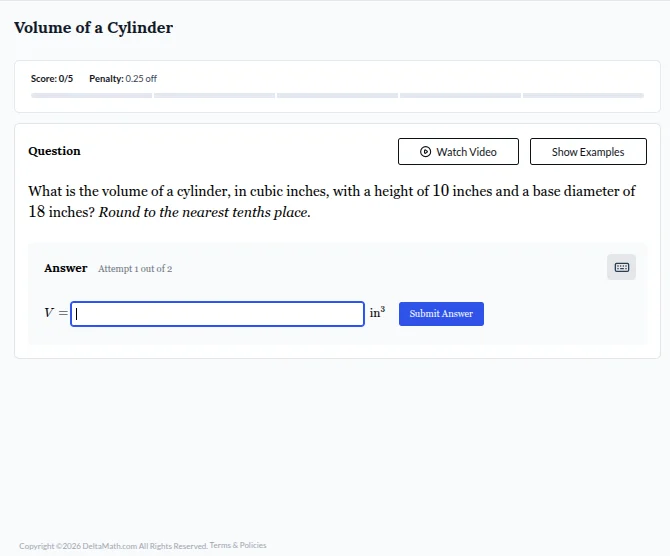
what is the volume of a cylinder, in cubic inches, with a height of 10 inches and a base diameter of 18 inches? round to the nearest tenths place.
answer attempt 1 out of 2
v = in³ submit answer
copyright ©2026 deltamath.com all rights reserved. terms & policies
Step1: Find the radius of the base
The diameter of the base is 18 inches, so the radius \( r \) is half of the diameter.
\( r=\frac{18}{2}=9 \) inches.
Step2: Use the formula for the volume of a cylinder
The formula for the volume \( V \) of a cylinder is \( V=\pi r^{2}h \), where \( r \) is the radius and \( h \) is the height. We know \( r = 9 \) inches and \( h=10 \) inches. Substitute these values into the formula:
\( V=\pi\times(9)^{2}\times10 \)
First, calculate \( 9^{2}=81 \). Then, \( V=\pi\times81\times10 = 810\pi \).
Step3: Calculate the numerical value and round
Using \( \pi\approx3.14159 \), we have \( V\approx810\times3.14159 \approx 2544.69 \). Rounding to the nearest tenths place, we look at the hundredths digit (9), which is greater than or equal to 5, so we round up the tenths digit (6) to 7. Wait, no, wait: \( 810\times3.14159 = 810\times3 + 810\times0.14159=2430+114.6879 = 2544.6879 \). The tenths place is 6, hundredths is 8. Since 8 ≥ 5, we round the tenths place up: 2544.7? Wait, no, 2544.6879 rounded to the nearest tenth: the number is 2544.6 (tenths place) and 8 (hundredths). So we add 0.1 to the tenths place: 2544.7? Wait, no, 2544.6879: the tenths digit is 6, the next digit is 8, so we round 6 up to 7, so 2544.7? Wait, no, 2544.6879 is approximately 2544.7 when rounded to the nearest tenth? Wait, no, 2544.6879: let's do it properly. The number is 2 5 4 4. 6 8 7 9. The tenths place is the first digit after the decimal, which is 6. The hundredths place is 8. Since 8 > 5, we increase the tenths place by 1: 6 + 1 = 7. So the number rounded to the nearest tenth is 2544.7? Wait, but let's check the calculation again. \( 810\times3.1415926535 = 810\times3.1415926535 \). Let's calculate 800×3.1415926535 = 2513.2741228, and 10×3.1415926535 = 31.415926535. Adding them together: 2513.2741228 + 31.415926535 = 2544.6900493. So when rounding to the nearest tenth, we look at the hundredth digit, which is 9 (wait, no: 2544.6900493, the decimal part is.6900493. So the tenths digit is 6, hundredths is 9. Oh! I made a mistake earlier. 810π: π is approximately 3.14159265, so 8103.14159265 = 8103 + 8100.14159265 = 2430 + 114.6890465 = 2544.6890465. So the decimal part is.6890465. So the tenths place is 6, hundredths is 8, thousandths is 9? Wait, no: 2544.6890465. So digits after decimal: 6 (tenths), 8 (hundredths), 9 (thousandths), 0 (ten - thousandths), etc. So when rounding to the nearest tenth, we look at the hundredths digit (8). Since 8 ≥ 5, we round up the tenths digit (6) to 7. So the volume is approximately 2544.7 cubic inches? Wait, but let's check with a calculator: 810π. π≈3.14159265, 8103.14159265 = 2544.6900465. Rounded to the nearest tenth: look at the hundredths place (9? Wait, no, 2544.6900465: the decimal is.6900465. So tenths: 6, hundredths:9, thousandths:0. Wait, I see my mistake earlier. 810π = 810*3.1415926535 = 2544.6900465. So the decimal part is.6900465. So the tenths digit is 6, hundredths digit is 9. Since 9 ≥ 5, we round up the tenths digit: 6 + 1 = 7. So 2544.7? Wait, no, 2544.6900465 rounded to the nearest tenth: the number is 2544.6 (tenths) and 9 (hundredths). So we add 0.1 to the tenths place: 2544.7. Yes, that's correct.

Snap & solve any problem in the app
Get step-by-step solutions on Sovi AI
Photo-based solutions with guided steps
Explore more problems and detailed explanations
2544.7