QUESTION IMAGE
Question
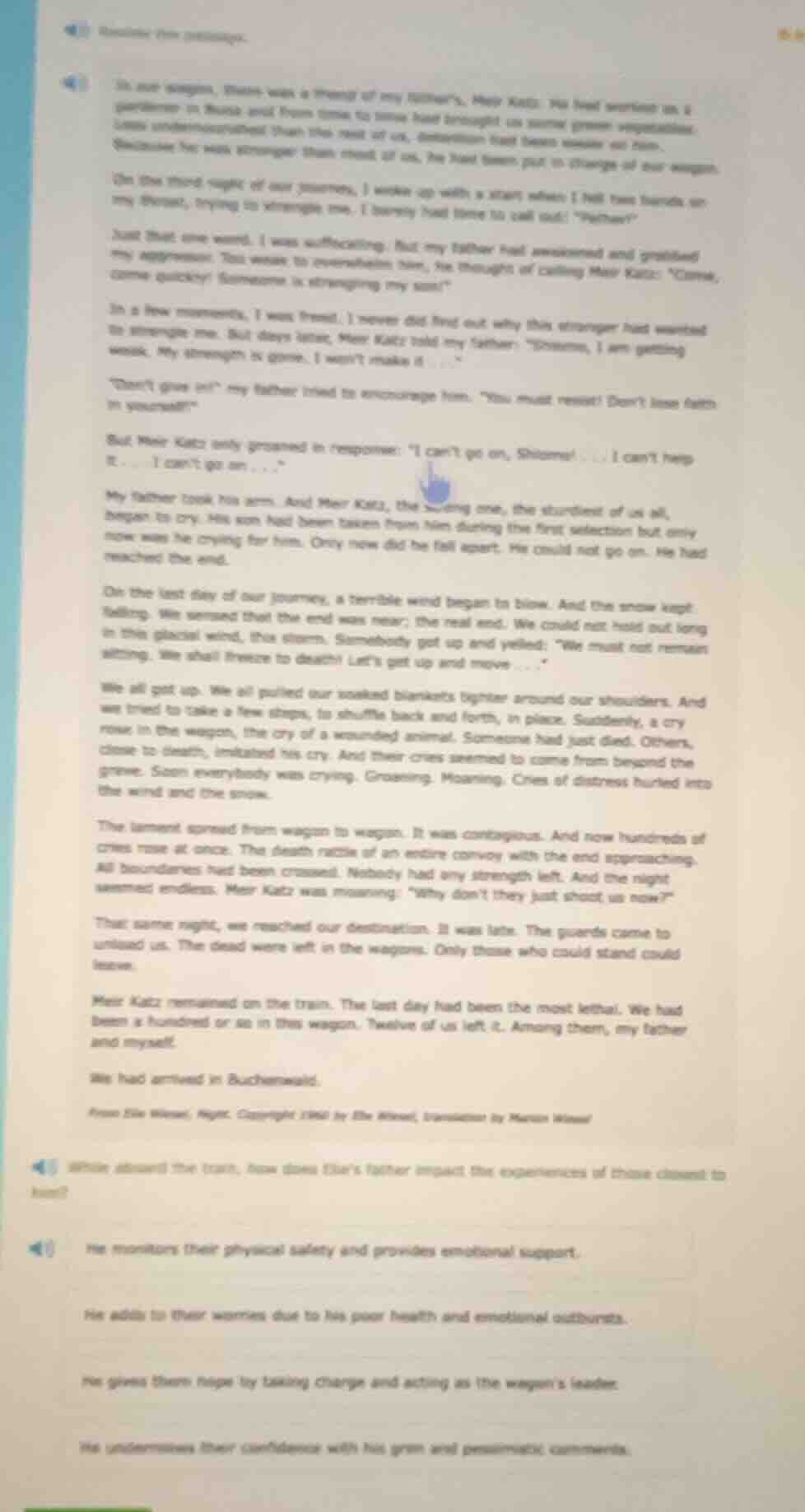
in our wagon, there was a friend of my father’s, meir katz. he had worked as a gardener in buda and from time to time had brought us some prime vegetables. less undernourished than the rest of us, detention had been easier on him. because he was stronger than most of us, he had been put in charge of our wagon.
on the third night of our journey, i woke up with a start when i felt two hands on my throat, trying to strangle me. i barely had time to call out: “father!”
just that one word. i was suffocating. but my father had awakened and grabbed my aggressor. too weak to overwhelm him, he thought of calling meir katz: “come, come quickly! someone is strangling my son!”
in a few moments, i was freed. i never did find out why this stranger had wanted to strangle me. but days later, meir katz told my father: “shlomo, i am getting weak. my strength is gone. i won’t make it... ”
“don’t give up!” my father tried to encourage him. “you must resist! don’t lose faith in yourself!”
but meir katz only groaned in response: “i can’t go on, shlomo!... i can’t help it... i can’t go on... ”
my father took his arm. and meir katz, the strong one, the stoutest of us all, began to cry. his son had been taken from him during the first selection but only now was he crying for him. only now did he fall apart. he could not go on. he had reached the end.
on the last day of our journey, a terrible wind began to blow. and the snow kept falling. we sensed that the end was near: the real end. we could not hold out long in this glacial wind, this storm. somebody got up and yelled: “we must not remain sitting. we shall freeze to death! let’s get up and move... ”
we all got up. we all pulled our soaked blankets tighter around our shoulders. and we tried to take a few steps, to shuffle back and forth, in place. suddenly, a cry rose to the wagon, the cry of a wounded animal. someone had just died. others, close to death, imitated his cry. and their cries seemed to come from beyond the grave. soon everybody was crying. groaning. moaning. cries of distress hurled into the wind and the snow.
the lament spread from wagon to wagon. it was contagious. and now hundreds of cries rose at once. the death rattle of an entire convoy with the end approaching. all boundaries had been crossed. nobody had any strength left. and the night seemed endless. meir katz was moaning: “why don’t they just shoot us now?”
that same night, we reached our destination. it was late. the guards came to unload us. the dead were left in the wagons. only those who could stand could leave.
meir katz remained on the train. the last day had been the most lethal. we had been a hundred or so in this wagon. twelve of us left it. among them, my father and myself.
we had arrived in buchenwald.
from elie wiesel, night. copyright 1960 by elie wiesel, translation by marion wiesel
while aboard the train, how does elie’s father impact the experiences of those closest to him?
he monitors their physical safety and provides emotional support.
he adds to their worries due to his poor health and emotional outbursts.
he gives them hope by taking charge and acting as the wagon’s leader.
he undermines their confidence with his grim and pessimistic comments.
To solve this, we analyze Elie's father's actions:
- Physical safety: He wakes up to save Elie from being strangled and calls for help.
- Emotional support: He encourages Meir Katz not to give up, saying "Don't give up! You must resist! Don't lose faith in yourself!".
Now let's analyze the other options:
- Option 2: There's no indication his health or outbursts add worry; he's supportive. Eliminate.
- Option 3: He doesn't take charge as a leader of the wagon, just supports individuals. Eliminate.
- Option 4: His comments are encouraging, not undermining confidence. Eliminate.

Snap & solve any problem in the app
Get step-by-step solutions on Sovi AI
Photo-based solutions with guided steps
Explore more problems and detailed explanations
A. He monitors their physical safety and provides emotional support.