QUESTION IMAGE
Question
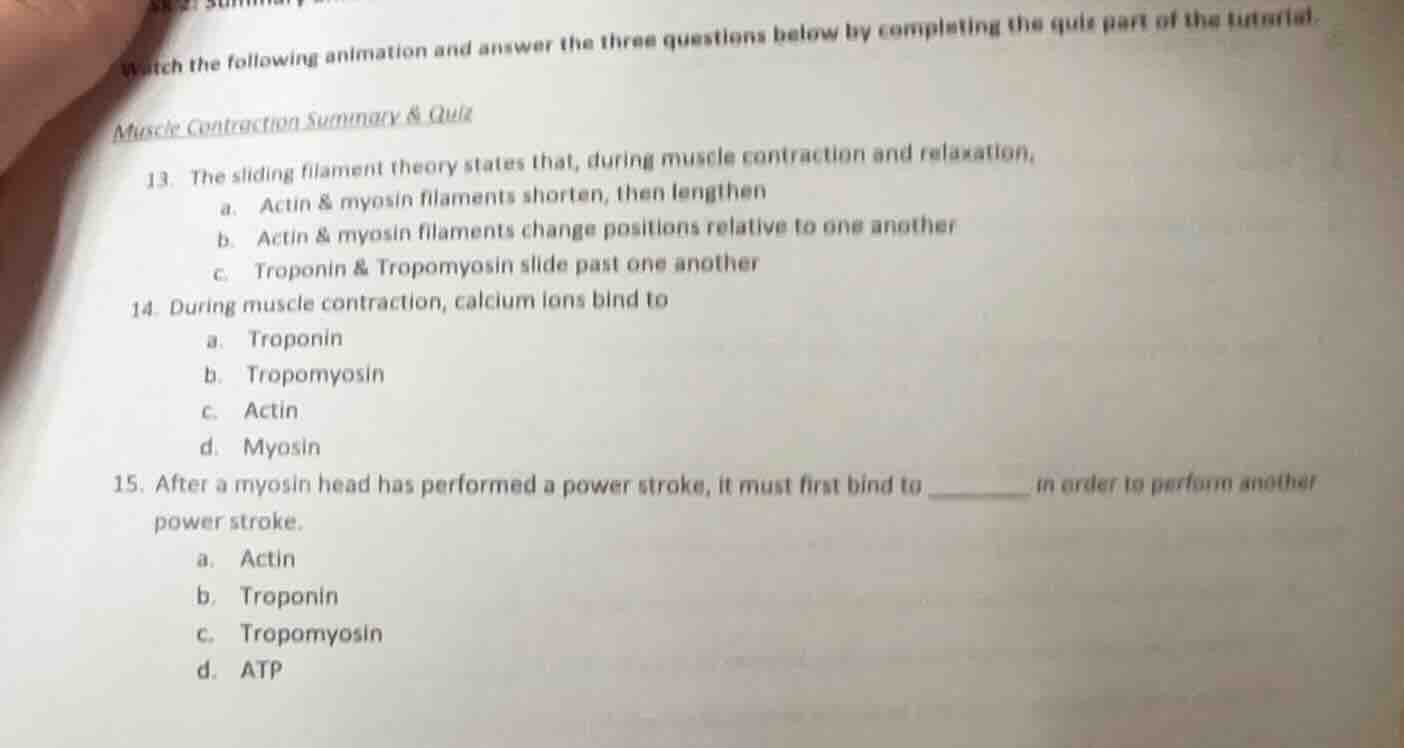
watch the following animation and answer the three questions below by completing the quiz part of the tutorial.
muscle contraction summary & quiz
- the sliding filament theory states that, during muscle contraction and relaxation,
a. actin & myosin filaments shorten, then lengthen
b. actin & myosin filaments change positions relative to one another
c. troponin & tropomyosin slide past one another
- during muscle contraction, calcium ions bind to
a. troponin
b. tropomyosin
c. actin
d. myosin
- after a myosin head has performed a power stroke, it must first bind to ______ in order to perform another power stroke.
a. actin
b. troponin
c. tropomyosin
d. atp
Brief Explanations
- For question 13: The sliding filament theory core principle is that actin and myosin filaments do not change length, but slide past each other to shorten or lengthen the sarcomere during contraction/relaxation.
- For question 14: In muscle contraction, calcium ions released from the sarcoplasmic reticulum bind to troponin, which shifts tropomyosin to expose actin binding sites.
- For question 15: After a power stroke, the myosin head remains attached to actin until it binds ATP, which causes the myosin head to detach and reset for another stroke.

Snap & solve any problem in the app
Get step-by-step solutions on Sovi AI
Photo-based solutions with guided steps
Explore more problems and detailed explanations
- b. Actin & myosin filaments change positions relative to one another
- a. Troponin
- d. ATP