QUESTION IMAGE
Question
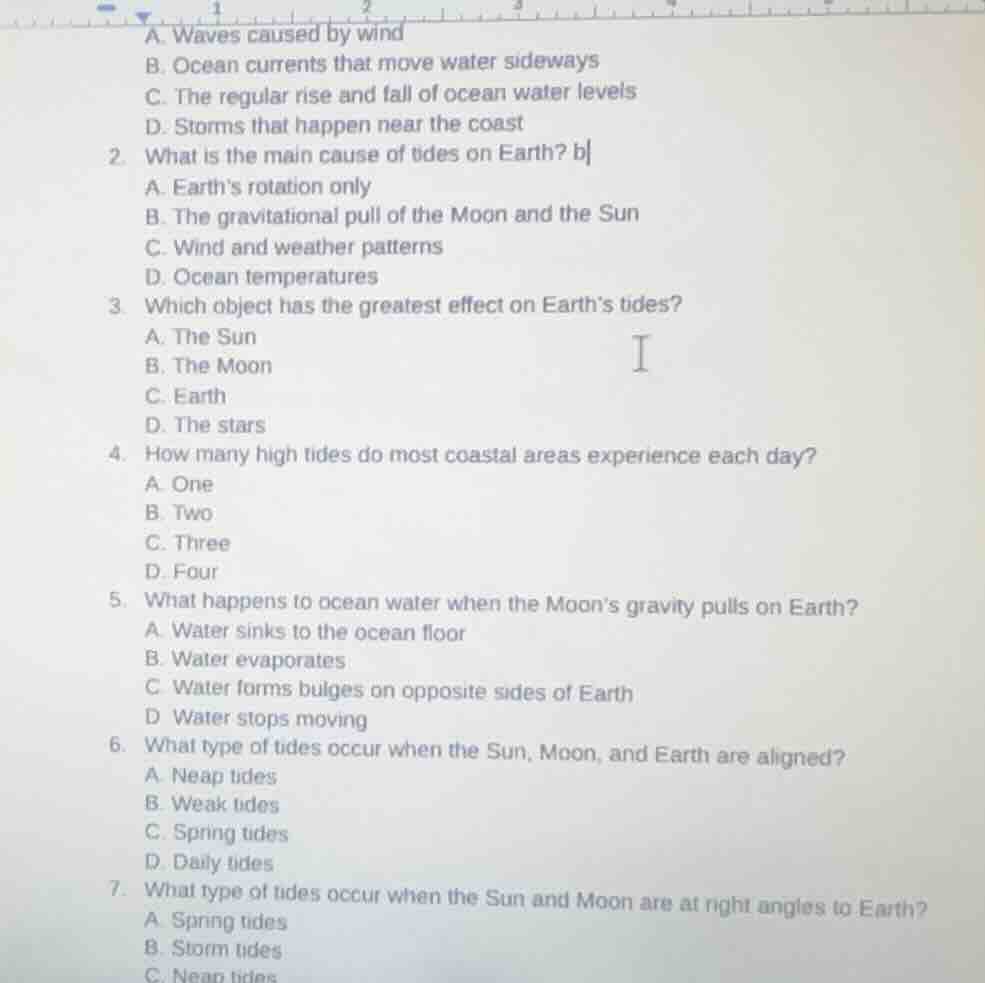
a. waves caused by wind
b. ocean currents that move water sideways
c. the regular rise and fall of ocean water levels
d. storms that happen near the coast
- what is the main cause of tides on earth? b|
a. earths rotation only
b. the gravitational pull of the moon and the sun
c. wind and weather patterns
d. ocean temperatures
- which object has the greatest effect on earths tides?
a. the sun
b. the moon
c. earth
d. the stars
- how many high tides do most coastal areas experience each day?
a. one
b. two
c. three
d. four
- what happens to ocean water when the moons gravity pulls on earth?
a. water sinks to the ocean floor
b. water evaporates
c. water forms bulges on opposite sides of earth
d water stops moving
- what type of tides occur when the sun, moon, and earth are aligned?
a. neap tides
b. weak tides
c. spring tides
d. daily tides
- what type of tides occur when the sun and moon are at right angles to earth?
a. spring tides
b. storm tides
c. neap tides
Question 2
Tides are mainly caused by the gravitational forces exerted by the Moon and the Sun on Earth's oceans. Earth's rotation alone (A) doesn't cause tides. Wind/weather (C) and ocean temperatures (D) affect ocean currents or waves, not tides. So the main cause is the gravitational pull of the Moon and the Sun.
The Moon is closer to Earth than the Sun, so its gravitational pull has a stronger effect on Earth's tides. The Sun (A) has a lesser effect, Earth (C) can't affect its own tides in this way, and stars (D) are too far. Thus, the Moon has the greatest effect.
Most coastal areas experience two high tides and two low tides each day due to Earth's rotation and the Moon's gravitational pull. One (A), three (C), or four (D) don't match the typical tidal pattern.

Snap & solve any problem in the app
Get step-by-step solutions on Sovi AI
Photo-based solutions with guided steps
Explore more problems and detailed explanations
B. The gravitational pull of the Moon and the Sun