QUESTION IMAGE
Question
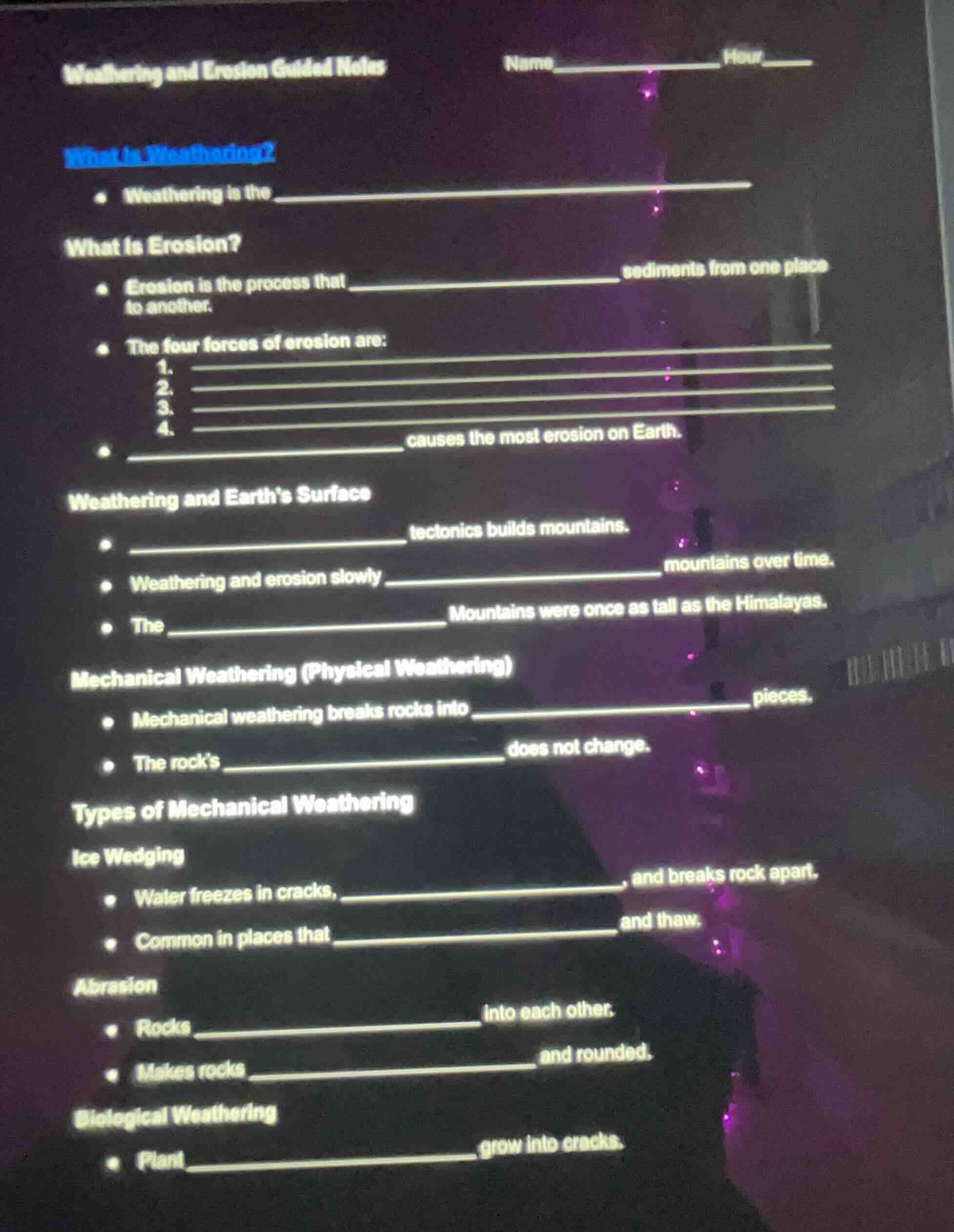
weathering and erosion guided notes \t\t\t\tname \t\t\t\thour
what is weathering?
- weathering is the
what is erosion?
- erosion is the process that sediments from one place to another.
- the four forces of erosion are:
1.
2.
3.
4.
- causes the most erosion on earth.
weathering and earth’s surface
- tectonics builds mountains.
- weathering and erosion slowly mountains over time.
- the mountains were once as tall as the himalayas.
mechanical weathering (physical weathering)
- mechanical weathering breaks rocks into pieces.
- the rock’s does not change.
types of mechanical weathering
ice wedging
- water freezes in cracks, , and breaks rock apart.
- common in places that and thaw.
abrasion
- rocks into each other.
- makes rocks and rounded.
biological weathering
- plant grow into cracks.
Brief Explanations
This is a fill - in - the - blank worksheet about weathering and erosion, which belongs to the field of Geography (a subfield of Natural Science). To answer these blanks, we can use the following knowledge:
What Is Weathering?
- Weathering is the breakdown of rocks into smaller pieces (either physically or chemically) at or near the Earth's surface.
What Is Erosion?
- Erosion is the process that moves sediments from one place to another.
- The four forces of erosion are:
- Water
- Wind
- Ice (Glaciers)
- Gravity
- Water causes the most erosion on Earth.
Weathering and Earth's Surface
- Plate tectonics builds mountains.
- Weathering and erosion slowly wear down mountains over time.
- The Appalachian Mountains were once as tall as the Himalayas.
Mechanical Weathering (Physical Weathering)
- Mechanical weathering breaks rocks into smaller pieces.
- The rock’s chemical composition does not change.
Types of Mechanical Weathering
Ice Wedging
- Water freezes in cracks, expands, and breaks rock apart.
- Common in places that freeze and thaw.
Abrasion
- Rocks collide into each other.
- Makes rocks smooth and rounded.
Biological Weathering
- Plant roots grow into cracks.

Snap & solve any problem in the app
Get step-by-step solutions on Sovi AI
Photo-based solutions with guided steps
Explore more problems and detailed explanations
What Is Weathering?
- Weathering is the breakdown of rocks into smaller pieces (either physically or chemically) at or near the Earth's surface.
What Is Erosion?
- Erosion is the process that moves sediments from one place to another.
- The four forces of erosion are:
- Water
- Wind
- Ice (Glaciers)
- Gravity
- Water causes the most erosion on Earth.
Weathering and Earth's Surface
- Plate tectonics builds mountains.
- Weathering and erosion slowly wear down mountains over time.
- The Appalachian Mountains were once as tall as the Himalayas.
Mechanical Weathering (Physical Weathering)
- Mechanical weathering breaks rocks into smaller pieces.
- The rock’s chemical composition does not change.
Types of Mechanical Weathering
Ice Wedging
- Water freezes in cracks, expands, and breaks rock apart.
- Common in places that freeze and thaw.
Abrasion
- Rocks collide into each other.
- Makes rocks smooth and rounded.
Biological Weathering
- Plant roots grow into cracks.