QUESTION IMAGE
Question
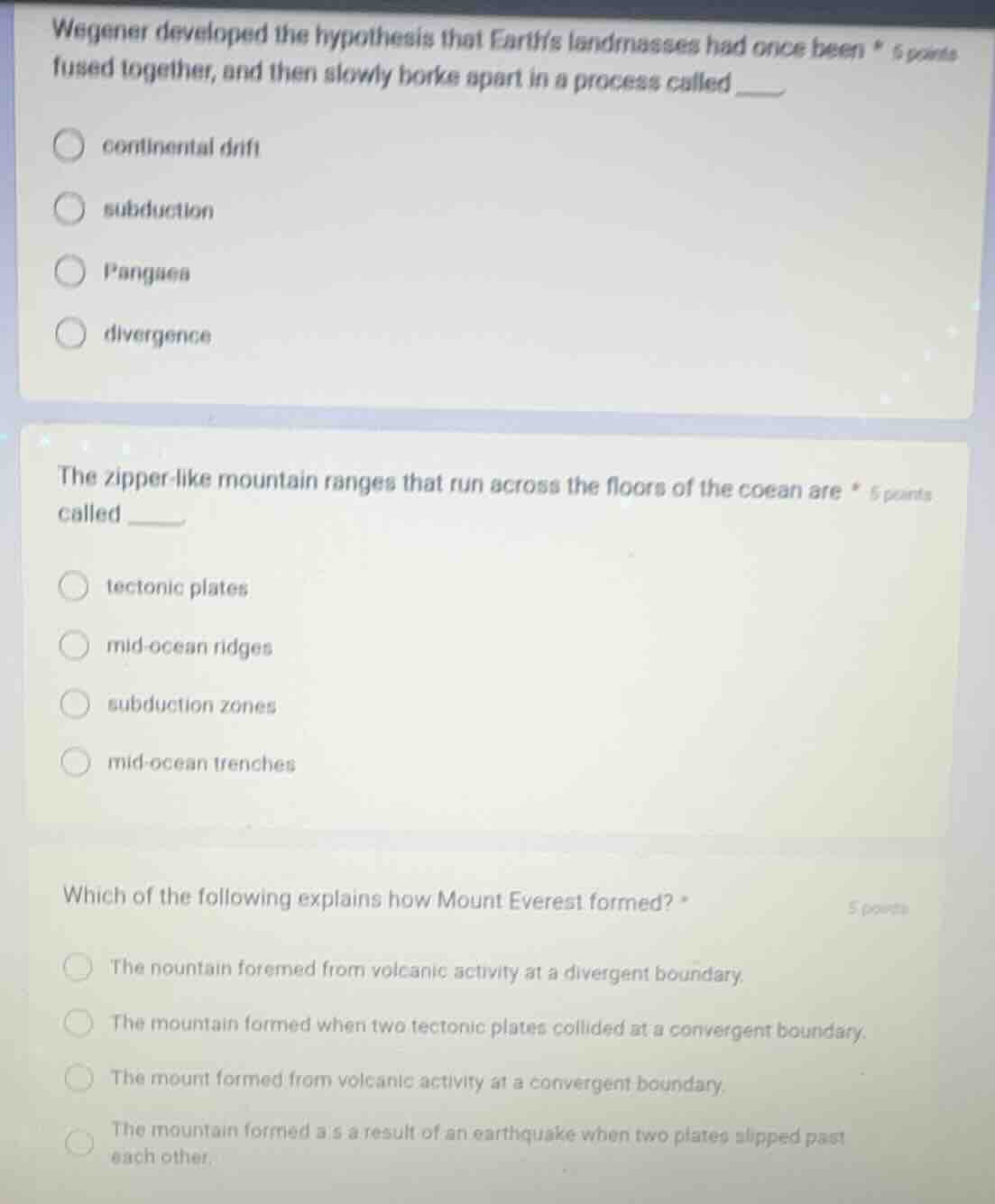
wegener developed the hypothesis that earths landmasses had once been fused together, and then slowly broke apart in a process called ____
options: continental drift, subduction, pangaea, divergence
the zipper - like mountain ranges that run across the floors of the ocean are called ____
options: tectonic plates, mid - ocean ridges, subduction zones, mid - ocean trenches
which of the following explains how mount everest formed?
options: the mountain formed from volcanic activity at a divergent boundary.
the mountain formed when two tectonic plates collided at a convergent boundary.
the mount formed from volcanic activity at a convergent boundary.
the mountain formed as a result of an earthquake when two plates slipped past each other.
First Question:
Wegener's hypothesis about Earth's landmasses fusing and then breaking apart is known as continental drift. Subduction is a process at plate boundaries, Pangaea is the supercontinent, and divergence is a plate movement type, not the overall process of landmasses moving apart.
Mid - ocean ridges are the zipper - like mountain ranges on the ocean floor. Tectonic plates are the large pieces of the Earth's crust, subduction zones are areas where one plate subducts under another, and mid - ocean trenches are deep depressions in the ocean floor, not the mountain - like structures.
Mount Everest formed when the Indian and Eurasian tectonic plates collided at a convergent boundary, causing the crust to fold and uplift. It is not formed from volcanic activity (it's a fold mountain), and the last option describes a transform boundary (where plates slip past), not the formation of Everest.

Snap & solve any problem in the app
Get step-by-step solutions on Sovi AI
Photo-based solutions with guided steps
Explore more problems and detailed explanations
A. continental drift