QUESTION IMAGE
Question
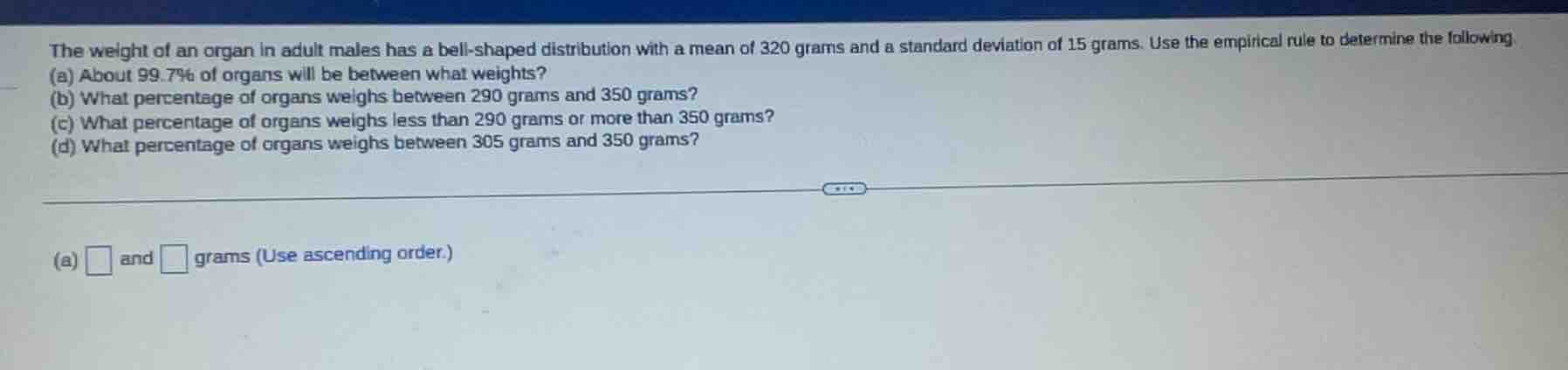
the weight of an organ in adult males has a bell-shaped distribution with a mean of 320 grams and a standard deviation of 15 grams. use the empirical rule to determine the following.
(a) about 99.7% of organs will be between what weights?
(b) what percentage of organs weighs between 290 grams and 350 grams?
(c) what percentage of organs weighs less than 290 grams or more than 350 grams?
(d) what percentage of organs weighs between 305 grams and 350 grams?
(a) $square$ and $square$ grams (use ascending order.)
Step1: Recall Empirical Rule basics
For bell-shaped distributions:
- 68% within $\mu\pm1\sigma$
- 95% within $\mu\pm2\sigma$
- 99.7% within $\mu\pm3\sigma$
Given $\mu=320$, $\sigma=15$
---
Part (a)
Step1: Calculate 3σ range
Lower bound: $\mu - 3\sigma = 320 - 3\times15$
Upper bound: $\mu + 3\sigma = 320 + 3\times15$
Step2: Compute values
Lower: $320 - 45 = 275$
Upper: $320 + 45 = 365$
---
Part (b)
Step1: Map values to σ range
$290 = 320 - 2\times15 = \mu-2\sigma$
$350 = 320 + 2\times15 = \mu+2\sigma$
Step2: Apply empirical rule
95% of data lies in $\mu\pm2\sigma$
---
Part (c)
Step1: Use complement rule
Total data = 100%, subtract % from (b)
Percentage = $100\% - 95\%$
Step2: Compute result
$100\% - 95\% = 5\%$
---
Part (d)
Step1: Map values to σ range
$305 = 320 - 1\times15 = \mu-1\sigma$
$350 = 320 + 2\times15 = \mu+2\sigma$
Step2: Split into segments
% = (% between $\mu-\sigma$ and $\mu$) + (% between $\mu$ and $\mu+2\sigma$)
$\frac{68\%}{2} + \frac{95\%}{2} = 34\% + 47.5\%$
Step3: Sum the segments
$34\% + 47.5\% = 81.5\%$

Snap & solve any problem in the app
Get step-by-step solutions on Sovi AI
Photo-based solutions with guided steps
Explore more problems and detailed explanations
(a) 275 and 365 grams
(b) 95%
(c) 5%
(d) 81.5%