QUESTION IMAGE
Question
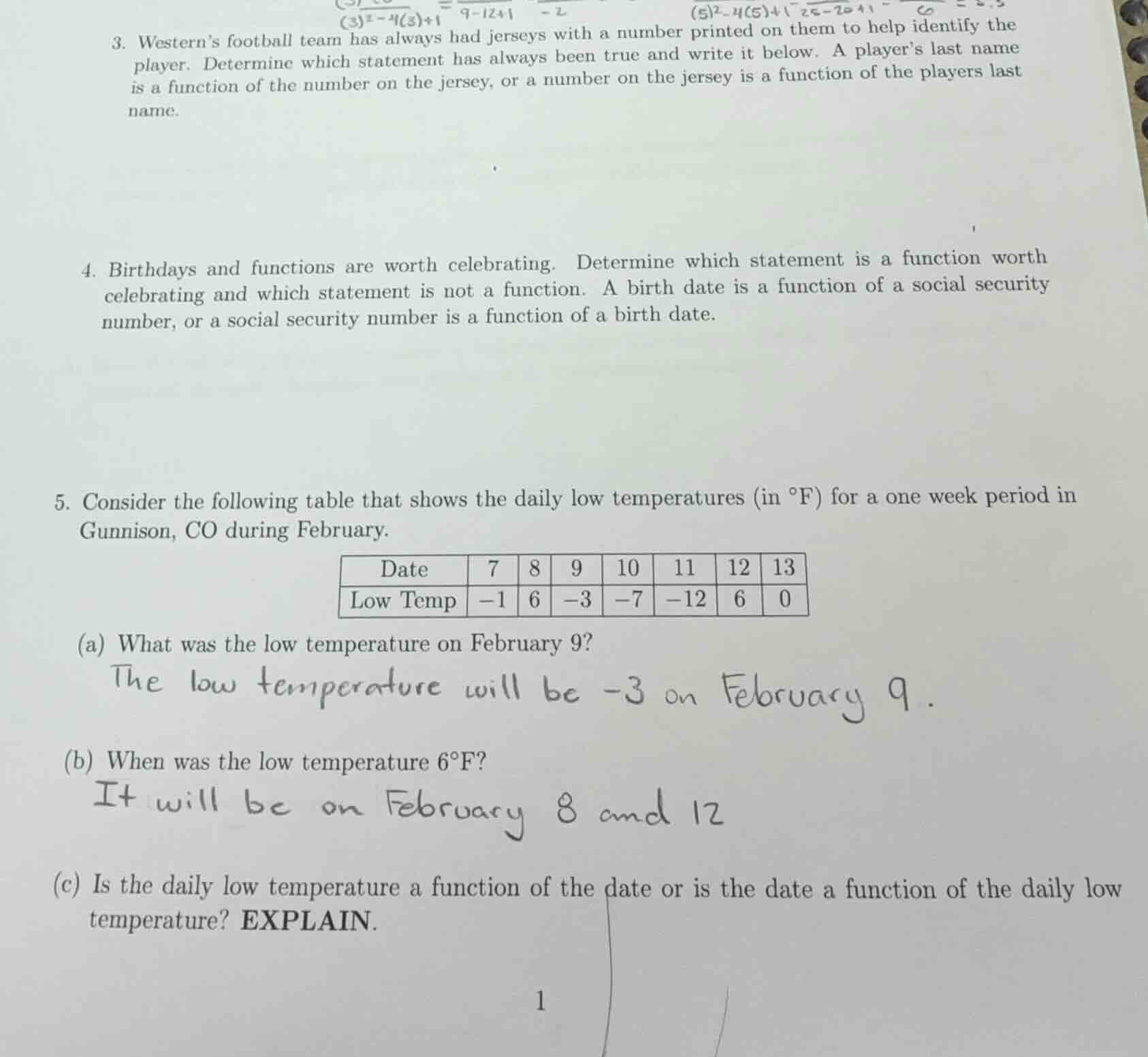
- westerns football team has always had jerseys with a number printed on them to help identify the player. determine which statement has always been true and write it below. a players last name is a function of the number on the jersey, or a number on the jersey is a function of the players last name.
- birthdays and functions are worth celebrating. determine which statement is a function worth celebrating and which statement is not a function. a birth date is a function of a social security number, or a social security number is a function of a birth date.
- consider the following table that shows the daily low temperatures (in $^circ$f) for a one week period in gunnison, co during february.
| date | 7 | 8 | 9 | 10 | 11 | 12 | 13 |
| low temp | $-1$ | $6$ | $-3$ | $-7$ | $-12$ | $6$ | $0$ |
(a) what was the low temperature on february 9?
the low temperature will be $-3$ on february 9.
(b) when was the low temperature $6^circ$f?
it will be on february 8 and 12
(c) is the daily low temperature a function of the date or is the date a function of the daily low temperature? explain.
Problem 3
To determine if a relation is a function, we use the definition: a function is a relation where each input (independent variable) has exactly one output (dependent variable).
- For "A player’s last name is a function of the number on the jersey": A jersey number (input) should map to only one last name. But in a football team, each jersey number is assigned to one player, so one number → one last name. Wait, no—wait, actually, a jersey number is unique to a player, so number → last name: each number (input) has one last name (output). But "A number on the jersey is a function of the player’s last name": A last name (input) could have multiple players (so multiple numbers), so one last name could map to multiple numbers. So the correct function is "A player’s last name is a function of the number on the jersey"? Wait, no—wait, let's re-express. Let's define the domain and range.
If we consider the relation: (number, last name). Each number is assigned to one player, so each number (input) has exactly one last name (output). So number → last name is a function.
If we consider (last name, number): a last name could be shared by multiple players (unlikely, but possible), or even if not, if a last name is unique, but the problem is about "always true". In a football team, jersey numbers are unique, so each number has one last name. But last names: if two players have the same last name, then one last name would map to two numbers. So "A number on the jersey is a function of the player’s last name" would not be a function (since one last name could have multiple numbers). Therefore, "A player’s last name is a function of the number on the jersey" is always true, because each jersey number (input) has exactly one last name (output).
Using the function definition: each input has exactly one output.
- "A birth date is a function of a social security number": A social security number (SSN) is unique to a person, so each SSN (input) has exactly one birth date (output). So this is a function.
- "A social security number is a function of a birth date": A birth date (input) can correspond to multiple people (hence multiple SSNs), so one birth date would map to multiple SSNs. Thus, this is not a function.
To determine if a relation is a function, check if each input has exactly one output.
- "Daily low temperature is a function of the date": Domain is dates (7,8,9,10,11,12,13), range is low temps. Each date (input) has exactly one low temp (output). So this is a function.
- "Date is a function of the daily low temperature": Domain is low temps (values like -1,6,-3,-7,-12,0). A low temp like 6 appears on dates 8 and 12. So one low temp (input) maps to multiple dates (outputs). Thus, this is not a function.
So the daily low temperature is a function of the date because each date (input) has exactly one low temperature (output), while a date is not a function of the daily low temperature because a low temperature (e.g., 6°F) can occur on multiple dates (February 8 and 12), meaning one input (low temp) has multiple outputs (dates).

Snap & solve any problem in the app
Get step-by-step solutions on Sovi AI
Photo-based solutions with guided steps
Explore more problems and detailed explanations
A player’s last name is a function of the number on the jersey.