QUESTION IMAGE
Question
what am i?
a prime number is only divisible by the number 1 and itself.
a composite number is divisible by more than 1 and itself.
the number 2 has only two factors, which are 1 and 2 (itself).
if it is only divisible by these factors. therefore, 2 is a prime number.
the number 4 has 1, 2, and 4 as factors so it is divisible by
more than 1 and itself. therefore, 4 is a composite number.
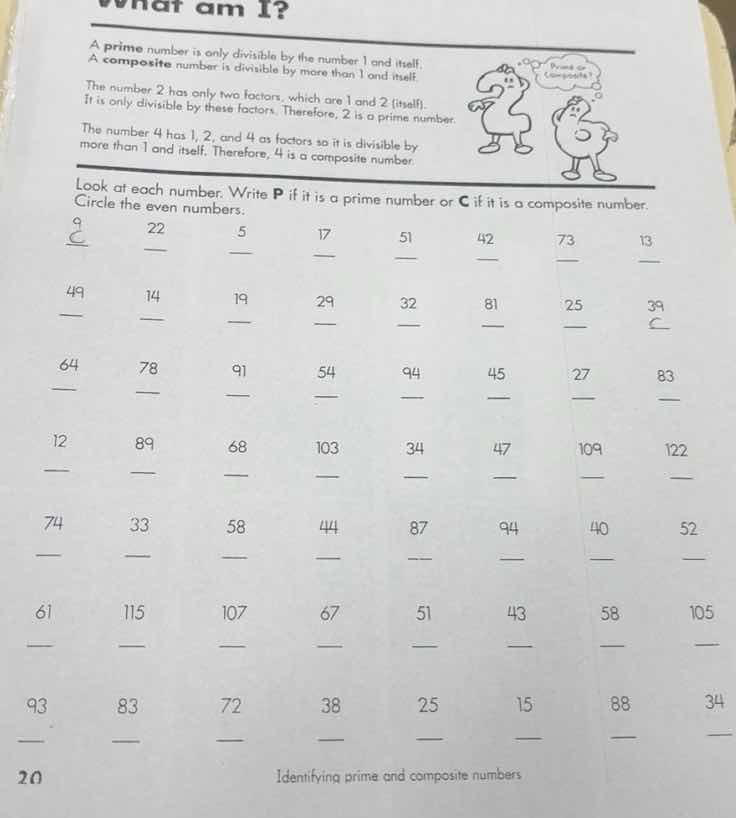
look at each number. write p if it is a prime number or c if it is a composite number.
circle the even numbers.
9
22
5
17
51
42
73
13
49
14
19
29
32
81
25
39
64
78
91
54
94
45
27
83
12
89
68
103
34
47
109
122
74
33
58
44
87
94
40
52
61
115
107
67
51
43
58
105
93
83
72
38
25
15
88
34
20
identifying prime and composite numbers
Step1: Definir números primos/compuestos
Un número primo (P) solo es divisible por 1 y sí mismo. Un número compuesto (C) tiene más de 2 divisores. Los números pares mayores que 2 son compuestos.
Step2: Clasificar cada fila
Analizar cada número según la definición:
Fila 1
- 9: Divisible por 1,3,9 → C
- 22: Par >2 → C
- 5: Solo 1,5 → P
- 17: Solo 1,17 → P
- 51: Divisible por 3,17 → C
- 42: Par >2 → C
- 73: Solo 1,73 → P
- 13: Solo 1,13 → P
Fila 2
- 49: Divisible por 7 → C
- 14: Par >2 → C
- 19: Solo 1,19 → P
- 29: Solo 1,29 → P
- 32: Par >2 → C
- 81: Divisible por 3,9 → C
- 25: Divisible por 5 → C
- 39: Divisible por 3,13 → C
Fila 3
- 64: Par >2 → C
- 78: Par >2 → C
- 91: Divisible por 7,13 → C
- 54: Par >2 → C
- 94: Par >2 → C
- 45: Divisible por 3,5 → C
- 27: Divisible por 3,9 → C
- 83: Solo 1,83 → P
Fila 4
- 12: Par >2 → C
- 89: Solo 1,89 → P
- 68: Par >2 → C
- 103: Solo 1,103 → P
- 34: Par >2 → C
- 47: Solo 1,47 → P
- 109: Solo 1,109 → P
- 122: Par >2 → C
Fila 5
- 74: Par >2 → C
- 33: Divisible por 3,11 → C
- 58: Par >2 → C
- 44: Par >2 → C
- 87: Divisible por 3,29 → C
- 94: Par >2 → C
- 40: Par >2 → C
- 52: Par >2 → C
Fila 6
- 61: Solo 1,61 → P
- 115: Divisible por 5,23 → C
- 107: Solo 1,107 → P
- 67: Solo 1,67 → P
- 51: Divisible por 3,17 → C
- 43: Solo 1,43 → P
- 58: Par >2 → C
- 105: Divisible por 3,5,7 → C
Fila 7
- 93: Divisible por 3,31 → C
- 83: Solo 1,83 → P
- 72: Par >2 → C
- 38: Par >2 → C
- 25: Divisible por 5 → C
- 15: Divisible por 3,5 → C
- 88: Par >2 → C
- 34: Par >2 → C
Step3: Marcar números pares
Los números pares a circulan son: 22, 42, 14, 32, 64, 78, 54, 94, 12, 68, 34, 122, 74, 58, 44, 94, 40, 52, 58, 72, 38, 88, 34

Snap & solve any problem in the app
Get step-by-step solutions on Sovi AI
Photo-based solutions with guided steps
Explore more problems and detailed explanations
Fila 1
9: C, 22: C (circular), 5: P, 17: P, 51: C, 42: C (circular), 73: P, 13: P
Fila 2
49: C, 14: C (circular), 19: P, 29: P, 32: C (circular), 81: C, 25: C, 39: C
Fila 3
64: C (circular), 78: C (circular), 91: C, 54: C (circular), 94: C (circular), 45: C, 27: C, 83: P
Fila 4
12: C (circular), 89: P, 68: C (circular), 103: P, 34: C (circular), 47: P, 109: P, 122: C (circular)
Fila 5
74: C (circular), 33: C, 58: C (circular), 44: C (circular), 87: C, 94: C (circular), 40: C (circular), 52: C (circular)
Fila 6
61: P, 115: C, 107: P, 67: P, 51: C, 43: P, 58: C (circular), 105: C
Fila 7
93: C, 83: P, 72: C (circular), 38: C (circular), 25: C, 15: C, 88: C (circular), 34: C (circular)