QUESTION IMAGE
Question
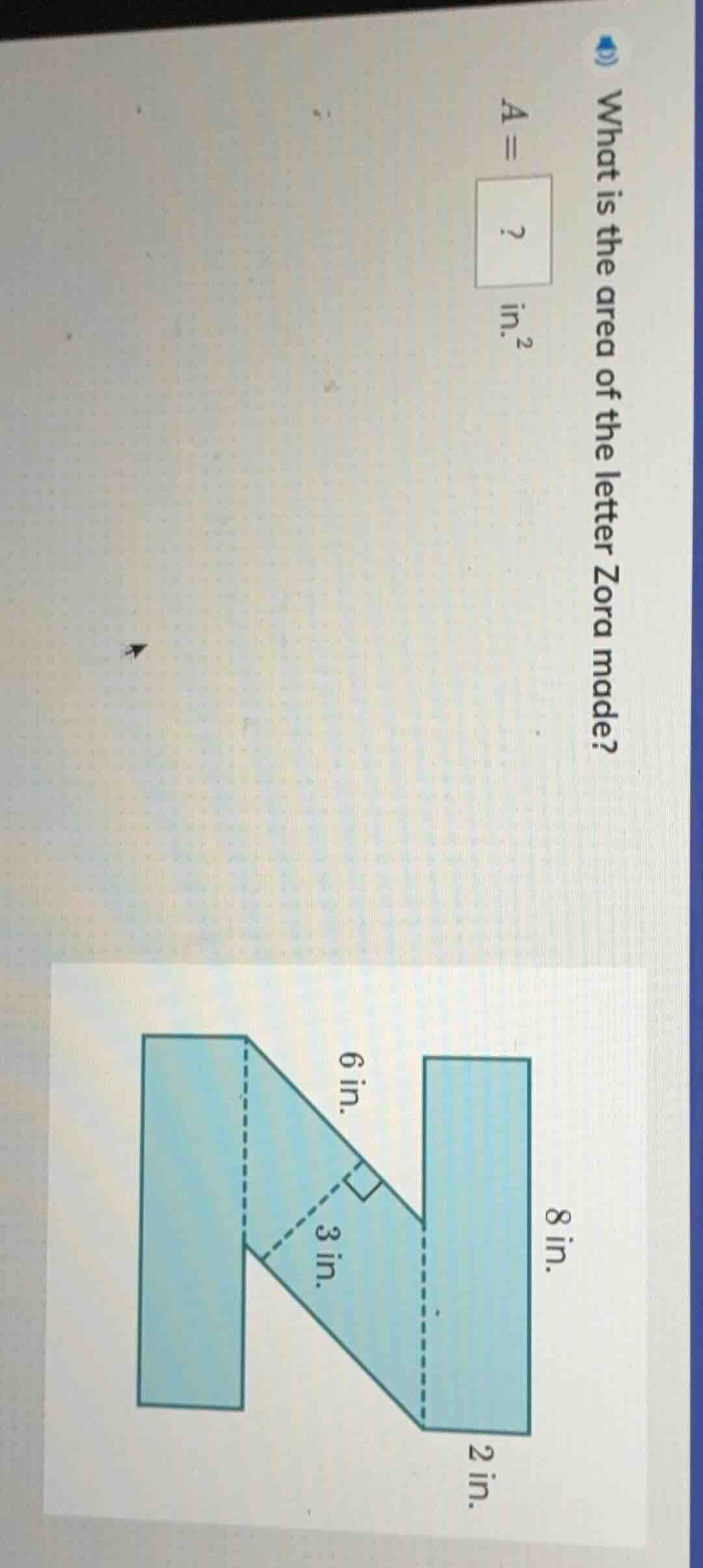
what is the area of the letter zora made? a = ? in.²
Step1: Analyze the shape
The letter Z can be divided into two rectangles and a parallelogram (or we can also consider it as two rectangles and a parallelogram, but actually, looking at the dimensions, we can split it into two rectangles of size \(8 \text{ in} \times 2 \text{ in}\) and a parallelogram with base \(6 \text{ in}\) and height \(3 \text{ in}\), but wait, actually, another way: the total shape can be considered as two rectangles (left and right) and a middle parallelogram. Wait, no, let's check the dimensions. The left rectangle: height 8 in, width let's see, the right rectangle is 8 in height and 2 in width. The middle part: the parallelogram has base 6 in and height 3 in? Wait, no, maybe better to split into two rectangles and a parallelogram, or maybe two rectangles and a parallelogram, but let's calculate each part.
Wait, actually, the left rectangle: height 8 in, width 2 in? Wait, no, the right rectangle is 8 in height and 2 in width. The left rectangle is also 8 in height and 2 in width? Wait, no, looking at the diagram, the two vertical rectangles: each has height 8 in and width 2 in. Then the middle part is a parallelogram with base 6 in and height 3 in? Wait, no, the middle part: the slanted part, the base is 6 in, and the height (the distance between the two parallel sides) is 3 in. Wait, but let's calculate the area of each part.
First, the two rectangles: each has area \( \text{length} \times \text{width} = 8 \times 2 \). There are two of them, so \(2 \times (8 \times 2)\). Then the middle parallelogram: area is \( \text{base} \times \text{height} = 6 \times 3 \). Wait, but wait, is that correct? Wait, maybe I made a mistake. Wait, the total shape: let's see, the height of the rectangles is 8 in, width 2 in. The middle part: the parallelogram has base 6 in and height 3 in. Wait, but let's check the dimensions again. The vertical sides: the left and right rectangles are 8 in tall, 2 in wide. The middle part: the slanted part, the base is 6 in, and the height (the perpendicular distance) is 3 in. So let's calculate each area.
Step2: Calculate area of two rectangles
Each rectangle has area \( A_{\text{rectangle}} = 8 \times 2 = 16 \text{ in}^2 \). There are two rectangles, so total area for rectangles: \( 2 \times 16 = 32 \text{ in}^2 \).
Step3: Calculate area of parallelogram
The parallelogram has base \( b = 6 \text{ in} \) and height \( h = 3 \text{ in} \). The area of a parallelogram is \( A_{\text{parallelogram}} = b \times h = 6 \times 3 = 18 \text{ in}^2 \).
Step4: Total area
Now, sum the areas of the two rectangles and the parallelogram: \( 32 + 18 = 50 \text{ in}^2 \). Wait, but wait, is that correct? Wait, maybe I messed up the dimensions. Wait, let's re-examine the diagram. The two vertical rectangles: each is 8 in height, 2 in width. So each area is \(8 \times 2 = 16\), two of them: \(32\). The middle part: the parallelogram, base 6 in, height 3 in: \(6 \times 3 = 18\). So total area: \(32 + 18 = 50\). Wait, but let's check again. Alternatively, maybe the middle part is a parallelogram with base 6 in and height 3 in, and the two rectangles are 8x2 each. So yes, that seems right.
Wait, but another way: maybe the total shape can be considered as a big rectangle minus something, but no, the way we split is correct. Let's verify:
Area of first rectangle (left): \(8 \times 2 = 16\)
Area of second rectangle (right): \(8 \times 2 = 16\)
Area of parallelogram (middle): \(6 \times 3 = 18\)
Total area: \(16 + 16 + 18 = 50\)
Step1 (Alternative approach):
Wait, maybe the two rectangles are…

Snap & solve any problem in the app
Get step-by-step solutions on Sovi AI
Photo-based solutions with guided steps
Explore more problems and detailed explanations
\(50\)