QUESTION IMAGE
Question
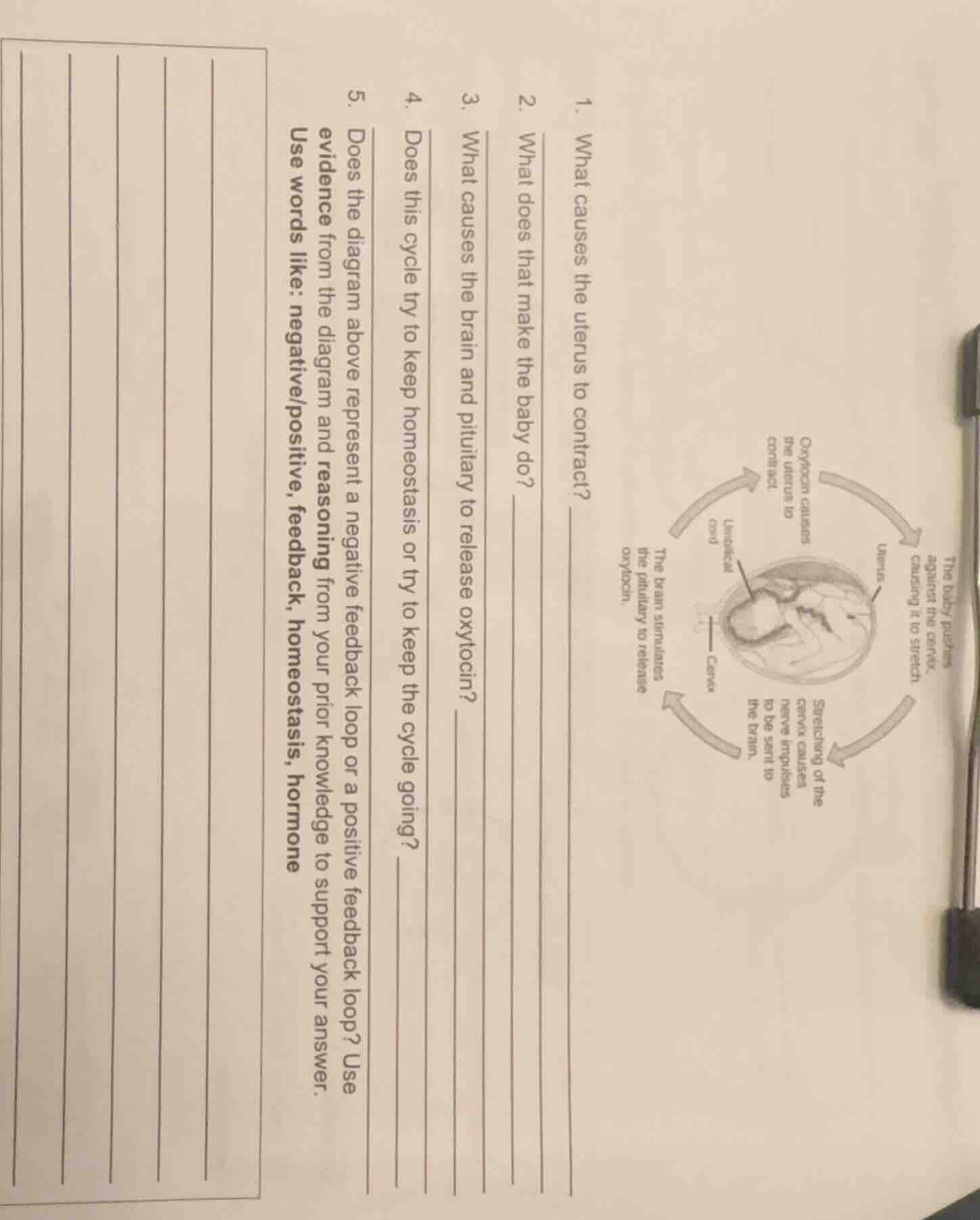
- what causes the uterus to contract?
- what does that make the baby do?
- what causes the brain and pituitary to release oxytocin?
- does this cycle try to keep homeostasis or try to keep the cycle going?
- does the diagram above represent a negative feedback loop or a positive feedback loop? use evidence from the diagram and reasoning from your prior knowledge to support your answer. use words like: negative/positive, feedback, homeostasis, hormone
(diagram description: the baby pushes against the cervix, causing it to stretch. stretching of the cervix causes nerve impulses to be sent to the brain. the brain stimulates the pituitary to release oxytocin. oxytocin causes the uterus to contract. uterine contraction causes the baby to push against the cervix, repeating the cycle.)
Brief Explanations
- Identified the trigger for uterine contraction from the diagram's cycle.
- Connected uterine contractions to the baby's movement in the birth process.
- Traced the sensory signal pathway that triggers oxytocin release.
- Distinguished between feedback loop goals: homeostasis vs. process completion.
- Compared the cycle's mechanism to positive/negative feedback definitions, using diagram details and hormonal feedback knowledge.

Snap & solve any problem in the app
Get step-by-step solutions on Sovi AI
Photo-based solutions with guided steps
Explore more problems and detailed explanations
- The hormone oxytocin causes the uterus to contract.
- That makes the baby push against the cervix, causing it to stretch.
- Nerve impulses sent to the brain from the stretched cervix cause the brain and pituitary to release oxytocin.
- This cycle tries to keep the cycle going (it does not maintain homeostasis).
- This is a positive feedback loop. The diagram shows that uterine contractions (triggered by oxytocin) cause more stretching of the cervix, which triggers more oxytocin release, leading to stronger contractions. Positive feedback amplifies a process rather than reversing it to maintain homeostasis (which is the role of negative feedback). The hormone oxytocin drives the cycle forward, increasing the intensity of contractions until birth is completed, rather than returning the body to a set state.