QUESTION IMAGE
Question
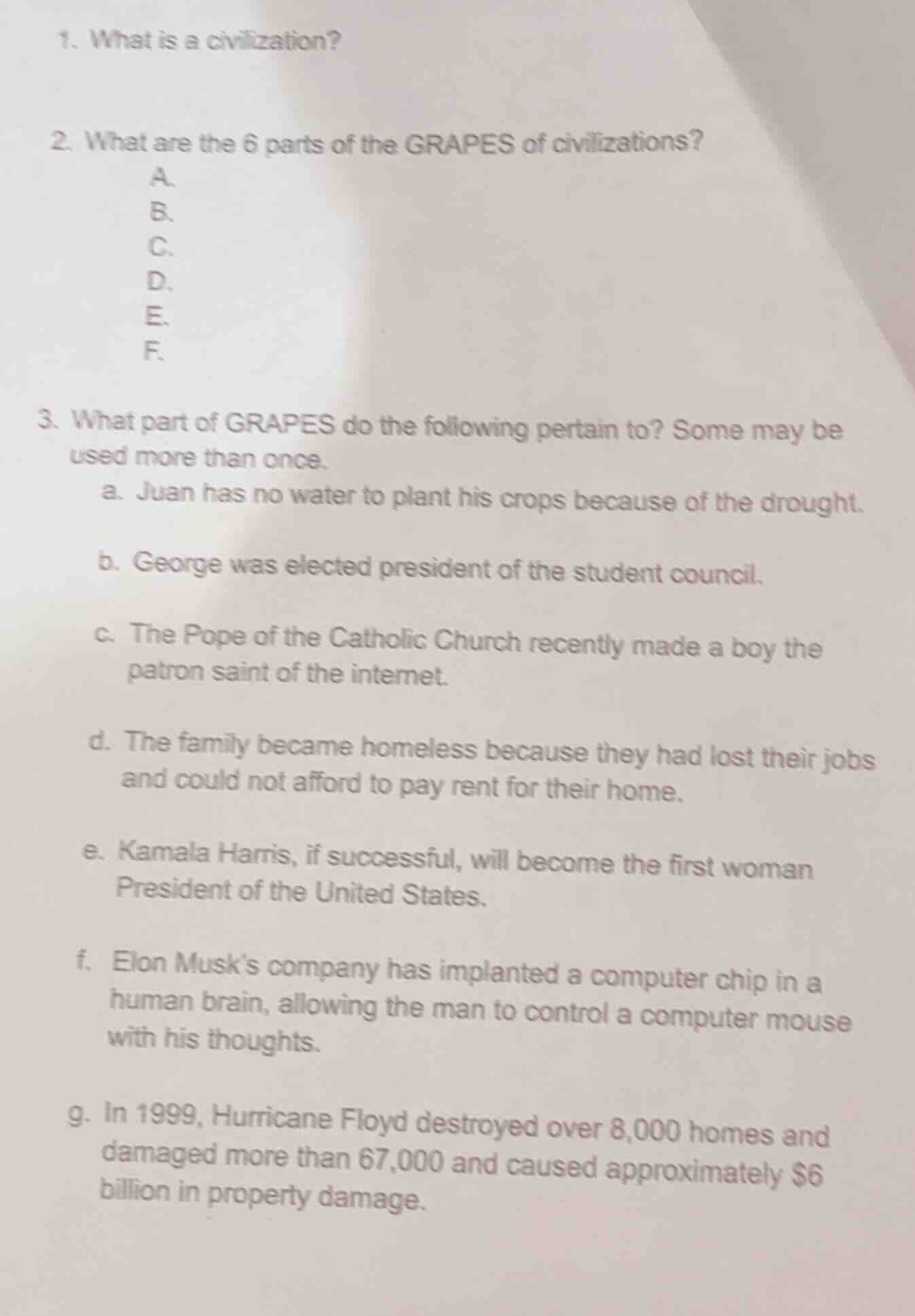
- what is a civilization?2. what are the 6 parts of the grapes of civilizations?a.b.c.d.e.f.3. what part of grapes do the following pertain to? some may be used more than once.a. juan has no water to plant his crops because of the drought.b. george was elected president of the student council.c. the pope of the catholic church recently made a boy the patron saint of the internet.d. the family became homeless because they had lost their jobs and could not afford to pay rent for their home.e. kamala harris, if successful, will become the first woman president of the united states.f. elon musks company has implanted a computer chip in a human brain, allowing the man to control a computer mouse with his thoughts.g. in 1999, hurricane floyd destroyed over 8,000 homes and damaged more than 67,000 and caused approximately $6 billion in property damage.
Brief Explanations
- Defines civilization by its core, distinguishing traits of advanced human societies.
- Lists the standard six components of the GRAPES framework for analyzing civilizations, where each letter corresponds to a key category: Geography, Religion, Achievements, Politics, Economics, Social Structure.
- Matches each scenario to the relevant GRAPES category:
- a: Drought (environmental/geographic factor) impacts crops.
- b: Student council election relates to governance/politics.
- c: Catholic Church actions fall under religion.
- d: Job loss and housing affordability relate to economic stability.
- e: A presidential election is a political process.
- f: Brain-computer chip technology is a scientific/technological achievement.
- g: Hurricane damage is a geographic/environmental event.

Snap & solve any problem in the app
Get step-by-step solutions on Sovi AI
Photo-based solutions with guided steps
Explore more problems and detailed explanations
- A complex, organized human society characterized by urban development, social hierarchy, shared culture, systems of government, technology, and economic activity, typically with advanced features like writing, agriculture, and specialized labor.
- A. Geography, B. Religion, C. Achievements, D. Politics, E. Economics, F. Social Structure
- a. Geography
b. Politics
c. Religion
d. Economics
e. Politics
f. Achievements
g. Geography