QUESTION IMAGE
Question
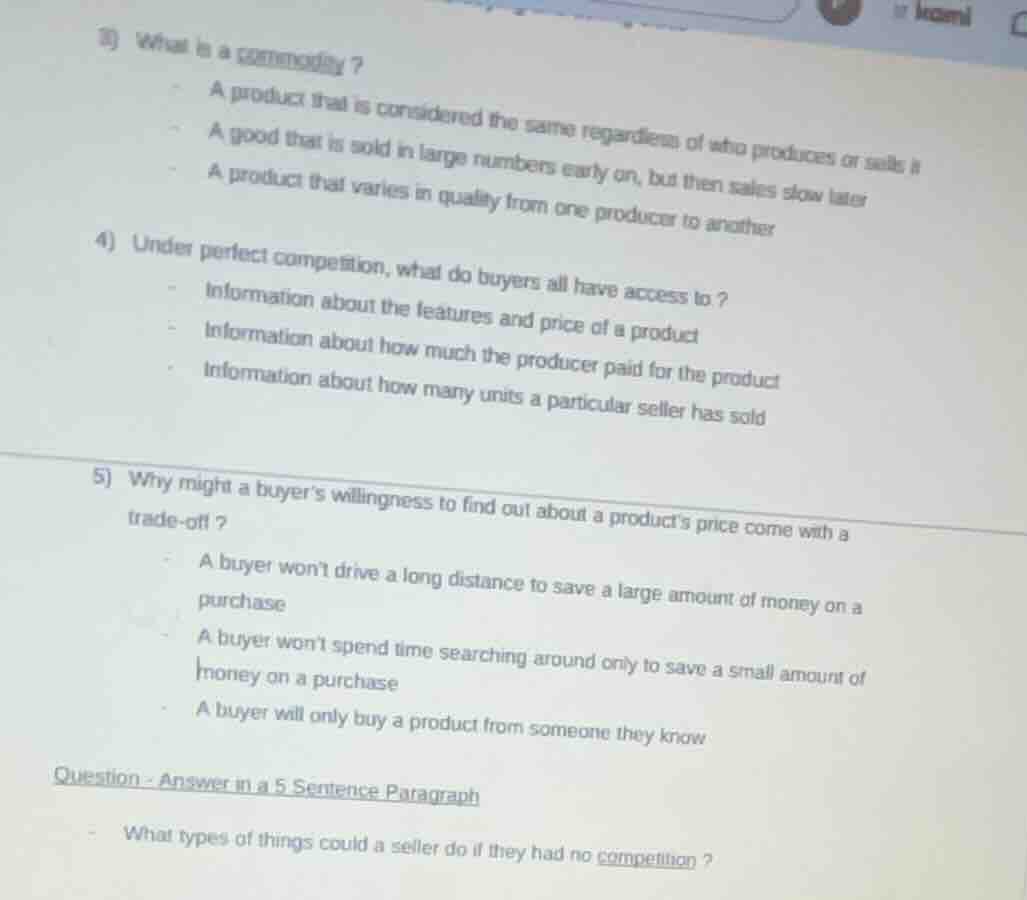
- what is a commodity?
- a product that is considered the same regardless of who produces or sells it
- a good that is sold in large numbers early on, but then sales slow later
- a product that varies in quality from one producer to another
- under perfect competition, what do buyers all have access to?
- information about the features and price of a product
- information about how much the producer paid for the product
- information about how many units a particular seller has sold
- why might a buyer’s willingness to find out about a product’s price come with a trade - off?
- a buyer won’t drive a long distance to save a large amount of money on a purchase
- a buyer won’t spend time searching around only to save a small amount of money on a purchase
- a buyer will only buy a product from someone they know
question - answer in a 5 sentence paragraph
- what types of things could a seller do if they had no competition?
Question 3 (Commodity Definition)
A commodity is a product that is considered the same regardless of who produces or sells it. This is because commodities like wheat or gold have uniform quality across producers, so the source doesn’t affect the product’s value. The other options are incorrect: selling in large numbers early then slowing isn’t a commodity trait, and commodities don’t vary in quality by producer.
In perfect competition, buyers have access to information about the features and price of a product. This is a key assumption of perfect competition (perfect information), allowing buyers to make informed choices. Producers’ costs and sellers’ sales volumes are not information buyers need or have access to in this model.
A buyer’s willingness to find a product’s price has a trade - off because a buyer won’t spend time searching around only to save a small amount of money on a purchase. The time and effort of searching (opportunity cost) outweighs the small savings. Driving long for large savings is rational, and buying only from known people is not a price - related trade - off.

Snap & solve any problem in the app
Get step-by-step solutions on Sovi AI
Photo-based solutions with guided steps
Explore more problems and detailed explanations
A. A product that is considered the same regardless of who produces or sells it