QUESTION IMAGE
Question
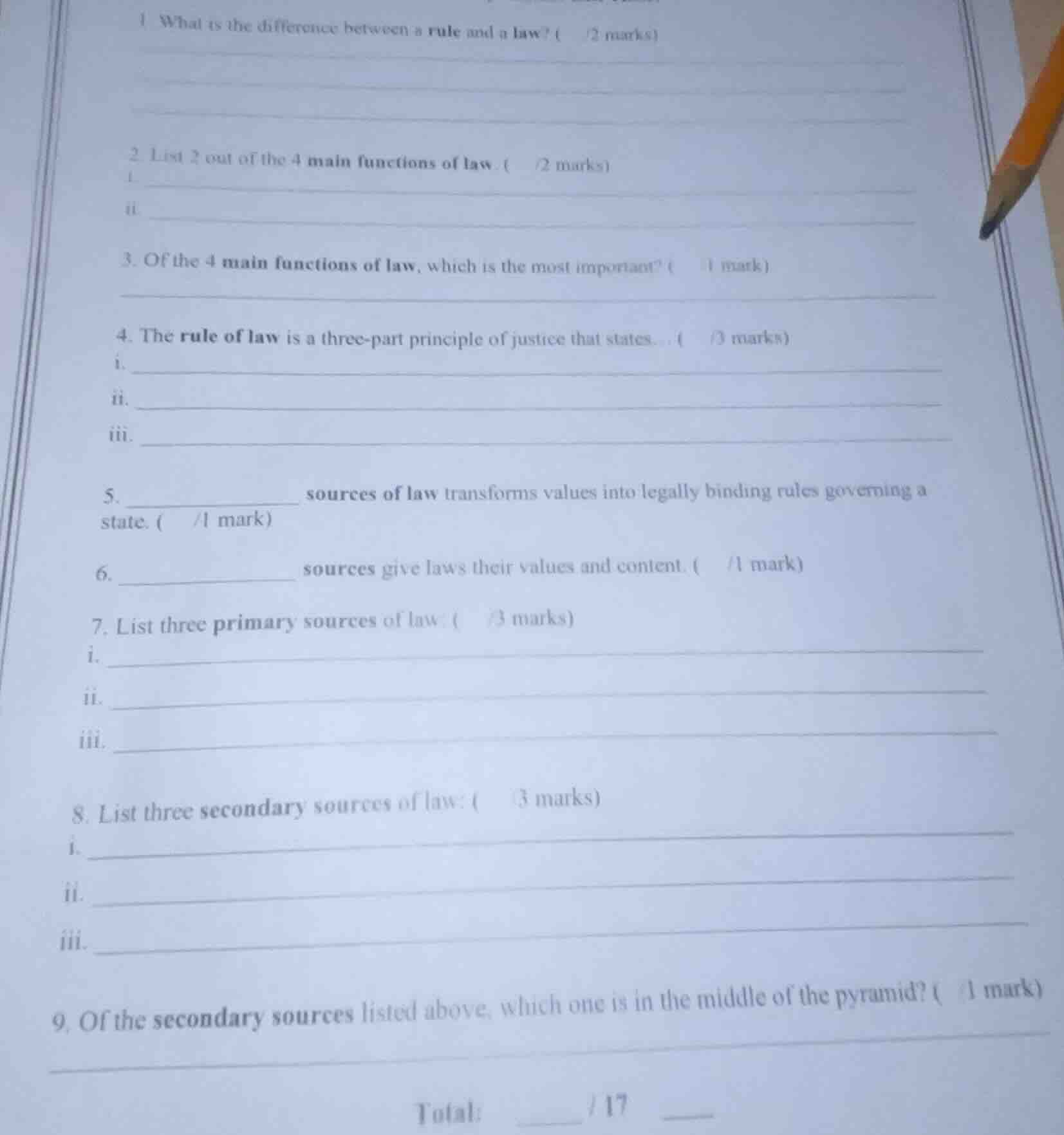
- what is the difference between a rule and a law? (2 marks)2. list 2 out of the 4 main functions of law. (2 marks)i.ii.3. of the 4 main functions of law, which is the most important? (1 mark)4. the rule of law is a three-part principle of justice that states... (3 marks)i.ii.iii.5. __________ sources of law transforms values into legally binding rules governing a state. (1 mark)6. ________ sources give laws their values and content. (1 mark)7. list three primary sources of law: (3 marks)i.ii.iii.8. list three secondary sources of law: (3 marks)i.ii.iii.9. of the secondary sources listed above, which one is in the middle of the pyramid? (1 mark)total: __/17
Brief Explanations
- Rules are often specific to a group/organization, unenforced by state; laws are state-enforced, universal.
- Common core functions of law include social order and dispute resolution.
- Maintaining social order is foundational for other legal functions to operate.
- The three-part rule of law principle focuses on equality, accountability, and fair process.
- Formal sources codify values into enforceable legal rules.
- Material sources shape the underlying content and values of laws.
- Primary sources are direct, binding legal authorities created by official bodies.
- Secondary sources interpret, analyze, or comment on primary legal sources.
- In a typical legal source pyramid, case law sits between legislation and academic commentary.

Snap & solve any problem in the app
Get step-by-step solutions on Sovi AI
Photo-based solutions with guided steps
Explore more problems and detailed explanations
- Rules are informal/organization-specific, not state-enforced; laws are state-mandated, universally binding, and carry official penalties for violations.
2.
i. Maintaining social order
ii. Resolving disputes between parties
- Maintaining social order
4.
i. All people/entities are equal under the law
ii. Those in power are accountable to the law
iii. Everyone has access to fair legal processes
- Formal
- Material
7.
i. Legislation (statutes/acts of parliament)
ii. Case law (judicial precedents)
iii. Constitutional law
8.
i. Legal textbooks and academic journals
ii. Legal commentaries and treatises
iii. Law review articles
- Case law