QUESTION IMAGE
Question
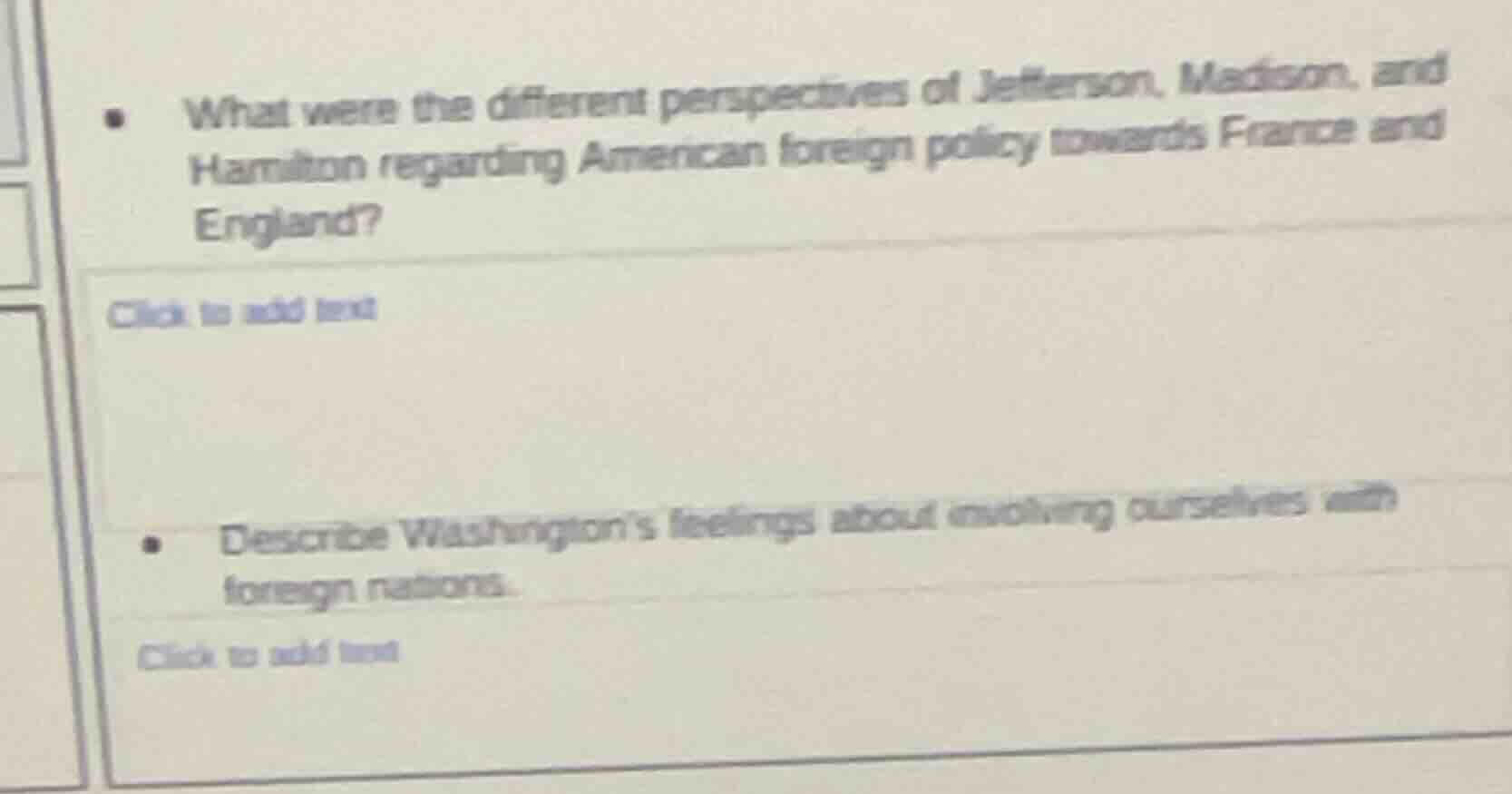
what were the different perspectives of jefferson, madison, and hamilton regarding american foreign policy towards france and england?
click to add text
describe washington’s feelings about involving ourselves with foreign nations.
click to add text
- For Jefferson, Madison, and Hamilton's foreign policy perspectives:
- Jefferson and Madison (Democratic-Republicans) favored aligning with France, citing ideological ties to the French Revolution and resentment of British colonial history.
- Hamilton (Federalist) prioritized close ties with Britain, driven by economic interests (trade, debt repayment) and opposition to the radical French Revolution.
- For Washington's views on foreign involvement:
Washington advocated for neutrality and avoiding permanent foreign alliances. He believed entanglement in European conflicts would threaten the young nation's stability and sovereignty, as outlined in his Farewell Address.

Snap & solve any problem in the app
Get step-by-step solutions on Sovi AI
Photo-based solutions with guided steps
Explore more problems and detailed explanations
- Perspectives on U.S. foreign policy toward France and England:
- Thomas Jefferson & James Madison: Supported alignment with France, motivated by shared revolutionary ideals and anti-British sentiment from the American Revolution. They opposed close ties with Britain.
- Alexander Hamilton: Pushed for strong economic and political ties with Britain, as British trade was critical to the U.S. economy, and he viewed the French Revolution as too radical and unstable.
- George Washington's feelings on foreign involvement:
Washington strongly opposed entanglement in foreign conflicts and permanent alliances. He argued in his Farewell Address that the young United States should remain neutral in European disputes to protect its independence, stability, and ability to grow domestically.