QUESTION IMAGE
Question
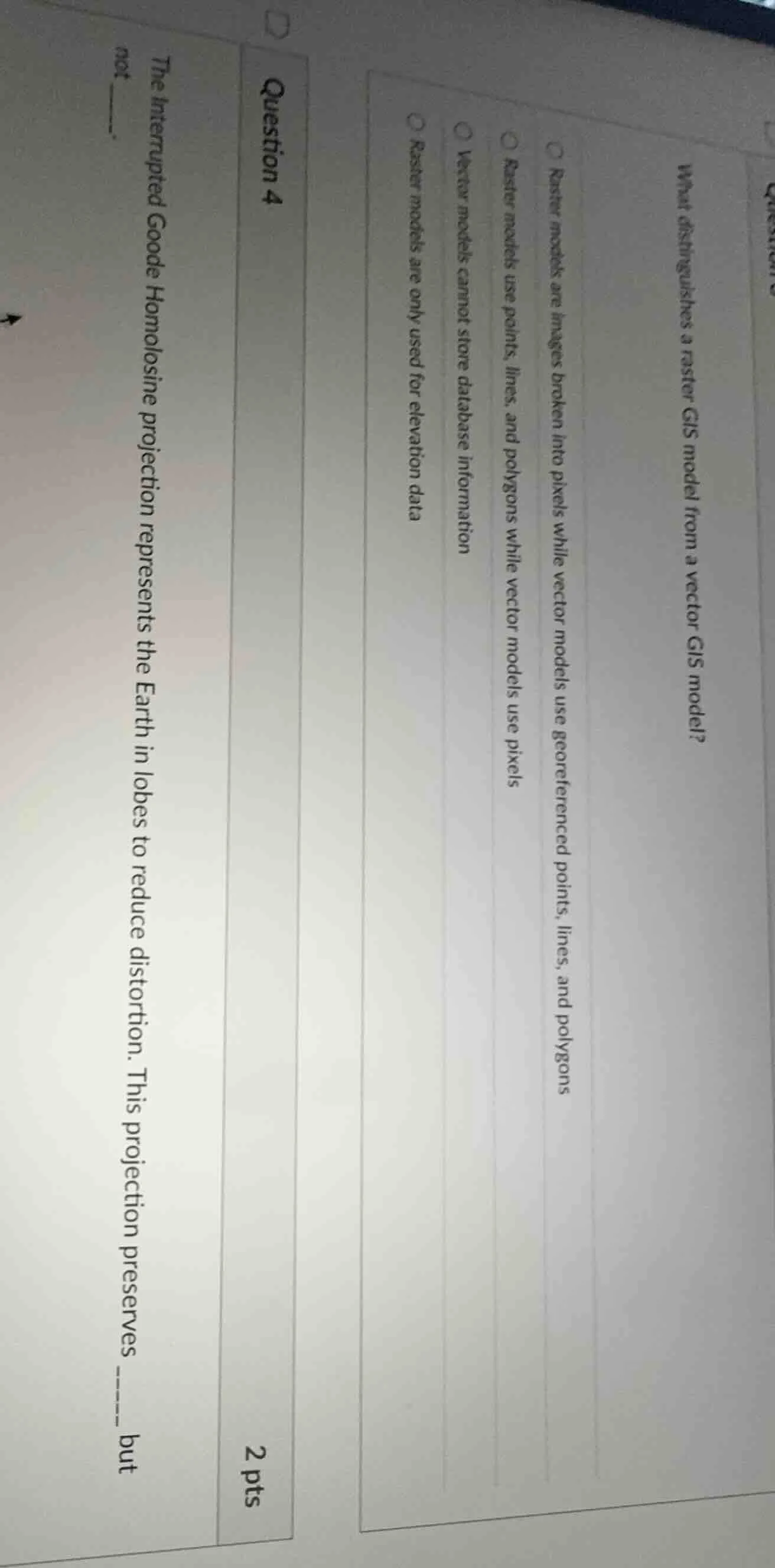
what distinguishes a raster gis model from a vector gis model?○ raster models are images broken into pixels while vector models use georeferenced points, lines, and polygons○ raster models use points, lines, and polygons while vector models use pixels○ vector models cannot store database information○ raster models are only used for elevation dataquestion 42 ptsthe interrupted goode homolosine projection represents the earth in lobes to reduce distortion. this projection preserves __ but not __.
For the first question: Raster GIS models represent spatial data as a grid of pixels, while vector GIS models use discrete georeferenced points, lines, and polygons to represent spatial features. The other options are incorrect: raster models do not use points/lines/polygons (vector does), vector models can store database information, and raster models are used for more than just elevation data.
For Question 4: The Interrupted Goode Homolosine projection is an equal-area (equivalent) projection, meaning it preserves the relative area of landmasses, but it does not preserve shape (conformality) due to its interrupted lobed design that reduces overall distortion.

Snap & solve any problem in the app
Get step-by-step solutions on Sovi AI
Photo-based solutions with guided steps
Explore more problems and detailed explanations
- A. Raster models are images broken into pixels while vector models use georeferenced points, lines, and polygons
- area; shape (or conformality)