QUESTION IMAGE
Question
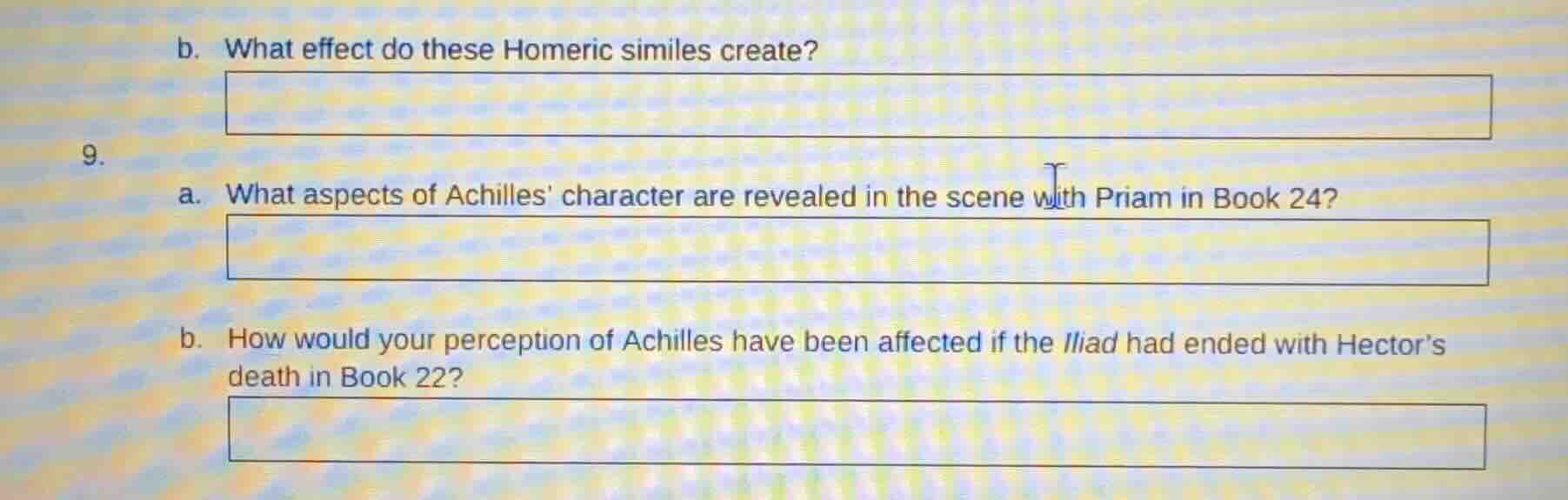
b. what effect do these homeric similes create?
9.
a. what aspects of achilles character are revealed in the scene with priam in book 24?
b. how would your perception of achilles have been affected if the iliad had ended with hectors death in book 22?
For 8b:
Homeric similes elaborate scenes vividly, grounding epic, larger-than-life moments in relatable, everyday natural or human experiences. They slow the narrative pace to emphasize key emotional or action beats, and they also elevate the gravity of the characters' struggles by drawing parallels to universal, recognizable phenomena.
For 9a:
In his scene with Priam in Book 24, Achilles shows profound vulnerability, grief, and empathy. He abandons his vengeful rage when he sees Priam's suffering, recognizing shared human loss, which reveals his capacity for compassion beneath his warrior fury.
For 9b:
If the Iliad ended with Hector's death in Book 22, Achilles would be remembered primarily as a brutal, wrath-driven warrior defined by his vengeance, rather than a complex figure who confronts the humanity of grief and reconciliation. The ending would frame him as a symbol of destructive rage, not a character capable of growth and empathy.

Snap & solve any problem in the app
Get step-by-step solutions on Sovi AI
Photo-based solutions with guided steps
Explore more problems and detailed explanations
8b. Homeric similes create a vivid, relatable context for epic events, slow the narrative to highlight key moments, and deepen the emotional weight of characters' struggles by linking them to universal, familiar experiences.
9a. The scene reveals Achilles' capacity for empathy, vulnerability, and his ability to set aside vengeful rage to recognize shared human grief.
9b. My perception of Achilles would be limited to a one-note, wrathful, destructive warrior; the nuance of his growth, empathy, and understanding of shared human suffering would be entirely absent, leaving him defined only by his vengeance.