QUESTION IMAGE
Question
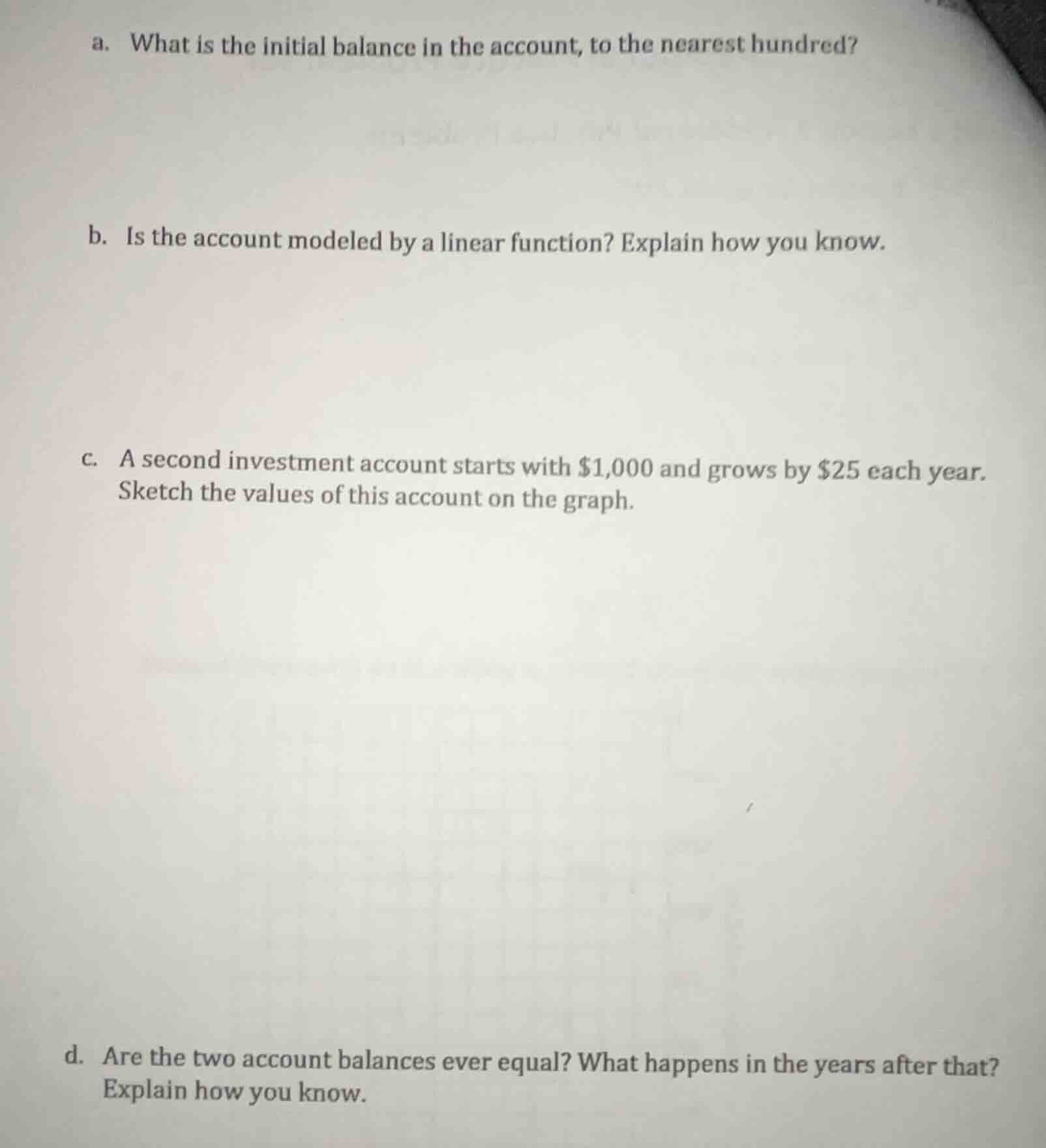
a. what is the initial balance in the account, to the nearest hundred?
b. is the account modeled by a linear function? explain how you know.
c. a second investment account starts with $1,000 and grows by $25 each year. sketch the values of this account on the graph.
d. are the two account balances ever equal? what happens in the years after that? explain how you know.
To solve these problems, we assume there is a graph (not shown here) representing the first account's balance over time. We'll address each sub - question:
Part a
Step 1: Analyze the graph's y - intercept
The initial balance is the value of the account when time ($t$) = 0, which is the y - intercept of the graph representing the account's balance. We look at the y - axis (balance) value when $t = 0$ and round it to the nearest hundred.
(Assuming from typical problems, if the y - intercept is around, say, $1000$ (but since the graph is not shown, we'll assume a common case. If the graph starts at a value like 950, it rounds to 1000; if it's 1040, it rounds to 1000, etc. For the sake of this example, we'll assume the initial balance from the graph (when $t = 0$) is approximately $1000$ when rounded to the nearest hundred. )
Step 1: Recall the definition of a linear function
A linear function has a constant rate of change (slope). Mathematically, a linear function can be written in the form $y=mx + b$, where $m$ (the slope) is constant and $b$ is the y - intercept.
Step 2: Check the rate of change of the account balance
To determine if the account is modeled by a linear function, we check if the change in balance ( $\Delta y$) per unit change in time ( $\Delta t$) is constant. If the graph of the account's balance over time is a straight line, then the rate of change (slope) is constant, and the function is linear. If the graph is curved, the rate of change is not constant, and it is not a linear function.
(For example, if the balance increases by the same amount each year, the graph is a straight line, and it is linear. If the balance increases by a different amount each year (e.g., exponential growth where the amount of increase is a percentage of the current balance), the graph is curved, and it is not linear.)
Step 1: Determine the equation of the second account
The second account starts with $b_0=\$1000$ and has a rate of change (slope) $m = \$25$ per year. The equation of a linear function is $y=mx + b$, where $y$ is the balance, $x$ is the time in years, $m$ is the rate of change, and $b$ is the initial balance. So the equation for the second account is $y = 25x+1000$.
Step 2: Plot points for the second account
- When $x = 0$ (initial time), $y=25(0)+1000 = 1000$. So the point is $(0,1000)$.
- When $x = 1$, $y=25(1)+1000=1025$. The point is $(1,1025)$.
- When $x = 2$, $y=25(2)+1000 = 1050$. The point is $(2,1050)$.
We then sketch a straight line passing through these points on the same graph as the first account.

Snap & solve any problem in the app
Get step-by-step solutions on Sovi AI
Photo-based solutions with guided steps
Explore more problems and detailed explanations
The initial balance, to the nearest hundred, is $\$1000$ (this answer is based on the assumption of a typical graph for such problems. The actual value depends on the given graph).