QUESTION IMAGE
Question
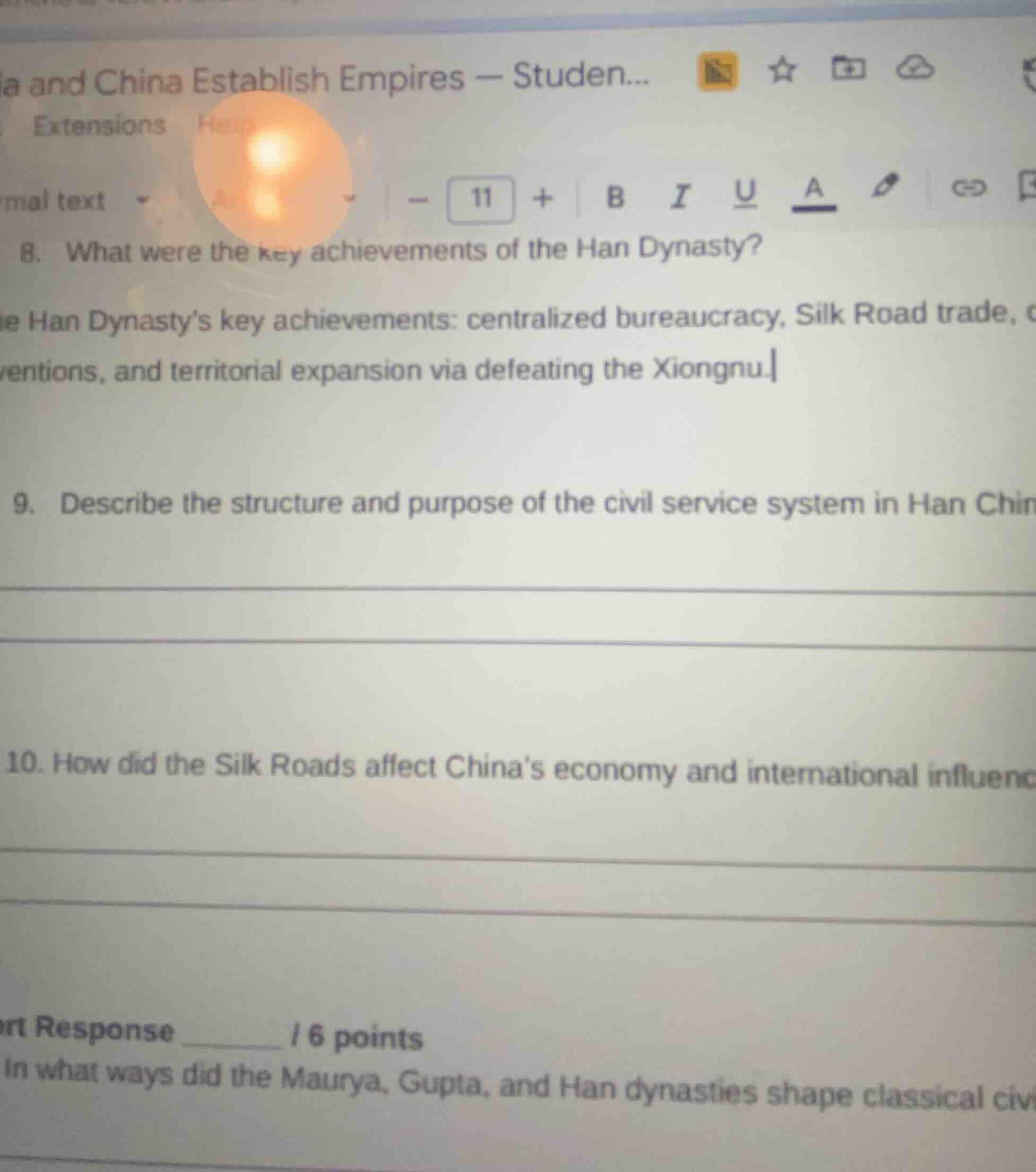
- what were the key achievements of the han dynasty?
the han dynastys key achievements: centralized bureaucracy, silk road trade,
inventions, and territorial expansion via defeating the xiongnu.
- describe the structure and purpose of the civil service system in han chin
- how did the silk roads affect china’s economy and international influenc
ort response ______ / 6 points
in what ways did the maurya, gupta, and han dynasties shape classical civi
Question 9
The civil service system in Han China had a structure where officials were selected via examinations (later, initially via recommendations) and hierarchical ranks. Its purpose was to centralize governance, ensure competent administration, and reduce aristocratic dominance by recruiting based on merit (Confucian learning - related for exams later), maintaining order, collecting taxes, and implementing imperial policies across the empire.
Economically, the Silk Roads let China export silk, porcelain, etc., importing goods (spices, gems) and precious metals, boosting trade - related industries (textiles, crafts) and urban growth (oases, capital - linked cities). Internationally, it spread Chinese culture (Confucianism, technologies like papermaking), enhanced diplomatic ties (e.g., with Central Asian states), and made China a key Eurasian trade hub, elevating its status as a cultural and economic power.
Maurya (Ashoka’s dharma, centralized admin), Gupta (Hindu - Buddhist culture, math/science advances), and Han (Confucian bureaucracy, Silk Road, territorial unity) shaped classical civilizations by: centralizing power (Maurya/Han), advancing culture (Gupta’s arts, Han’s literature), promoting trade (Han’s Silk Road, Maurya’s regional trade), and establishing administrative models (Han’s civil service, Maurya’s spy network) that endured, influencing statecraft, culture, and economic systems in their regions (South Asia, East Asia) and beyond.

Snap & solve any problem in the app
Get step-by-step solutions on Sovi AI
Photo-based solutions with guided steps
Explore more problems and detailed explanations
Structure: It had a hierarchical setup with ranks (e.g., local to imperial levels). Recruitment initially relied on recommendations (from nobles, scholars) and later evolved toward civil service exams (testing Confucian knowledge). Officials were organized in departments (like finance, justice) to manage empire - wide affairs (tax, law, infrastructure).
Purpose: To create a merit - based (over time) administrative class, centralize imperial power by reducing noble influence, ensure efficient governance (tax collection, law enforcement, policy implementation), and maintain social order through a structured, competent bureaucracy.