QUESTION IMAGE
Question
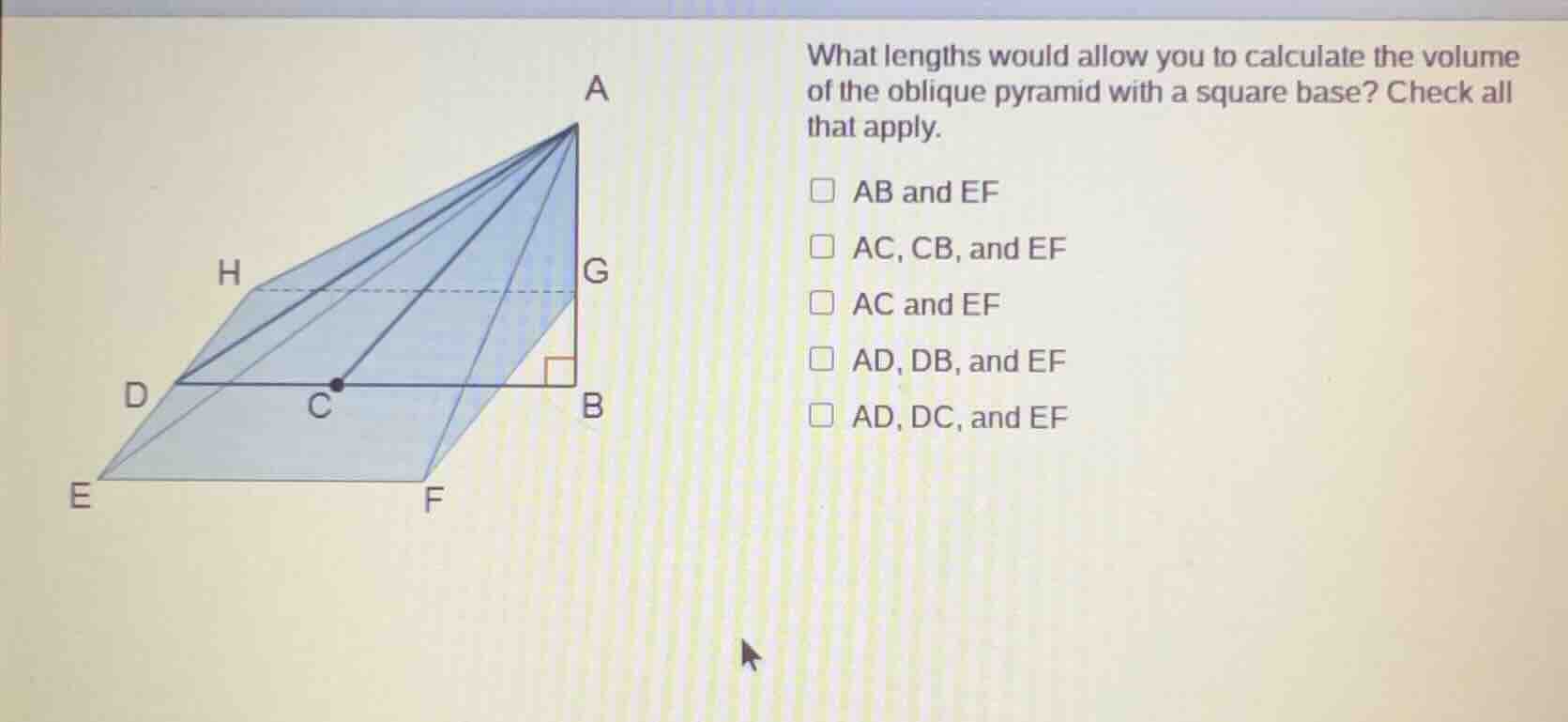
what lengths would allow you to calculate the volume of the oblique pyramid with a square base? check all that apply. ab and ef ac, cb, and ef ac and ef ad, db, and ef ad, dc, and ef
Brief Explanations
The volume of a pyramid is given by \( V=\frac{1}{3}Bh \), where \( B \) is the area of the base and \( h \) is the height. For a square - based oblique pyramid:
- The base is a square, so if we know the length of a side of the square base (e.g., \( EF \) can be a side of the square base), and the height of the pyramid. The height of the pyramid is the perpendicular distance from the apex (point \( A \)) to the base.
- For option AB and EF: \( AB \) can be considered as the height (since \( \angle ABG = 90^{\circ} \), \( AB \) is perpendicular to the base - related plane) and \( EF \) is the side of the square base. With \( EF \), we can find the area of the square base (\( B = EF^{2}\)) and with \( AB \) as the height, we can calculate the volume.
- For option AC, CB, and EF: We can use the Pythagorean theorem in right - triangle \( ACB \) (since \( \angle ABC=90^{\circ} \)) to find \( AB=\sqrt{AC^{2}-CB^{2}} \) (or other combinations to find the height). Then, with \( EF \) as the side of the square base, we can find the base area and then the volume.
- For option AD, DB, and EF: In right - triangle \( ADB \) (since \( \angle ABD = 90^{\circ} \)), we can find \( AB=\sqrt{AD^{2}-DB^{2}} \) (the height of the pyramid) using the Pythagorean theorem. And with \( EF \) as the side of the square base, we can find the base area and then the volume.
- For option AD, DC, and EF: In right - triangle \( ADC \) (since \( \angle ACD = 90^{\circ} \)), we can find \( AC=\sqrt{AD^{2}-DC^{2}} \), and then we can use other geometric relationships to find the height of the pyramid. And with \( EF \) as the side of the square base, we can find the base area and then the volume.
- For option AC and EF: We cannot directly find the height of the pyramid from just \( AC \) and \( EF \) because \( AC \) is not necessarily the height (it is a slant edge), and we don't have enough information to find the perpendicular height from \( AC \) alone.

Snap & solve any problem in the app
Get step-by-step solutions on Sovi AI
Photo-based solutions with guided steps
Explore more problems and detailed explanations
A. AB and EF
B. AC, CB, and EF
D. AD, DB, and EF
E. AD, DC, and EF