QUESTION IMAGE
Question
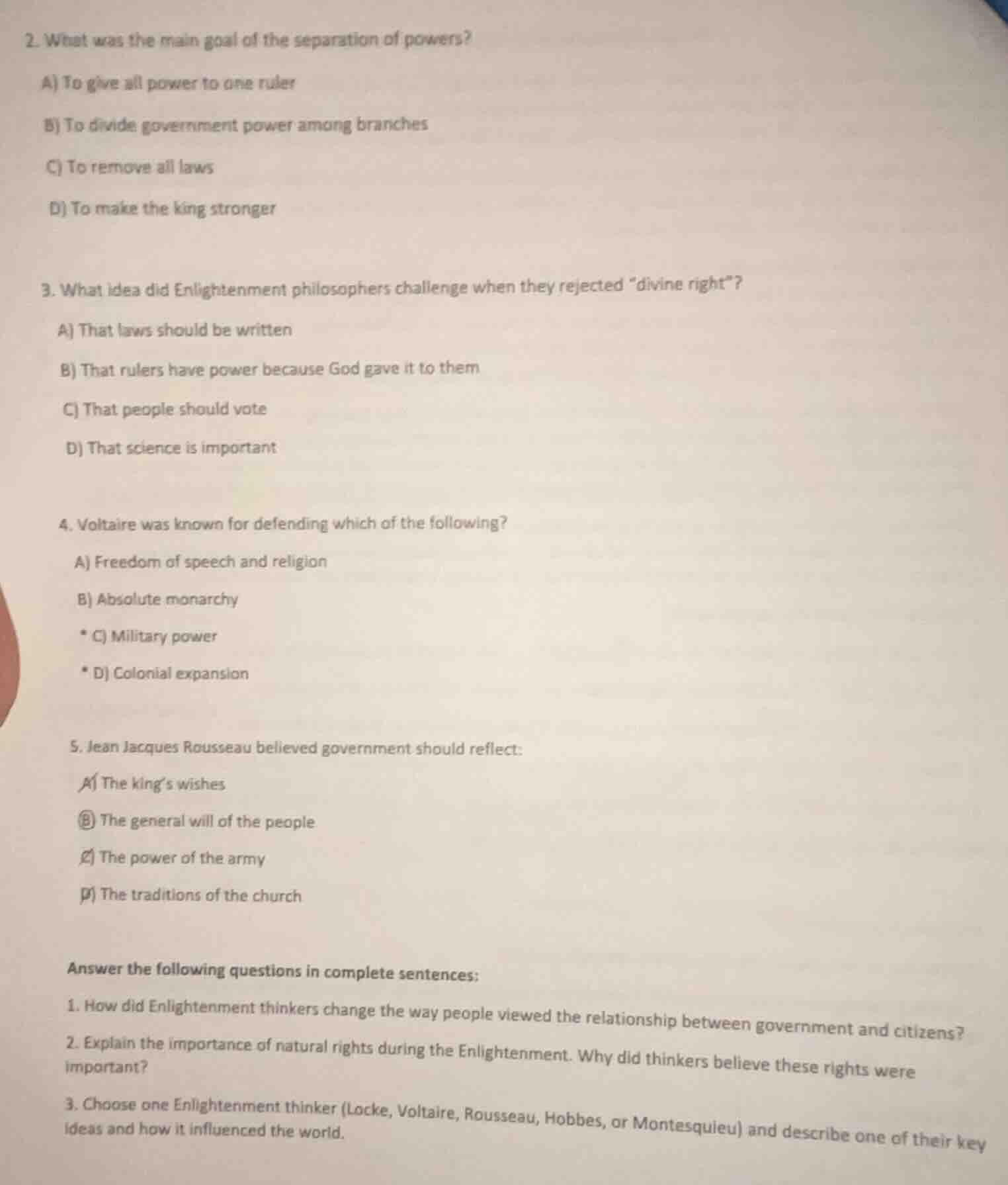
- what was the main goal of the separation of powers?
a) to give all power to one ruler
b) to divide government power among branches
c) to remove all laws
d) to make the king stronger
- what idea did enlightenment philosophers challenge when they rejected \divine right\?
a) that laws should be written
b) that rulers have power because god gave it to them
c) that people should vote
d) that science is important
- voltaire was known for defending which of the following?
a) freedom of speech and religion
b) absolute monarchy
- c) military power
- d) colonial expansion
- jean jacques rousseau believed government should reflect:
a) the king’s wishes
b) the general will of the people
c) the power of the army
d) the traditions of the church
answer the following questions in complete sentences:
- how did enlightenment thinkers change the way people viewed the relationship between government and citizens?
- explain the importance of natural rights during the enlightenment. why did thinkers believe these rights were important?
- choose one enlightenment thinker (locke, voltaire, rousseau, hobbes, or montesquieu) and describe one of their key ideas and how it influenced the world.
Question 2
The separation of powers is a political concept where government power is divided among different branches (like legislative, executive, judicial) to prevent abuse. Option A is wrong as it's the opposite of separation. Option C is incorrect as separation of powers doesn't remove laws. Option D is wrong as it's not about strengthening the king. So B is correct.
"Divine right" is the idea that rulers' authority comes from God. Enlightenment philosophers challenged this by promoting ideas of popular sovereignty or rational governance. Option A is about written laws (not related to divine right). Option C is about voting (not related). Option D is about science (not related). So B is correct.
Voltaire was a strong advocate for freedom of speech and religion, criticizing religious intolerance and censorship. Option B is wrong as he opposed absolute monarchy. Options C and D are not his main focuses. So A is correct.

Snap & solve any problem in the app
Get step-by-step solutions on Sovi AI
Photo-based solutions with guided steps
Explore more problems and detailed explanations
B) To divide government power among branches