QUESTION IMAGE
Question
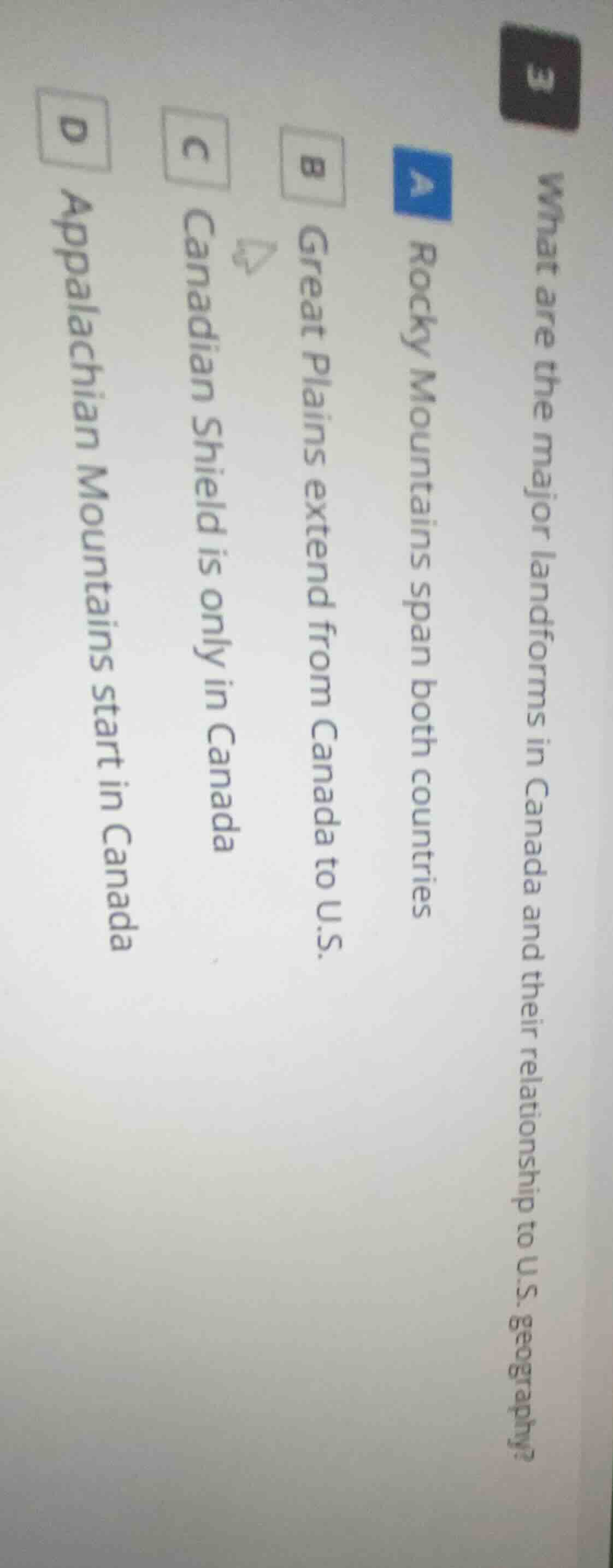
what are the major landforms in canada and their relationship to u.s. geography?
a rocky mountains span both countries
b great plains extend from canada to u.s.
c canadian shield is only in canada
d appalachian mountains start in canada
To determine the correct option, we analyze each:
- Option A: Rocky Mountains span both Canada and the US (correct, as they extend through both countries).
- Option B: Great Plains extend from Canada to US (true, but the question is about major landforms in Canada and their US relation; Rocky Mts are a key shared landform).
- Option C: Canadian Shield is only in Canada (true, but it doesn't relate to US geography, so not the best for the "relationship to US" part).
- Option D: Appalachian Mts start in Canada (they extend into Canada from the US, so this is incorrect).
The best answer considering the relationship to US geography and being a major landform shared (or spanning) is A, but wait—re - evaluating: Wait, the Great Plains do extend from Canada to US, but the Rocky Mountains also span both. However, the Canadian Shield is only in Canada (so no US relation). Appalachian Mts: the Appalachian range extends into Canada from the US, so "start in Canada" is wrong. Wait, maybe the question is about which statement is correct. Let's check each statement's truth:
- A: Rocky Mountains span both countries (correct, they run through western Canada and US).
- B: Great Plains extend from Canada to US (correct, the Great Plains region includes parts of Canada and US).
- C: Canadian Shield is only in Canada (correct, it's a large geological shield mostly in Canada, with some in Greenland etc., but mainly Canada, and no US part).
- D: Appalachian Mts start in Canada (incorrect, they start in the US and extend north into Canada).
But the question is "What are the major landforms in Canada and their relationship to U.S. geography?". So we need a statement that is true about a Canadian landform and its US relation.
- A: Rocky Mts span both (correct relation).
- B: Great Plains extend from Canada to US (correct relation).
- C: Canadian Shield is only in Canada (so no US relation, so not answering the "relationship to US" part).
- D: False.
Now, between A and B. The Rocky Mountains are a major landform that spans both countries. The Great Plains also do. But maybe the intended correct answer is A? Wait, no—wait the Canadian Shield is only in Canada (so C is true but no US relation). Let's check the options again. The question is asking for the correct statement about major Canadian landforms and their US relation.
Wait, the options are statements, and we need to pick the correct one. Let's verify each statement:
- A: Rocky Mountains span both countries (True).
- B: Great Plains extend from Canada to US (True).
- C: Canadian Shield is only in Canada (True).
- D: Appalachian Mts start in Canada (False, they extend into Canada from the US).
But the question is "What are the major landforms in Canada and their relationship to U.S. geography?"—so the statement that shows a relationship (spanning or extending to US) and is true. Now, maybe the intended answer is A? Or B? Wait, maybe the question has a typo, but based on standard knowledge:
Rocky Mountains: span Canada and US (correct, major landform, shared).
Great Plains: extend from Canada to US (correct, major landform, shared).
Canadian Shield: only in Canada (correct, but no US relation).
Appalachian Mts: the Appalachian range includes parts of Canada (Newfoundland etc.) but the main range is in the US, so "start in Canada" is wrong.
Now, if we have to choose the best answer among the options (assuming one is correct), let's re - check the options' wording:
Option A: "Rocky Mountains span both countries"—correct.
Option B: "Great Plains extend from Canada to U.S."—correct.
Option C: "…

Snap & solve any problem in the app
Get step-by-step solutions on Sovi AI
Photo-based solutions with guided steps
Explore more problems and detailed explanations
A. Rocky Mountains span both countries