QUESTION IMAGE
Question
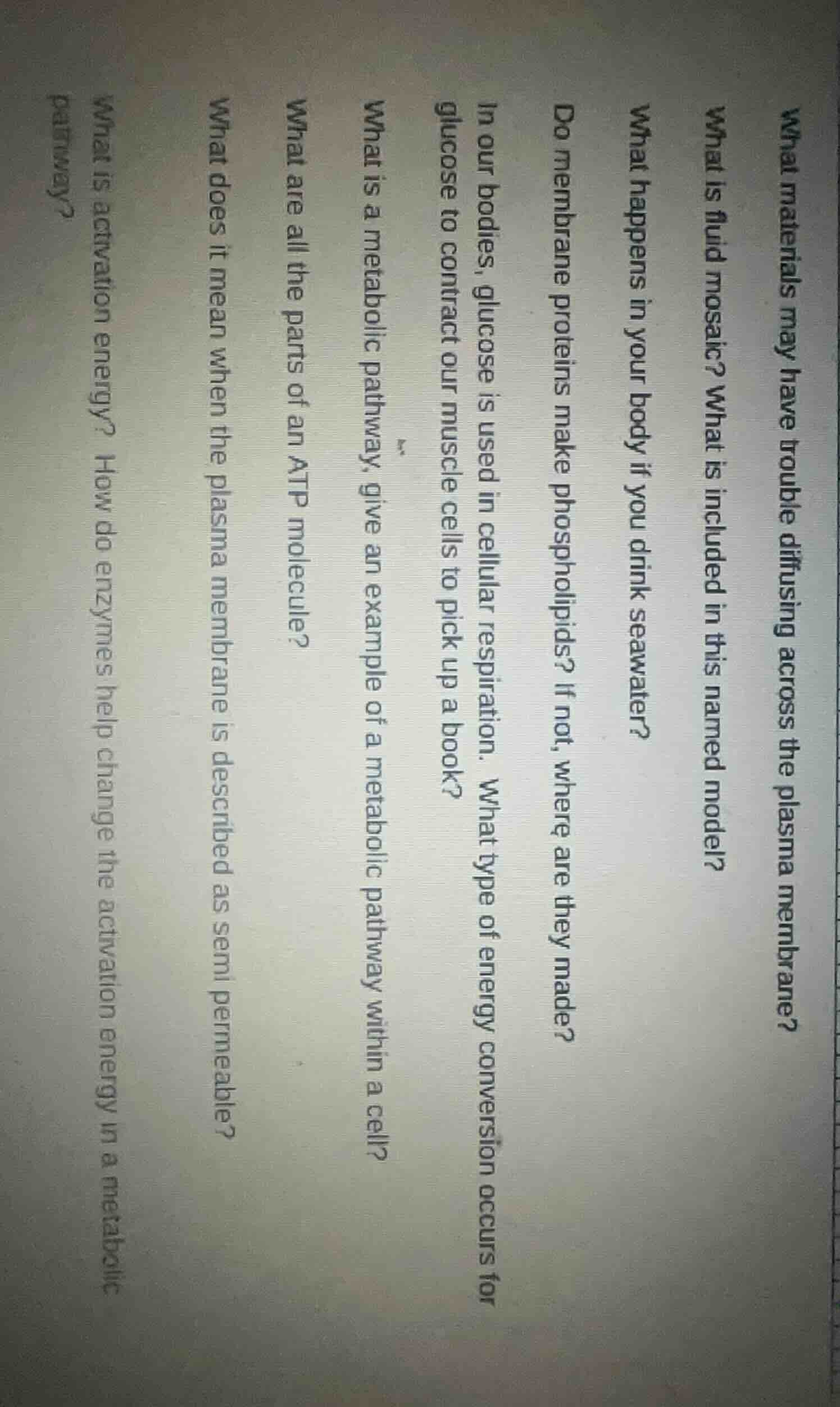
what materials may have trouble diffusing across the plasma membrane?
what is fluid mosaic? what is included in this named model?
what happens in your body if you drink seawater?
do membrane proteins make phospholipids? if not, where are they made?
in our bodies, glucose is used in cellular respiration. what type of energy conversion occurs for glucose to contract our muscle cells to pick up a book?
what is a metabolic pathway, give an example of a metabolic pathway within a cell?
what are all the parts of an atp molecule?
what does it mean when the plasma membrane is described as semi permeable?
what is activation energy? how do enzymes help change the activation energy in a metabolic pathway?
Since there are multiple sub - questions related to biological concepts (like plasma membrane, cellular respiration, ATP, enzymes, metabolic pathways etc.), we'll use the Answer - Explanation Format for each sub - question:
Sub - question 1: What materials may have trouble diffusing across the plasma membrane?
Large, polar, or charged molecules (e.g., ions, large proteins, polysaccharides) have trouble diffusing across the plasma membrane. The plasma membrane is mainly composed of a phospholipid bilayer with a hydrophobic interior. Non - polar molecules can diffuse easily, but polar and charged molecules are repelled by the hydrophobic core, and large molecules can't pass through the small spaces between phospholipids.
The fluid mosaic model describes the structure of the plasma membrane. It is "fluid" because the phospholipids and proteins can move within the membrane. The "mosaic" part comes from the diverse arrangement of proteins (integral and peripheral), phospholipids, cholesterol (in animal cells), and carbohydrates (attached to lipids or proteins) in the membrane.
Seawater has a higher solute (salt, mainly NaCl) concentration than body fluids. When you drink it, the osmotic gradient causes water to leave your cells (osmosis: water moves from low solute to high solute concentration). This can lead to dehydration of cells, especially in the digestive tract and other tissues, and may cause symptoms like thirst, nausea, and in severe cases, organ dysfunction.

Snap & solve any problem in the app
Get step-by-step solutions on Sovi AI
Photo-based solutions with guided steps
Explore more problems and detailed explanations
Large, polar, or charged molecules (e.g., ions, large proteins, polysaccharides)