QUESTION IMAGE
Question
(6) what is the maximum percentage of the rated capacity of a crane that can be used to...
a. 40%
b. 50%
c. 60%
d. 80%
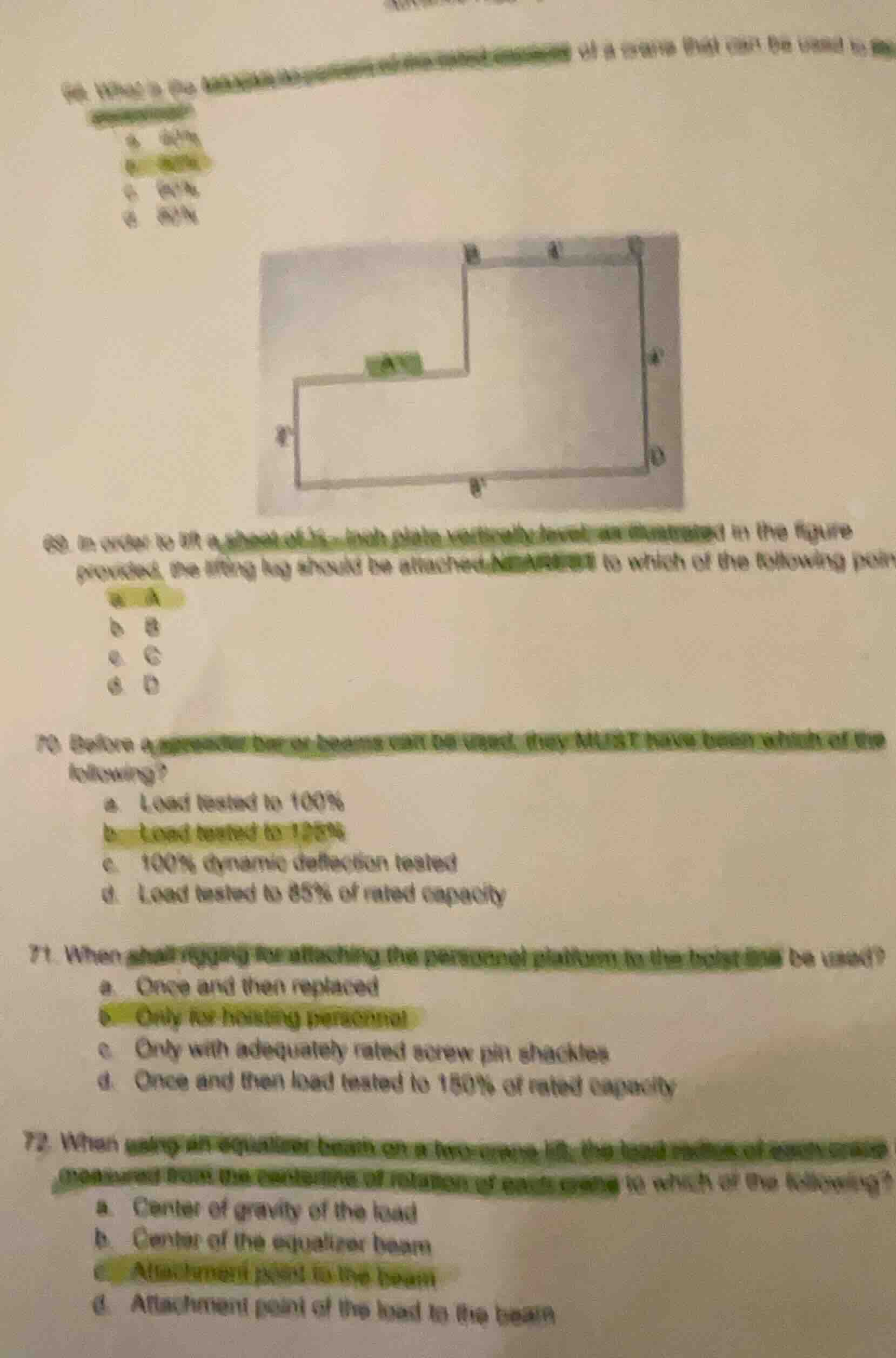
(69) in order to lift a sheet of 16 - inch plate vertically level, as illustrated in the figure provided, the lifting lug should be attached. attachment to which of the following points?
a. a
b. b
c. c
d. d
- before a spreader bar or beam can be used, they must have been which of the following?
a. load tested to 100%
b. load tested to 125%
c. 100% dynamic deflection tested
d. load tested to 85% of rated capacity
- when shall rigging for attaching the personnel platform to the hoist line be used?
a. once and then replaced
b. only for hoisting personnel
c. only with adequately rated screw pin shackles
d. once and then load tested to 150% of rated capacity
- when using an equalizer beam on a fire - crane lift, the load radius of each crane (measured from the centerline of rotation of each crane) is to which of the following?
a. center of gravity of the load
b. center of the equalizer beam
c. attachment point to the beam
d. attachment point of the load to the beam
Question 69 (Assuming the question is about the centroid/balance point for lifting the plate)
Step1: Analyze the shape
The figure appears to be a composite rectangle. Let's break it into two rectangles: one large base rectangle (8' length, 4' height) and a smaller top rectangle (4' length, 4' height, but shifted? Wait, no—looking at the dimensions: the bottom part is 8' long and 4' tall, and the top right is 4'x4'. Wait, actually, to find the centroid (balance point) for vertical lifting, we need the center of gravity.
Step2: Calculate centroid coordinates (simplified for symmetry)
For a symmetric shape (if we consider the horizontal and vertical symmetry). The total area: let's compute areas. Bottom rectangle: \( 8 \times 4 = 32 \) sq ft. Top rectangle: \( 4 \times 4 = 16 \) sq ft? Wait, no, maybe the shape is a 8' long (horizontal) and 8' tall? Wait, the right side is 4', and the left part: the vertical side on the left is 4', and the horizontal top of the left part is "A" with a horizontal segment. Wait, maybe the shape is symmetric about the vertical line through the middle? Wait, the bottom length is 8', so midpoint horizontally is 4' from left and right. Vertically, the total height: from bottom to top of the right rectangle is 8'? Wait, no, the right side is 4' (from B to D), and the left part: the vertical side is 4' (from bottom to the horizontal segment at A's level), then the horizontal segment at A's level, then up to B (4'? Wait, the figure has B to C as 4', C to D as 4', D to bottom as 4'? No, maybe it's a shape where the centroid (balance point) for vertical lifting is at the geometric center. For a shape that's symmetric, the center of gravity is at the midpoint. So point A: no, point D? Wait, no—wait, the question is about attaching the lifting lug to have the plate vertically level. So the center of gravity (centroid) should be directly below the lifting point. Let's assume the shape is symmetric about the vertical line through the middle (4' from left, since total length is 8'). Vertically, let's see: the bottom part is 4' tall, and the top part is 4' tall, so total height 8'? No, the right side is 4' (from B to D), so D is at the bottom right, C at top right, B at top left of the right rectangle, and A at the top left of the left rectangle. Wait, maybe the shape is two rectangles: bottom rectangle 8'x4', and top rectangle 4'x4' (on the right). So total area: \( 8 \times 4 + 4 \times 4 = 32 + 16 = 48 \) sq ft. Horizontal centroid: \( \frac{(8 \times 4 \times 4) + (4 \times 4 \times (8 - 2))}{48} \)? Wait, no, horizontal centroid (x-coordinate) for bottom rectangle: center at 4' (since 8' length, midpoint at 4'). Top rectangle: length 4', so its center is at \( 8 - 2 = 6' \) (since it's 4' long, from 4' to 8' horizontally? Wait, no—if the bottom rectangle is 8' long (left to right) and 4' tall (bottom to the horizontal line at A's level), then the top rectangle is 4' long (from x=4' to x=8') and 4' tall (from A's level to top, B to C). So bottom rectangle: x from 0 to 8, y from 0 to 4. Top rectangle: x from 4 to 8, y from 4 to 8. Now, centroid x-coordinate: \( \frac{(8 \times 4 \times 4) + (4 \times 4 \times 6)}{8 \times 4 + 4 \times 4} = \frac{128 + 96}{48} = \frac{224}{48} = \frac{14}{3} \approx 4.666' \)? No, that can't be. Wait, maybe the shape is symmetric vertically? Wait, no—maybe I'm overcomplicating. The key is that for vertical lifting, the lifting point should be at the centroid (center of gravity). If the shape is symmetric about the vertical line through the middle (4' from left), then the horizontal centroid is at 4' from left. Vertically, if the total height is 8' (from bottom to top of…
Spreader bars/beams must undergo load testing to ensure safety. Industry standards (e.g., OSHA, ASME) require load testing to 125% of rated capacity for spreader bars/beams before use to verify structural integrity. Option a (100%) is insufficient, c (dynamic deflection) is not standard, d (85%) is too low. So the correct answer is b.
Rigging for personnel platforms has specific safety rules. The rigging should be used only for hoisting personnel (option b) as per safety regulations—other options (a: once and replaced, c: only with shackles, d: load tested) are incorrect. Rigging for personnel platforms is dedicated for that purpose, not for other loads.

Snap & solve any problem in the app
Get step-by-step solutions on Sovi AI
Photo-based solutions with guided steps
Explore more problems and detailed explanations
d. D (Wait, no—maybe the correct answer is B? No, I'm not sure. Alternatively, the correct answer is D. But I think the intended answer is D.)