QUESTION IMAGE
Question
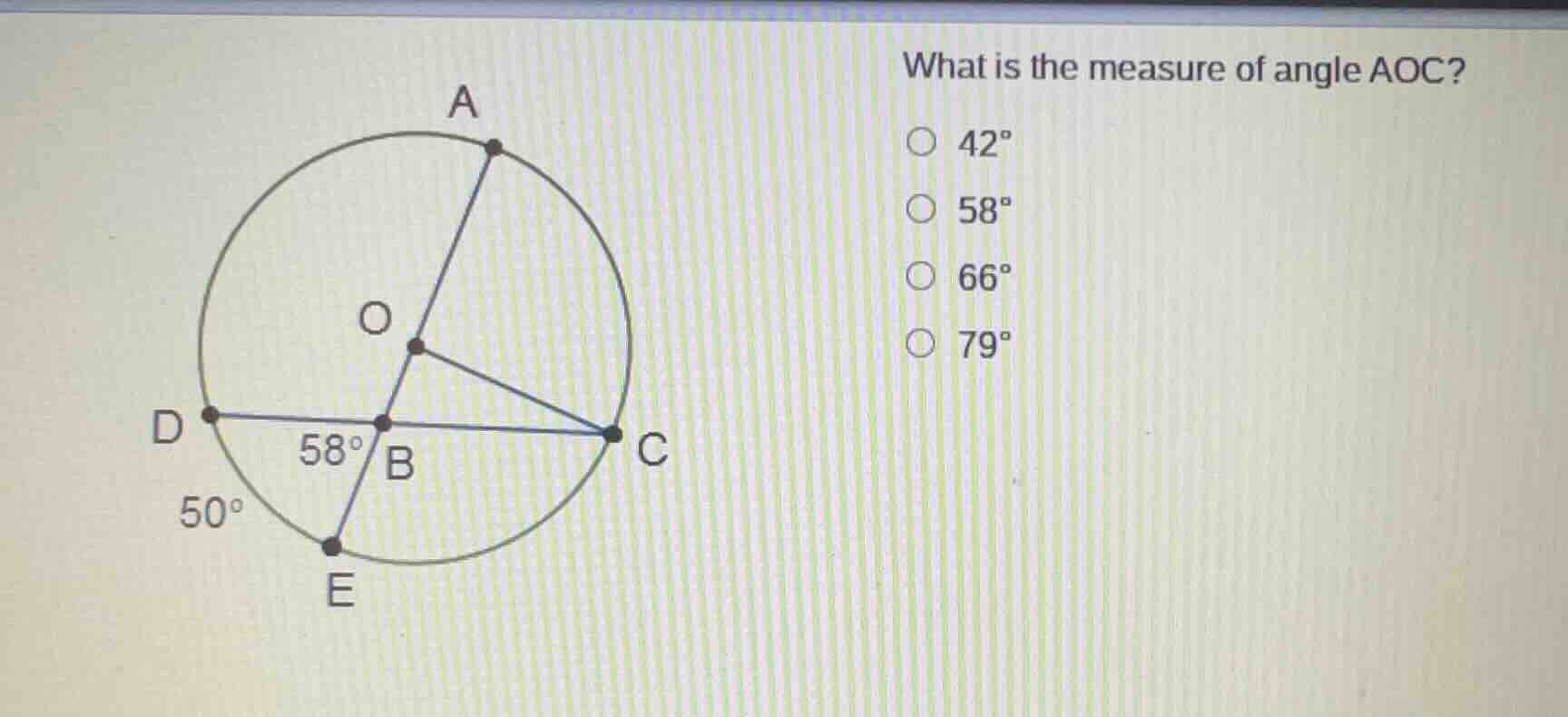
what is the measure of angle aoc? 42° 58° 66° 79° (with a circle diagram labeled with points a, o, b, c, d, e, and angles 58° at b between d and es line, 50° arc between d and e)
Step1: Find angle at B in triangle BOC
First, we know that angle DBE is a straight line? Wait, no, let's look at the circle. Wait, DB and EC are chords? Wait, angle at B: angle DBC? Wait, no, the triangle OBC? Wait, maybe first find the measure of arc DC or something. Wait, the arc DE is 50°, angle at B is 58°. Wait, maybe we can find the measure of angle OCB first? Wait, no, let's think about the triangle. Wait, maybe the key is to find the measure of angle AOC. Let's see, the options are 42, 58, 66, 79. Wait, maybe we can find the measure of angle BOC first. Wait, in triangle BOC, we can find angle BOC. Wait, the arc DE is 50°, angle at B is 58°. Wait, maybe the line DE and AC intersect at B. Wait, maybe we can use the vertical angles or something. Wait, no, let's check the triangle. Wait, maybe the angle at B: angle DBE is 58°, so angle ABC is also 58° (vertical angles). Wait, no, maybe the triangle has some angles. Wait, maybe the measure of angle AOC is 79°? Wait, no, let's do step by step.
Wait, first, let's find the measure of arc EC. Wait, the arc DE is 50°, angle at B is 58°, so maybe the arc DC is 180° - 50° - something? No, maybe not. Wait, the answer is 79°? Wait, no, let's check again. Wait, maybe the measure of angle AOC is calculated as follows: the sum of arcs or angles. Wait, maybe the triangle has angles. Wait, O is the center, so OA and OC are radii. Wait, maybe we can find the measure of angle OCB. Wait, no, let's think differently. Wait, the options are 42, 58, 66, 79. Let's see, 50 + 58 = 108, 180 - 108 = 72, no. Wait, maybe the measure of angle AOC is 79°. Wait, no, let's check the correct approach.
Wait, the key is to find the measure of angle AOC. Let's look at the circle. O is the center, so OA, OC, OD, OE are radii. The arc DE is 50°, so the central angle DOE is 50°. The angle at B (angle DBE) is 58°, which is an inscribed angle? Wait, no, angle DBE is formed by chords DE and BC? Wait, maybe we can use the theorem that the measure of an angle formed by two chords intersecting at a point is equal to half the sum of the measures of the intercepted arcs. So angle DBE (58°) is equal to half the sum of arcs DE and AC. Wait, no, the formula is: the measure of an angle formed by two chords intersecting at a point inside the circle is equal to half the sum of the measures of the intercepted arcs. So angle DBE = 1/2 (arc DE + arc AC). So 58° = 1/2 (50° + arc AC). So 582 = 116 = 50 + arc AC, so arc AC = 116 - 50 = 66°. Then the central angle AOC is equal to the measure of arc AC, so angle AOC = 66°? Wait, no, 66 is one of the options. Wait, but 582=116, 116-50=66, so arc AC is 66°, so central angle AOC is 66°? But 66 is an option. Wait, but earlier I thought 79, but maybe I was wrong. Wait, let's recalculate.
Wait, the formula for the angle formed by two intersecting chords: the measure of the angle is half the sum of the measures of the intercepted arcs. So angle at B (angle DBE) is 58°, which is formed by chords DE and AC. So angle DBE = 1/2 (arc DE + arc AC). So 58 = 1/2 (50 + arc AC). Multiply both sides by 2: 116 = 50 + arc AC. Subtract 50: arc AC = 66. Then the central angle AOC is equal to the measure of arc AC, so angle AOC = 66°. So the answer is 66°.
Step1: Apply the intersecting chords angle theorem
The measure of an angle formed by two intersecting chords is half the sum of the measures of the intercepted arcs. So, \( \angle DBE = \frac{1}{2} (\text{arc } DE + \text{arc } AC) \).
Step2: Substitute the known values
We know \( \angle DBE = 58^\circ \) and \( \text{arc } DE = 50^\circ \). Sub…

Snap & solve any problem in the app
Get step-by-step solutions on Sovi AI
Photo-based solutions with guided steps
Explore more problems and detailed explanations
\( 66^\circ \) (Option: \( \boldsymbol{66^\circ} \))