QUESTION IMAGE
Question
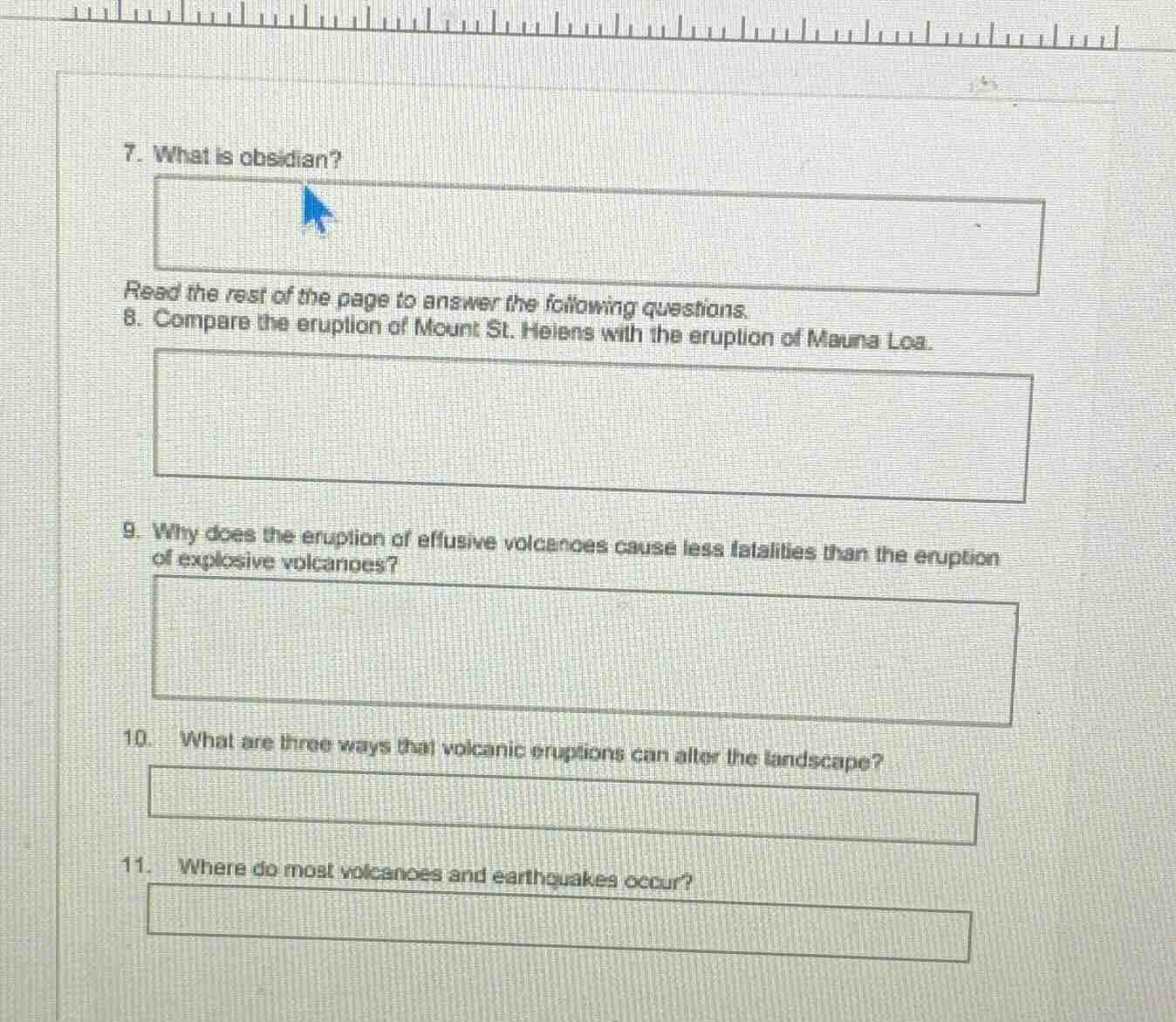
- what is obsidian?
read the rest of the page to answer the following questions.
- compare the eruption of mount st. helens with the eruption of mauna loa.
- why does the eruption of effusive volcanoes cause less fatalities than the eruption of explosive volcanoes?
- what are three ways that volcanic eruptions can alter the landscape?
- where do most volcanoes and earthquakes occur?
Brief Explanations
- Obsidian is a naturally occurring volcanic glass formed when felsic lava from a volcano cools rapidly with minimal crystal growth.
- Mount St. Helens had an explosive 1980 eruption: it was a violent, pyroclastic event that blew off the mountain's north face, sending ash, rock, and gas high into the atmosphere, causing massive destruction and fatalities. Mauna Loa is a shield volcano with effusive eruptions: it releases slow-moving, fluid basaltic lava that flows over large areas but rarely causes major fatalities as the lava moves slowly enough for evacuation.
- Effusive volcanoes release slow-moving, fluid lava that allows people to evacuate safely, with no sudden, violent blasts of ash, rock, or toxic gas. Explosive volcanoes have sudden, violent eruptions that hurl debris, release toxic gases, and trigger landslides/tsunamis with little warning, leading to more fatalities.
- 1. Lava flows can cover existing land and create new land (like Hawaii's islands). 2. Ash and pyroclastic deposits can bury existing landscapes and alter soil composition. 3. Eruptions can trigger landslides or create new landforms like craters, calderas, or volcanic cones.
- Most volcanoes and earthquakes occur along tectonic plate boundaries, particularly the Pacific Ring of Fire, where plates collide, diverge, or slide past each other, creating geological activity.

Snap & solve any problem in the app
Get step-by-step solutions on Sovi AI
Photo-based solutions with guided steps
Explore more problems and detailed explanations
- Obsidian is a volcanic glass formed by rapid cooling of felsic lava.
- Mount St. Helens: Violent explosive eruption (1980) with pyroclastic blasts, ash, and mountain collapse, causing heavy destruction/fatalities. Mauna Loa: Gentle effusive eruptions with slow-moving basaltic lava, minimal fatalities, creates new land.
- Effusive eruptions have slow, predictable lava for evacuation; explosive eruptions are sudden, violent, with deadly debris/gases and little warning.
- 1. Lava flows create/cover land. 2. Ash deposits bury/alter terrain. 3. Eruptions form new landforms (craters, cones).
- Most occur along tectonic plate boundaries, especially the Pacific Ring of Fire.