QUESTION IMAGE
Question
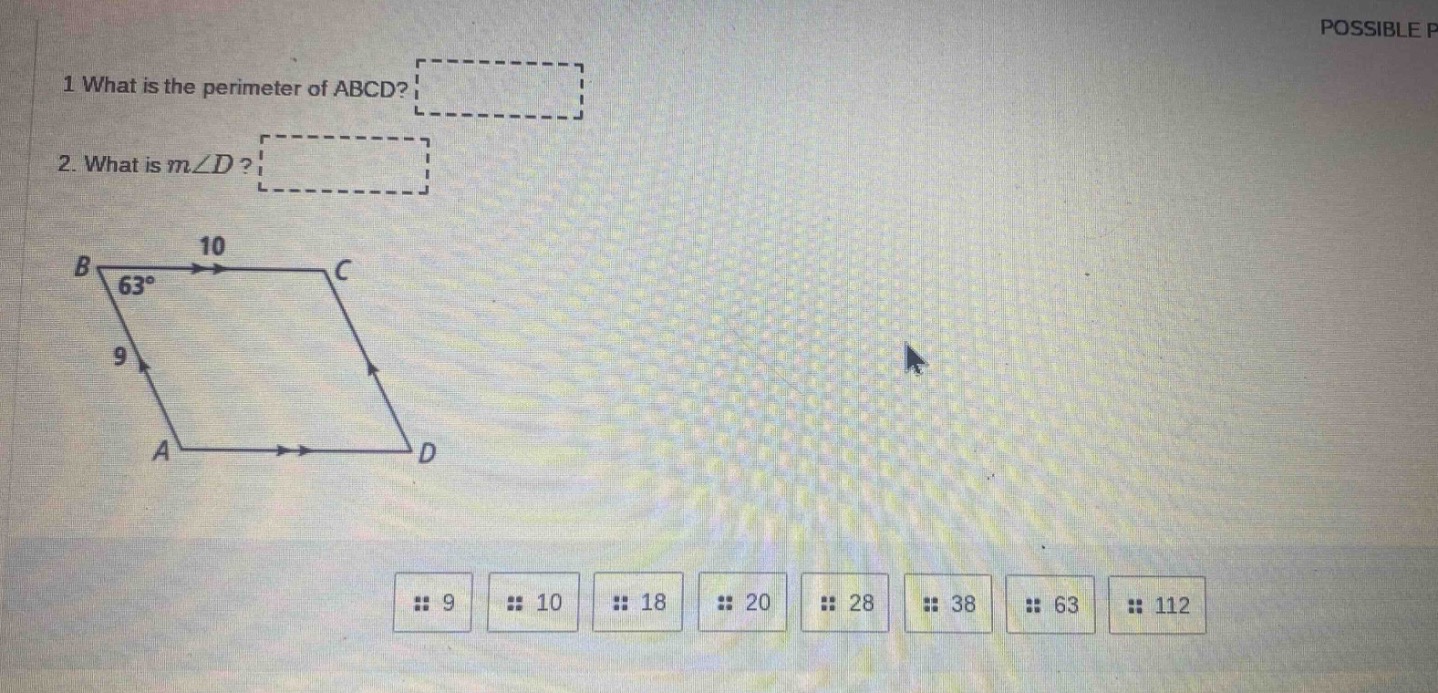
1 what is the perimeter of abcd?
- what is ( mangle d )?
(there is a parallelogram abcd with side lengths: ab = 9, bc = 10, and angle at b is ( 63^circ ))
(options: 9, 10, 18, 20, 28, 38, 63, 112)
Sub - question 1: Perimeter of ABCD
Step 1: Identify the shape
ABCD is a parallelogram, so opposite sides are equal. That means \(AB = CD = 9\) and \(BC=AD = 10\).
Step 2: Calculate the perimeter
The formula for the perimeter \(P\) of a parallelogram is \(P=2\times(a + b)\), where \(a\) and \(b\) are the lengths of adjacent sides. Here, \(a = 9\) and \(b = 10\). So \(P=2\times(9 + 10)=2\times19 = 38\).
Step 1: Properties of parallelogram
In a parallelogram, consecutive angles are supplementary, and opposite angles are equal. \(\angle B\) and \(\angle D\) are not opposite or consecutive in the way of supplementary for consecutive. Wait, actually, in parallelogram \(ABCD\), \(\angle B\) and \(\angle D\)? No, wait, \(\angle B\) and \(\angle A\) are supplementary, \(\angle B\) and \(\angle C\) are equal, \(\angle A\) and \(\angle D\) are equal. Wait, no, in parallelogram, opposite angles are equal. Wait, \(\angle B = 63^{\circ}\), and \(\angle D\) is equal to \(\angle B\)? No, wait, no. Wait, in parallelogram \(ABCD\), \(AB\parallel CD\) and \(AD\parallel BC\). So \(\angle B\) and \(\angle D\): Wait, no, \(\angle B\) and \(\angle A\) are consecutive angles (supplementary), \(\angle A\) and \(\angle D\) are consecutive angles? No, I made a mistake. Let's correct: In parallelogram, opposite angles are equal. So \(\angle B\) and \(\angle D\)? Wait, no, \(AB\) and \(CD\) are parallel, \(AD\) and \(BC\) are parallel. So \(\angle B\) and \(\angle D\): Wait, \(\angle B\) is at vertex \(B\), between \(AB\) and \(BC\). \(\angle D\) is at vertex \(D\), between \(AD\) and \(CD\). Since \(AB\parallel CD\) and \(AD\) is a transversal, \(\angle A+\angle D = 180^{\circ}\), and \(\angle A+\angle B=180^{\circ}\) (because \(AD\parallel BC\) and \(AB\) is a transversal). So \(\angle B=\angle D\)? Wait, no, if \(\angle A+\angle B = 180^{\circ}\) and \(\angle A+\angle D=180^{\circ}\), then \(\angle B=\angle D\). Wait, but \(\angle B = 63^{\circ}\), so \(\angle D=63^{\circ}\)? Wait, no, that can't be. Wait, no, I think I messed up. Wait, in the parallelogram, consecutive angles are supplementary. So \(\angle B\) and \(\angle C\) are supplementary? No, \(\angle B\) and \(\angle A\) are supplementary. Wait, let's look at the sides: \(AB\) and \(BC\) are adjacent sides. So \(\angle B\) is between \(AB\) and \(BC\). Then \(AD\) is parallel to \(BC\), so \(\angle A+\angle B = 180^{\circ}\), so \(\angle A=180 - 63=117^{\circ}\). Then \(\angle D\) is equal to \(\angle B\)? No, wait, no. Wait, opposite angles: \(\angle A=\angle C\), \(\angle B=\angle D\)? Wait, no, that's the property: In a parallelogram, opposite angles are equal. So \(\angle B=\angle D = 63^{\circ}\)? Wait, but that seems wrong. Wait, no, maybe I got the vertices wrong. Let's label the parallelogram: \(A - B - C - D - A\). So \(AB\) is connected to \(BC\), \(BC\) to \(CD\), \(CD\) to \(AD\), \(AD\) to \(AB\). So \(AB\parallel CD\), \(AD\parallel BC\). So \(\angle B\) and \(\angle D\): \(\angle B\) is at \(B\), between \(AB\) and \(BC\); \(\angle D\) is at \(D\), between \(CD\) and \(AD\). Since \(AB\parallel CD\) and \(BC\parallel AD\), \(\angle B\) and \(\angle D\) are equal? Wait, no, \(\angle B\) and \(\angle A\) are supplementary, \(\angle A\) and \(\angle D\) are supplementary, so \(\angle B=\angle D\). Yes, because if \(\angle A+\angle B = 180^{\circ}\) and \(\angle A+\angle D=180^{\circ}\), then \(\angle B=\angle D\) (by transitive property: \(\angle B = 180^{\circ}-\angle A\), \(\angle D=180^{\circ}-\angle A\), so \(\angle B=\angle D\)). So \(m\angle D = 63^{\circ}\).

Snap & solve any problem in the app
Get step-by-step solutions on Sovi AI
Photo-based solutions with guided steps
Explore more problems and detailed explanations
38