QUESTION IMAGE
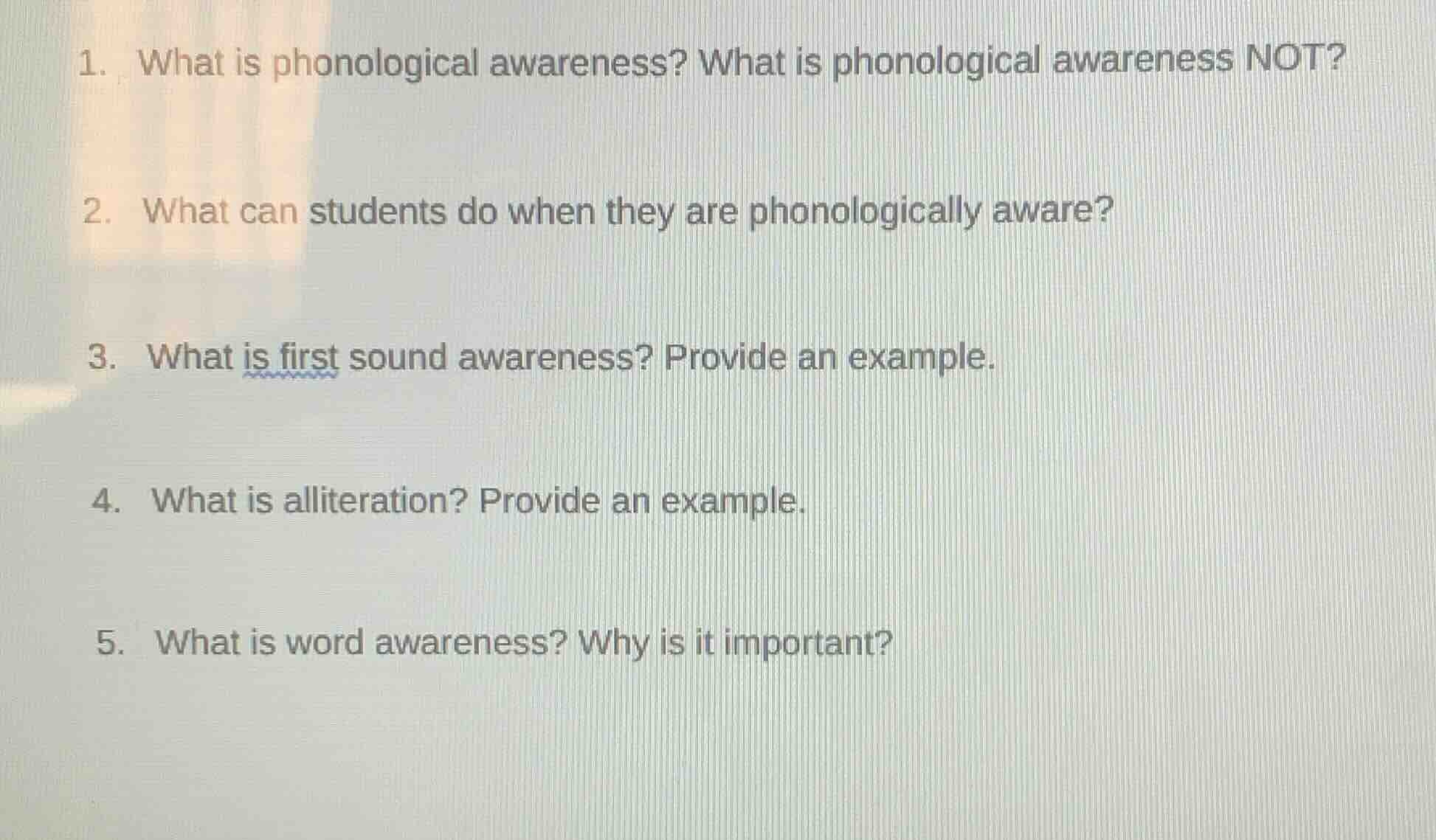
Question
- what is phonological awareness? what is phonological awareness not?
- what can students do when they are phonologically aware?
- what is first sound awareness? provide an example.
- what is alliteration? provide an example.
- what is word awareness? why is it important?
Brief Explanations
- Defines phonological awareness and clarifies what it excludes, focusing on oral sound skills vs. written language.
- Lists core skills demonstrated by phonologically aware students, tied to manipulating speech sounds.
- Explains first sound awareness and gives a concrete example of identifying initial speech sounds.
- Defines alliteration as a sound-based literary device and provides a common example.
- Explains word awareness and its foundational role in early literacy development.

Snap & solve any problem in the app
Get step-by-step solutions on Sovi AI
Photo-based solutions with guided steps
Explore more problems and detailed explanations
- Phonological awareness is the ability to recognize and manipulate the individual sound structures of spoken language (e.g., syllables, rhymes, phonemes). Phonological awareness is NOT related to written language (reading/writing letters/spelling) — it focuses solely on oral speech sounds.
- Phonologically aware students can: identify rhymes, count syllables in words, blend individual sounds to make words, segment words into individual sounds, and delete/substitute sounds to make new words.
- First sound awareness is the ability to recognize and identify the initial phoneme (speech sound) in a spoken word. Example: Recognizing that "cat", "car", and "cup" all start with the /k/ sound.
- Alliteration is a literary device where a series of words in a phrase or sentence start with the same initial consonant sound. Example: "Peter Piper picked a peck of pickled peppers" (most words start with the /p/ sound).
- Word awareness is the ability to recognize that spoken language is made up of individual, separate words (e.g., understanding that the sentence "The dog runs" is three distinct words, not one continuous sound stream). It is important because it is the foundational first step in phonological awareness, helping children break down oral language into manageable units before learning to connect sounds to written letters.