QUESTION IMAGE
Question
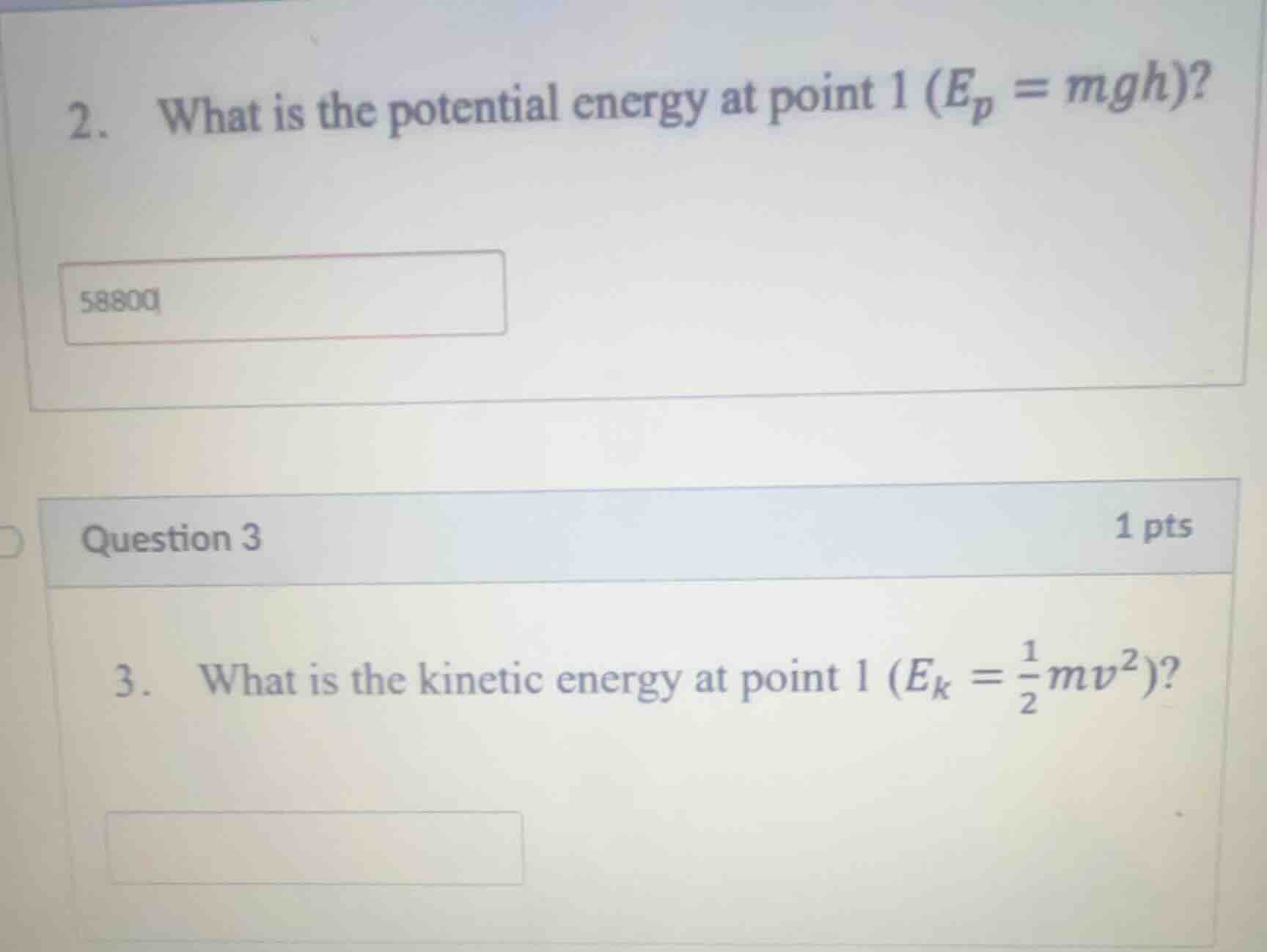
- what is the potential energy at point 1 ($e_p = mgh$)?
58800j
question 3
1 pts
- what is the kinetic energy at point 1 ($e_k = \frac{1}{2}mv^2$)?
To solve these problems, we need to know the values of mass (\(m\)), gravity (\(g\)), height (\(h\)) for potential energy, and velocity (\(v\)) for kinetic energy. Since the values of \(m\), \(g\), \(h\), and \(v\) are not provided in the question, we can't calculate the numerical answers. However, we can show the formulaic approach:
For Question 2 (Potential Energy at Point 1)
Step 1: Identify the formula
The formula for potential energy is given as \( E_p = mgh \), where \( m \) is mass, \( g \) is acceleration due to gravity (usually \( 9.8 \, \text{m/s}^2 \)), and \( h \) is the height at point 1.
Step 2: Substitute values
If we had the values of \( m \), \( g \), and \( h \), we would substitute them into the formula \( E_p = mgh \) to find the potential energy. For example, if \( m = 600 \, \text{kg} \), \( g = 9.8 \, \text{m/s}^2 \), and \( h = 10 \, \text{m} \), then \( E_p = 600 \times 9.8 \times 10 = 58800 \, \text{J} \) (which matches the hint in the box, so likely these are the values: \( m = 600 \, \text{kg} \), \( g = 9.8 \, \text{m/s}^2 \), \( h = 10 \, \text{m} \)).
For Question 3 (Kinetic Energy at Point 1)
Step 1: Identify the formula
The formula for kinetic energy is given as \( E_k = \frac{1}{2}mv^2 \), where \( m \) is mass and \( v \) is the velocity at point 1.
Step 2: Analyze the situation (assuming conservation of energy or given velocity)
If we assume that at point 1, the object is at rest (common in problems where it's at the highest point, like in a pendulum or roller coaster), then the velocity \( v = 0 \, \text{m/s} \). Substituting \( v = 0 \) into the formula:
\( E_k = \frac{1}{2}m(0)^2 = 0 \, \text{J} \).
If we use the same mass \( m = 600 \, \text{kg} \) as in the potential energy example and assume \( v = 0 \, \text{m/s} \), then \( E_k = \frac{1}{2} \times 600 \times 0^2 = 0 \, \text{J} \).
Final Answers (assuming the values from the potential energy hint and \( v = 0 \) at point 1):
For Question 2:

Snap & solve any problem in the app
Get step-by-step solutions on Sovi AI
Photo-based solutions with guided steps
Explore more problems and detailed explanations
\( 58800 \, \text{J} \) (using \( m = 600 \, \text{kg} \), \( g = 9.8 \, \text{m/s}^2 \), \( h = 10 \, \text{m} \))
For Question 3: