QUESTION IMAGE
Question
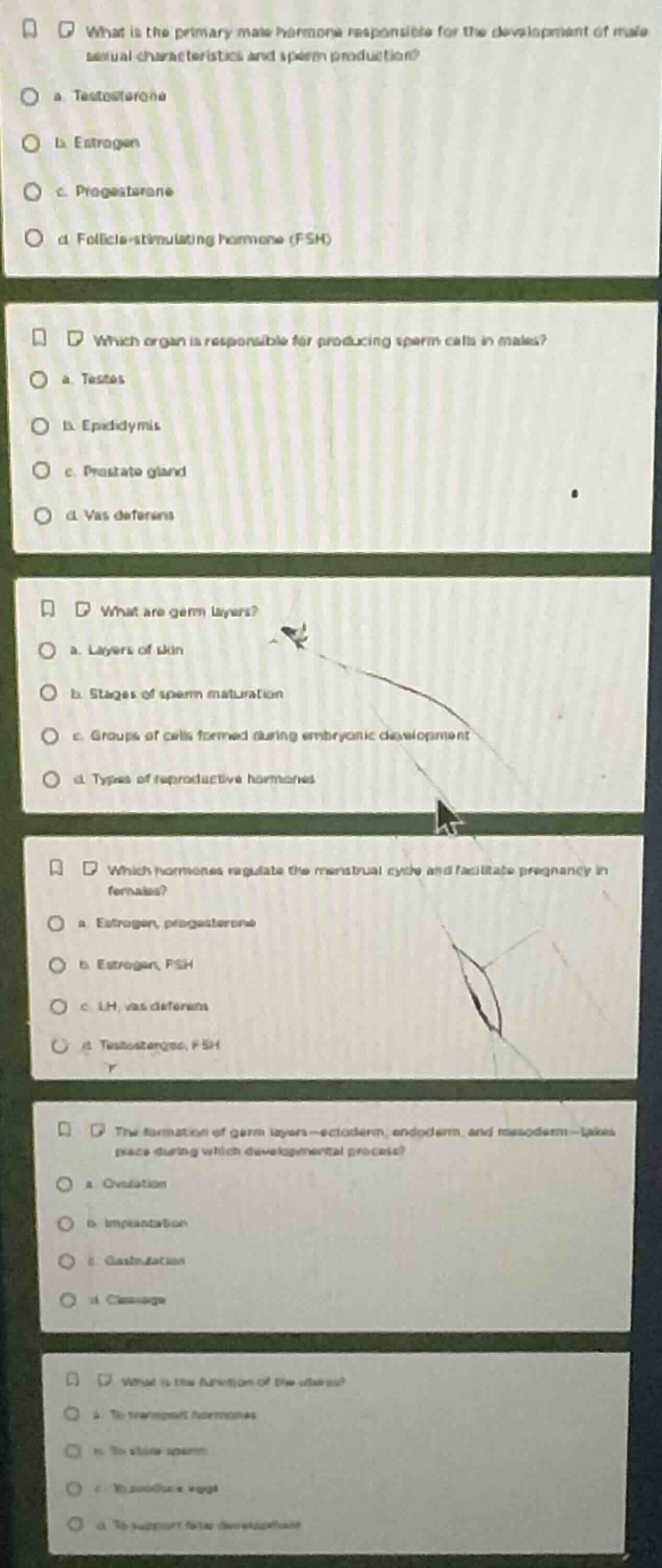
what is the primary male hormone responsible for the development of male sexual characteristics and sperm production?
a. testosterone
b. estrogen
c. progesterone
d. follicle - stimulating hormone (fsh)
which organ is responsible for producing sperm cells in males?
a. testes
b. epididymis
c. prostate gland
d. vas deferens
what are germ layers?
a. layers of skin
b. stages of sperm maturation
c. groups of cells formed during embryonic development
d. types of reproductive hormones
which hormones regulate the menstrual cycle and facilitate pregnancy in females?
a. estrogen, progesterone
b. estrogen, fsh
c. lh, vas deferens
d. testosterone, fsh
the formation of germ layers—ectoderm, endoderm, and mesoderm—takes place during which developmental process?
a. ovulation
b. implantation
c. gastrulation
d. cleavage
what is the function of the uterus?
a. to transport hormones
b. to store sperm
c. to produce an egg
d. to support fetal development
- The primary male hormone for male sexual traits and sperm production is testosterone; estrogen and progesterone are female hormones, FSH supports sperm production but is not the primary male hormone.
- The testes are the male reproductive organs that produce sperm; the epididymis stores mature sperm, prostate gland makes seminal fluid, vas deferens transports sperm.
- Germ layers are cell groups formed early in embryonic development that give rise to all body tissues; they are not skin layers, sperm maturation stages, or reproductive hormones.
- Estrogen and progesterone regulate the female menstrual cycle and support pregnancy; FSH and LH play roles but are not the main regulators for this function, and testosterone is a male hormone.
- Gastrulation is the embryonic process where the three germ layers (ectoderm, endoderm, mesoderm) form; ovulation is egg release, implantation is embryo attaching to uterus, cleavage is early cell division of the zygote.
- The uterus is the organ that supports fetal development during pregnancy; it does not transport hormones, store sperm, or produce eggs (ovaries produce eggs).

Snap & solve any problem in the app
Get step-by-step solutions on Sovi AI
Photo-based solutions with guided steps
Explore more problems and detailed explanations
- a. Testosterone
- a. Testes
- c. Groups of cells formed during embryonic development
- a. Estrogen, progesterone
- c. Gastrulation
- d. To support fetal development