QUESTION IMAGE
Question
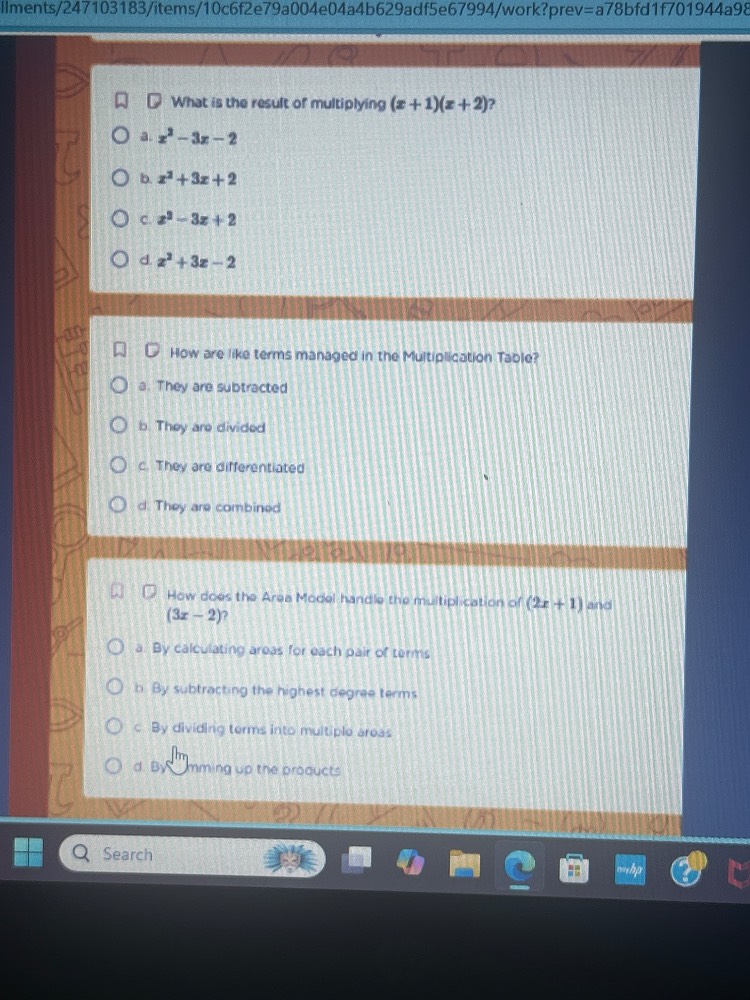
- what is the result of multiplying $(x+1)(x+2)?$
o a. $x^{2}-3x-2$
o b. $x^{2}+3x+2$
o c. $x^{2}-3x+2$
o d. $x^{2}+3x-2$
- how are like terms managed in the multiplication table?
o a. they are subtracted
o b. they are divided
o c. they are differentiated
o d. they are combined
- how does the area model handle the multiplication of $(2x + 1)$ and $(3x - 2)?$
o a. by calculating areas for each pair of terms
o b. by subtracting the highest degree terms
o c. by dividing terms into multiple areas
o d. by summing up the products
Step1: Expand using distributive property
$(x+1)(x+2) = x(x+2) + 1(x+2)$
Step2: Distribute terms
$= x^2 + 2x + x + 2$
Step3: Combine like terms
$= x^2 + 3x + 2$
Brief Explanations
- For the first question, expanding the binomial product and combining like terms gives the simplified polynomial.
- For the second question, in multiplication tables (and polynomial multiplication), like terms are grouped together through addition to simplify the result.
- For the third question, the Area Model for multiplication represents each term as a side length of a rectangle, and the total product is found by calculating the area of each sub-rectangle (each pair of terms multiplied) and summing them, with the core action being calculating areas for each term pair.

Snap & solve any problem in the app
Get step-by-step solutions on Sovi AI
Photo-based solutions with guided steps
Explore more problems and detailed explanations
- b. $x^2+3x+2$
- d. They are combined
- a. By calculating areas for each pair of terms