QUESTION IMAGE
Question
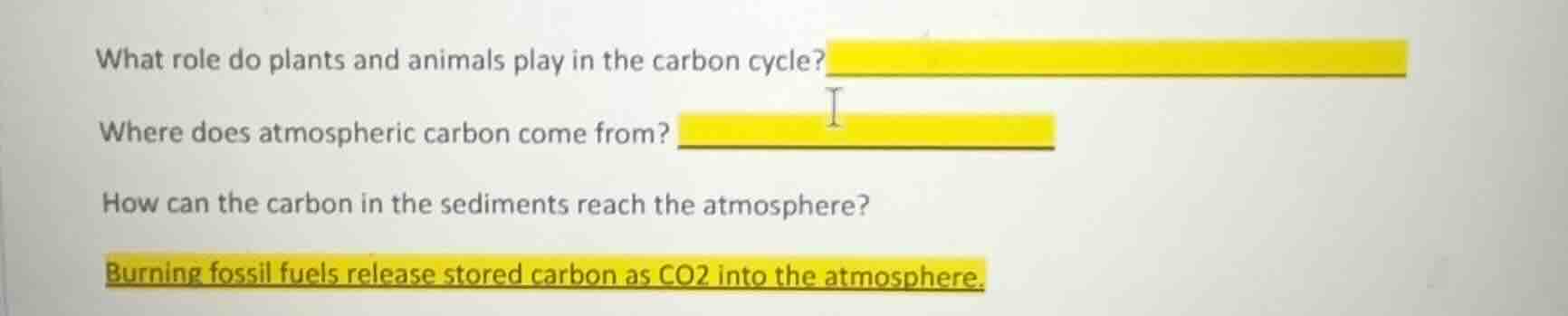
what role do plants and animals play in the carbon cycle?
where does atmospheric carbon come from?
how can the carbon in the sediments reach the atmosphere?
burning fossil fuels release stored carbon as co2 into the atmosphere.
1. Role of plants and animals in the carbon cycle
Plants: Through photosynthesis, plants take in $CO_2$ from the atmosphere and convert it into organic compounds (like glucose, $C_6H_{12}O_6$), storing carbon. This process is represented as $6CO_2 + 6H_2O \xrightarrow[\text{Chlorophyll}]{\text{Sunlight}} C_6H_{12}O_6 + 6O_2$. They also release carbon back via respiration ($C_6H_{12}O_6 + 6O_2
ightarrow 6CO_2 + 6H_2O + \text{Energy}$).
Animals: Animals consume plants (or other animals) to obtain organic carbon. During respiration, they break down these organic compounds, releasing $CO_2$ back into the atmosphere. When animals die, their bodies decompose, and decomposers (like bacteria and fungi) break down the organic matter, releasing carbon as $CO_2$ or incorporating it into the soil (which can later be part of sedimentary carbon stores over long periods).
Atmospheric carbon (as $CO_2$) comes from multiple sources:
- Respiration: All living organisms (plants, animals, microbes) respire, breaking down organic matter and releasing $CO_2$. For example, the respiration equation for glucose is $C_6H_{12}O_6 + 6O_2
ightarrow 6CO_2 + 6H_2O + \text{Energy}$.
- Combustion: Natural (like wildfires) and human - caused (burning fossil fuels, wood) combustion releases $CO_2$. Burning fossil fuels (coal, oil, natural gas) releases carbon that was stored in these fuels for millions of years.
- Decomposition: When organic matter (like dead plants and animals) decomposes, decomposers (bacteria, fungi) break it down and release $CO_2$.
- Volcanic activity: Volcanoes can release $CO_2$ (and other gases) from the Earth's interior into the atmosphere.
Sediments containing carbon (such as fossil fuels like coal, oil, and natural gas, or sedimentary rock with organic carbon) can release carbon to the atmosphere mainly through:
- Fossil fuel combustion: When humans mine and burn fossil fuels (coal, oil, natural gas), the carbon stored in these fuels (which were formed from ancient organic matter in sediments) is oxidized and released as $CO_2$. The reaction for burning methane (a component of natural gas) is $CH_4 + 2O_2
ightarrow CO_2 + 2H_2O$.
- Geological processes (over long timescales): Over millions of years, tectonic activity can subduct sedimentary rocks into the Earth's mantle. The high temperatures and pressures can cause the carbon in these rocks to be released as $CO_2$ through volcanic activity (when magma rises to the surface, it can carry this $CO_2$ with it).

Snap & solve any problem in the app
Get step-by-step solutions on Sovi AI
Photo-based solutions with guided steps
Explore more problems and detailed explanations
Plants: Photosynthesize to take in $CO_2$ (store carbon) and respire to release $CO_2$. Animals: Consume organic carbon, respire to release $CO_2$, and their decomposition contributes to carbon cycling.