QUESTION IMAGE
Question
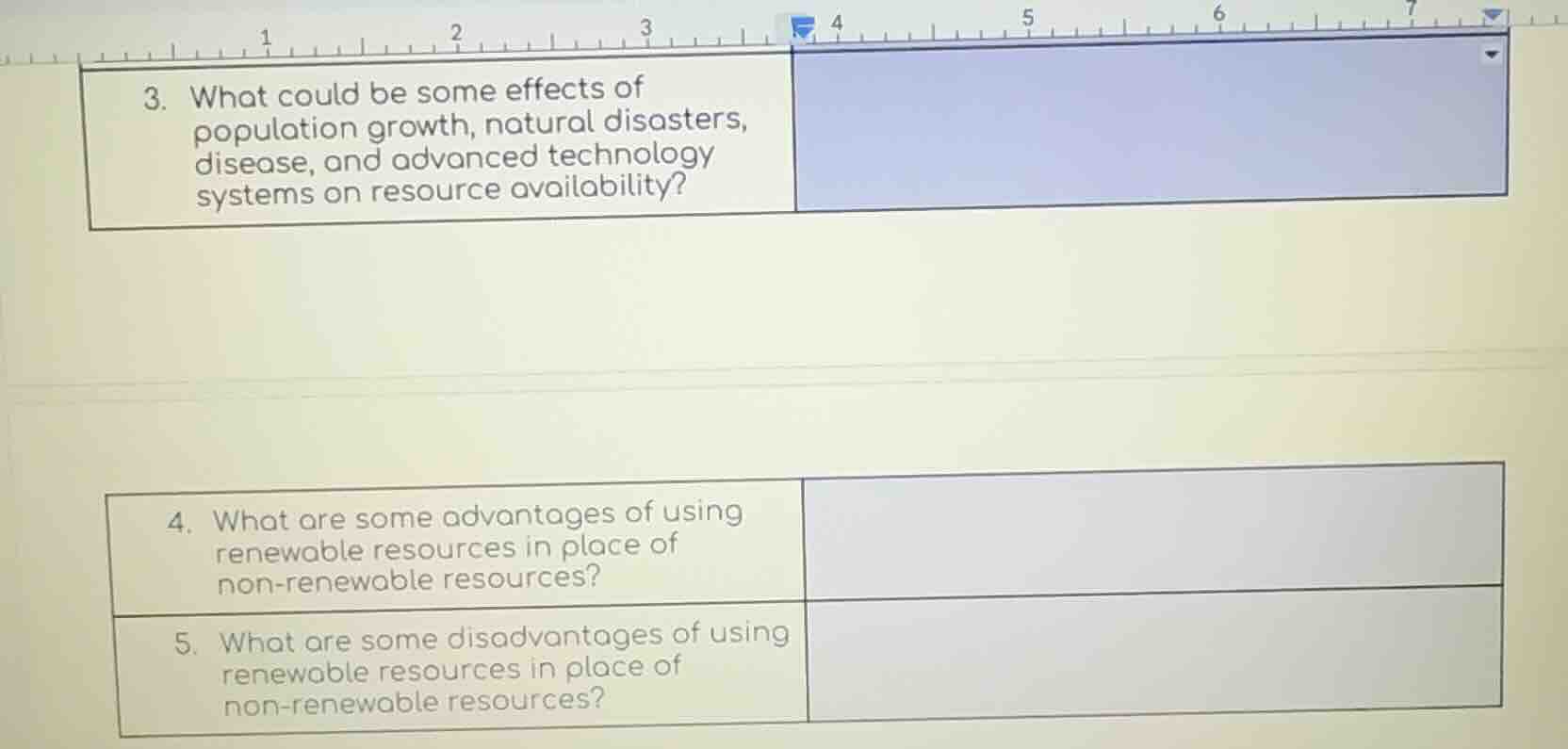
- what could be some effects of population growth, natural disasters, disease, and advanced technology systems on resource availability?
- what are some advantages of using renewable resources in place of non - renewable resources?
- what are some disadvantages of using renewable resources in place of non - renewable resources?
Brief Explanations
For Question 3:
- Population growth increases overall demand for food, water, energy, and land, straining resource supplies.
- Natural disasters can destroy resource infrastructure (e.g., crop fields, water treatment plants) and deplete local resources temporarily or permanently.
- Disease can reduce labor for resource production, and redirect resources (like medical supplies, food) to crisis response.
- Advanced technology can increase resource extraction efficiency, enable resource recycling, or create synthetic alternatives, but may also increase resource consumption rates.
For Question 4:
- Renewable resources (e.g., solar, wind) are naturally replenished, so they have a nearly infinite long-term supply compared to finite non-renewables.
- They produce far fewer greenhouse gas emissions, reducing climate change impacts.
- They decrease reliance on imported non-renewables, enhancing energy security.
- They create long-term, local job opportunities in installation and maintenance.
For Question 5:
- Most renewable energy sources (solar, wind) are intermittent, dependent on weather and time, requiring expensive energy storage solutions.
- The upfront cost of renewable infrastructure (solar panels, wind turbines) is often high.
- Some renewables (e.g., large hydro, biofuels) can cause environmental harm, like habitat destruction or deforestation.
- They may require more land or space to generate the same amount of energy as non-renewable facilities.

Snap & solve any problem in the app
Get step-by-step solutions on Sovi AI
Photo-based solutions with guided steps
Explore more problems and detailed explanations
3.
- Population growth: Raises resource demand, straining supplies.
- Natural disasters: Destroys resource infrastructure, depletes local resources.
- Disease: Reduces resource production labor, redirects resources to crisis response.
- Advanced technology: Boosts resource efficiency/recycling, but may increase consumption rates.
4.
- Near-infinite long-term supply via natural replenishment.
- Lower greenhouse gas emissions, reducing climate harm.
- Reduces reliance on imported non-renewables, improving energy security.
- Creates local, long-term jobs in installation/maintenance.
5.
- Intermittent supply (weather/time-dependent) needs costly storage.
- High upfront infrastructure costs.
- Some renewables cause habitat destruction or deforestation.
- Requires more land for equivalent energy output.