QUESTION IMAGE
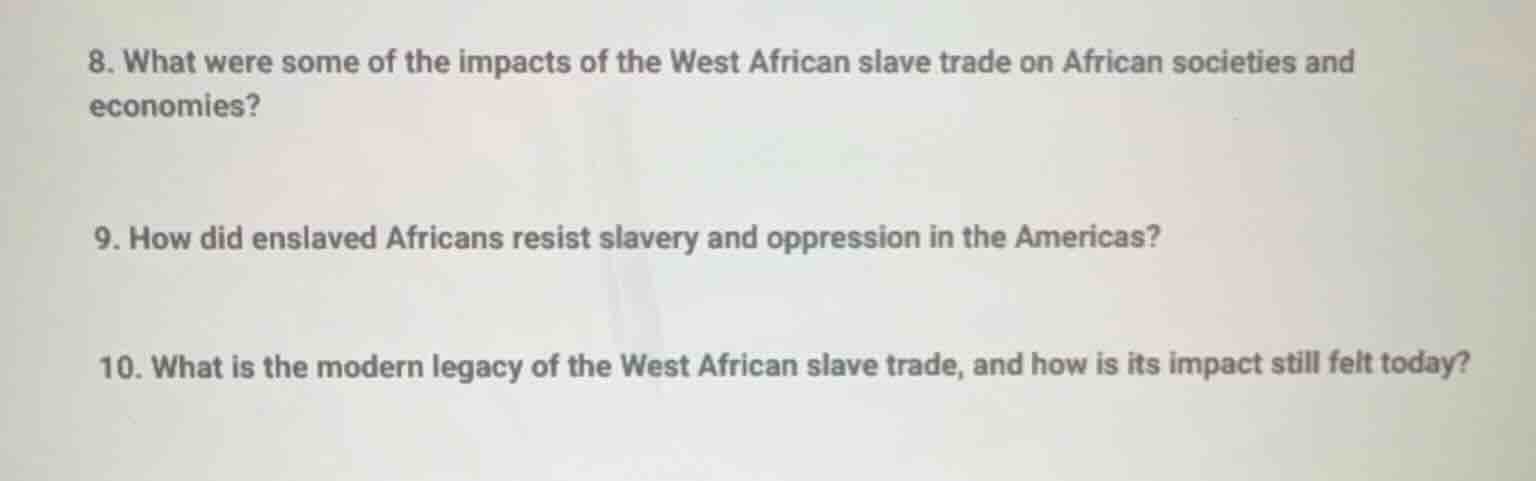
Question
- what were some of the impacts of the west african slave trade on african societies and economies?
- how did enslaved africans resist slavery and oppression in the americas?
- what is the modern legacy of the west african slave trade, and how is its impact still felt today?
Brief Explanations
For Question 8:
- Societal Impacts: The slave trade depleted West African societies of young, working-age people, disrupting family structures and weakening community cohesion. Many ethnic groups faced violent raids, leading to increased conflict and political instability as kingdoms raided rivals to capture enslaved people for trade. Cultural erasure occurred as enslaved people were separated from their languages, traditions, and spiritual practices.
- Economic Impacts: African economies became distorted, shifting from diverse production to a focus on capturing and trading people, which undermined agricultural and craft industries. European powers imposed unequal trade terms, so African societies did not develop sustainable, independent economic systems, creating long-term underdevelopment.
For Question 9:
- Everyday Resistance: Enslaved Africans engaged in subtle acts like slowing work pace, feigning illness, breaking tools, or stealing food to disrupt plantation operations and assert autonomy.
- Cultural Resistance: They preserved African languages, music, religious practices (blending them with European traditions to create new forms like Vodou or Gospel music), and oral histories to maintain their cultural identity.
- Open Resistance: This included organized revolts (such as the Haitian Revolution, the largest successful slave revolt in history), escape attempts to form maroon communities (independent settlements of formerly enslaved people), and armed uprisings against enslavers.
For Question 10:
- Racial Inequity: The slave trade created a foundational ideology of white supremacy that persists today, manifesting in systemic racism in areas like housing, education, employment, and criminal justice in the Americas and globally.
- Economic Disparities: The wealth generated from slave labor built the economic foundations of Western nations, while African societies and their diaspora communities faced generational poverty and limited access to resources.
- Cultural Identity: The diaspora created by the slave trade led to the development of distinct African diasporic cultures (e.g., African American, Afro-Caribbean) that have shaped global art, music, and cuisine, but also left ongoing intergenerational trauma from the violence and displacement of the trade.

Snap & solve any problem in the app
Get step-by-step solutions on Sovi AI
Photo-based solutions with guided steps
Explore more problems and detailed explanations
Question 8:
- Societal impacts: Depopulation of working-age people, broken family structures, increased inter-ethnic conflict, cultural erasure, and political instability.
- Economic impacts: Distorted economies focused on human trafficking, decline of local industries, unequal trade relations, and long-term underdevelopment.
Question 9:
- Everyday acts of resistance: Work slowdowns, feigning illness, sabotaging tools, and theft.
- Cultural resistance: Preservation of African languages, spiritual practices, and oral traditions, often blended with European customs.
- Open resistance: Organized revolts (e.g., Haitian Revolution), escape to maroon communities, and armed uprisings.
Question 10:
- Modern racial inequity: Systemic racism rooted in white supremacist ideologies from the slave trade, affecting housing, education, and criminal justice.
- Economic disparities: Generational wealth gaps, with Western nations benefiting from slave labor while African diaspora and African societies face ongoing underdevelopment.
- Cultural and intergenerational impacts: Rich African diasporic cultural contributions, paired with intergenerational trauma from displacement and violence.