QUESTION IMAGE
Question
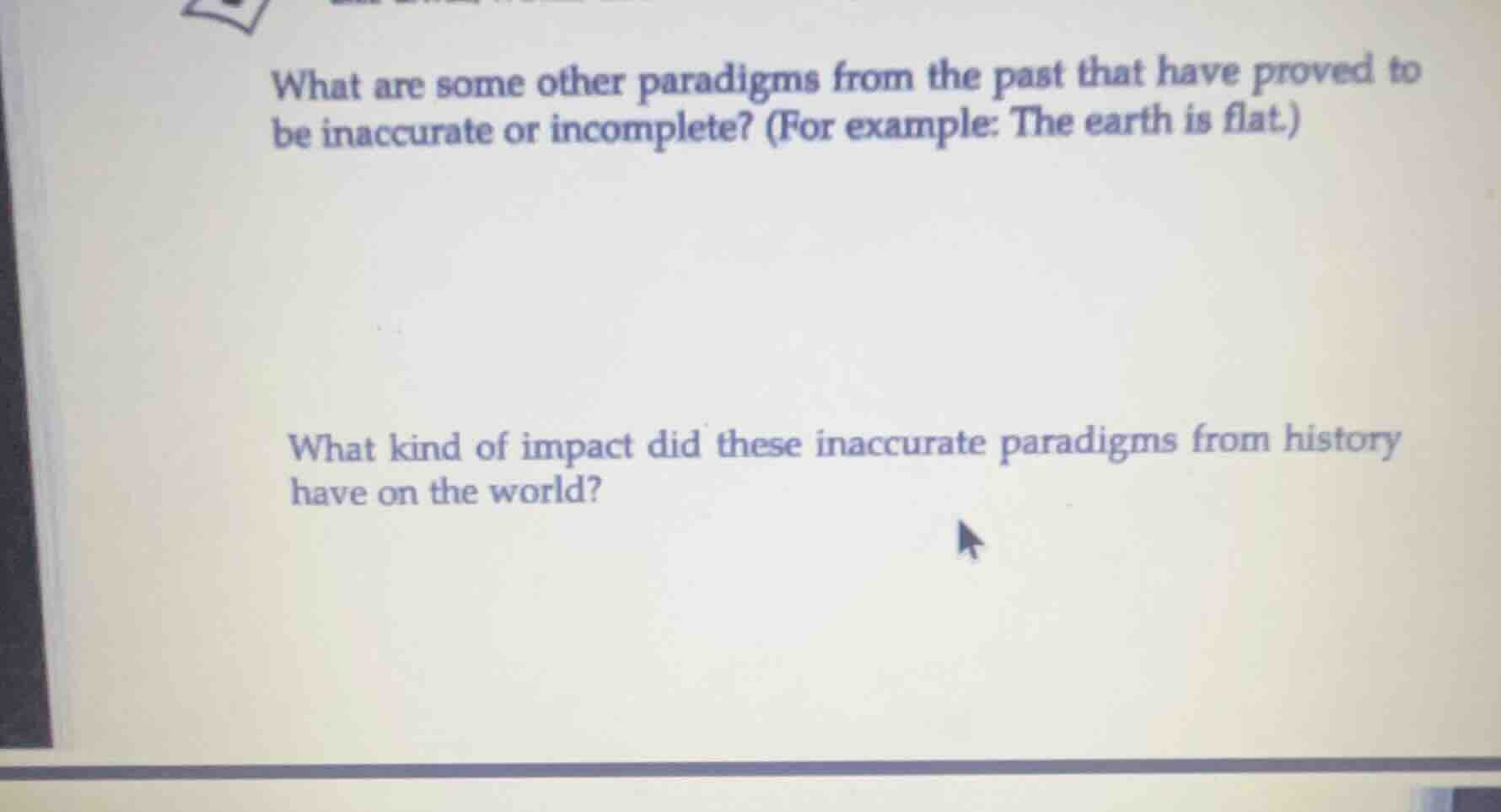
what are some other paradigms from the past that have proved to be inaccurate or incomplete? (for example: the earth is flat.) what kind of impact did these inaccurate paradigms from history have on the world?
Brief Explanations
- For the first question, inaccurate historical paradigms are outdated scientific or societal models disproven by later evidence.
- For the second question, their impacts include slowing scientific progress, enabling harmful social systems, and shaping cultural or political norms until corrected.

Snap & solve any problem in the app
Get step-by-step solutions on Sovi AI
Photo-based solutions with guided steps
Explore more problems and detailed explanations
- Examples of inaccurate/incomplete past paradigms:
- The geocentric model: The belief that the Earth was the stationary center of the universe, replaced by the heliocentric model.
- Phrenology: The idea that skull shape determines personality and intelligence, which has no scientific basis.
- Spontaneous generation: The claim that living organisms arise from non-living matter, disproven by experiments like Louis Pasteur's.
- The theory of humors: The ancient medical idea that health depended on balancing four bodily fluids (blood, phlegm, yellow bile, black bile), which was incorrect about human physiology.
- Impacts of these inaccurate paradigms:
- The geocentric model restricted astronomical research for centuries; challenging it (e.g., by Galileo) led to conflict with religious authorities, slowing the advancement of modern astronomy.
- Phrenology was used to justify racial discrimination and eugenics movements, as it was misapplied to claim supposed "superiority" of certain groups based on skull measurements.
- Spontaneous generation delayed the development of modern microbiology and germ theory, as scientists focused on disproving this idea instead of studying actual microbial origins.
- The theory of humors led to ineffective and sometimes harmful medical treatments (like bloodletting) that persisted for millennia, preventing the adoption of evidence-based healthcare practices.