QUESTION IMAGE
Question
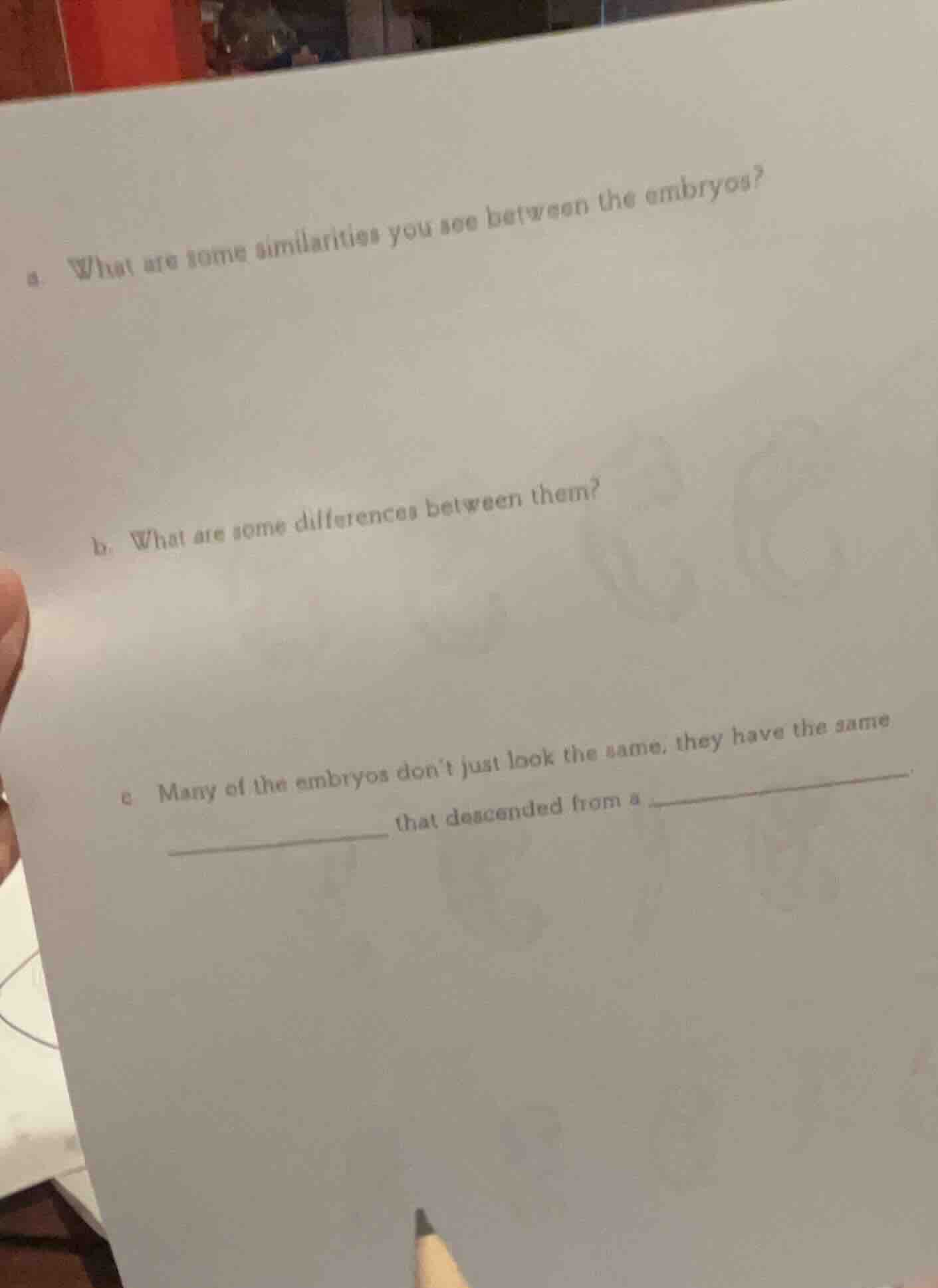
a. what are some similarities you see between the embryos?
b. what are some differences between them?
c. many of the embryos dont just look the same, they have the same
______________ that descended from a ______________.
Part a
To answer this, we consider typical embryonic similarities across species (e.g., vertebrates). Common similarities include having a notochord (in chordates), pharyngeal slits, a post - anal tail, and a dorsal nerve cord at some stage. They also often have a similar early - stage body plan with a head - like region and a developing digestive tract.
Differences arise due to species - specific development. For example, fish embryos develop gills for aquatic respiration, while mammal embryos develop lungs. Bird embryos have an amniotic sac and a shell - like structure for development, while human embryos have a placenta - based development. The size and shape of the embryos can also differ, as well as the timing of development of certain structures (e.g., limb buds in different vertebrate embryos).
This question relates to evolutionary biology and embryonic development. The concept of common embryonic structures (homologous structures in development) is tied to a common ancestor. Many embryos have the same developmental structures (like the notochord, pharyngeal arches) that descended from a common ancestor. So the first blank is "developmental structures" and the second blank is "common ancestor".

Snap & solve any problem in the app
Get step-by-step solutions on Sovi AI
Photo-based solutions with guided steps
Explore more problems and detailed explanations
Common similarities among embryos (e.g., vertebrate embryos) include having a notochord (in chordate embryos), pharyngeal slits, a post - anal tail, a dorsal nerve cord, and a relatively similar early - stage body plan with a developing head and digestive tract.