QUESTION IMAGE
Question
what did they find when they got to where they were going?
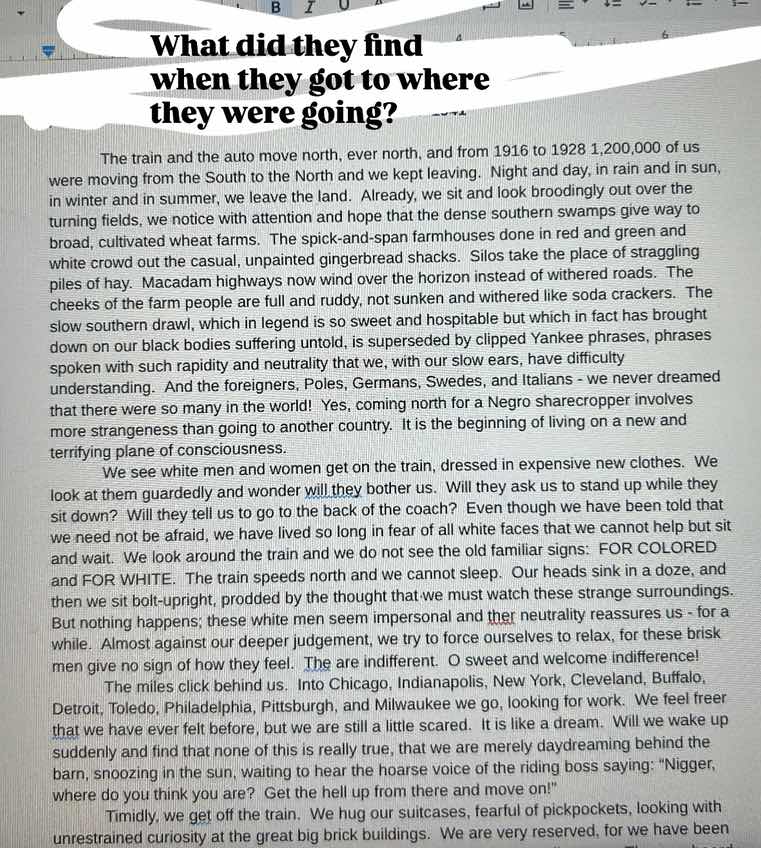
the train and the auto move north, ever north, and from 1916 to 1928 1,200,000 of us were moving from the south to the north and we kept leaving. night and day, in rain and in sun, in winter and in summer, we leave the land. already, we sit and look broodingly out over the turning fields, we notice with attention and hope that the dense southern swamps give way to broad, cultivated wheat farms. the spick-and-span farmhouses done in red and green and white crowd out the casual, unpainted gingerbread shacks. silos take the place of straggling piles of hay. macadam highways now wind over the horizon instead of withered roads. the cheeks of the farm people are full and ruddy, not sunken and withered like soda crackers. the slow southern drawl, which in legend is so sweet and hospitable but which in fact has brought down on our black bodies suffering untold, is superseded by clipped yankee phrases, phrases spoken with such rapidity and neutrality that we, with our slow ears, have difficulty understanding. and the foreigners, poles, germans, swedes, and italians - we never dreamed that there were so many in the world! yes, coming north for a negro sharecropper involves more strangeness than going to another country. it is the beginning of living on a new and terrifying plane of consciousness.
we see white men and women get on the train, dressed in expensive new clothes. we look at them guardedly and wonder will they bother us. will they ask us to stand up while they sit down? will they tell us to go to the back of the coach? even though we have been told that we need not be afraid, we have lived so long in fear of all white faces that we cannot help but sit and wait. we look around the train and we do not see the old familiar signs: for colored and for white. the train speeds north and we cannot sleep. our heads sink in a doze, and then we sit bolt-upright, prodded by the thought that we must watch these strange surroundings. but nothing happens; these white men seem impersonal and their neutrality reassures us - for a while. almost against our deeper judgement, we try to force ourselves to relax, for these brisk men give no sign of how they feel. they are indifferent. o sweet and welcome indifference!
the miles click behind us. into chicago, indianapolis, new york, cleveland, buffalo, detroit, toledo, philadelphia, pittsburgh, and milwaukee we go, looking for work. we feel freer that we have ever felt before, but we are still a little scared. it is like a dream. will we wake up suddenly and find that none of this is really true, that we are merely daydreaming behind the barn, snoozing in the sun, waiting to hear the hoarse voice of the riding boss saying:
igger, where do you think you are? get the hell up from there and move on!\
timidly, we get off the train. we hug our suitcases, fearful of pickpockets, looking with unrestrained curiosity at the great big brick buildings. we are very reserved, for we have been
The text describes the Great Migration of Black Americans from the South to the North (1916-1928). When they reached their northern destinations, they found:
- A drastically different landscape: replaced southern swamps with cultivated wheat farms, neat painted farmhouses instead of shabby shacks, macadam highways, and silos.
- A new cultural environment: fast-paced, neutral Yankee speech that was hard to understand, and a diverse population including European immigrants (Poles, Germans, Swedes, Italians).
- Absence of the racial segregation signs (like "FOR COLORED" and "FOR WHITE") common in the South, with initially indifferent white people.
- Large, imposing northern cities (Chicago, New York, Detroit, etc.) where they looked for work, feeling a mix of newfound freedom, fear, disorientation, and timidity.

Snap & solve any problem in the app
Get step-by-step solutions on Sovi AI
Photo-based solutions with guided steps
Explore more problems and detailed explanations
When they arrived in the Northern destinations, they found:
- A transformed landscape: cultivated wheat farms, tidy painted farmhouses, macadam highways, and silos replacing Southern swamps and shabby shacks.
- A new cultural and linguistic environment: fast, neutral Yankee speech they struggled to understand, and a diverse population including European immigrants they had never encountered before.
- No racial segregation signs (e.g., "FOR COLORED", "FOR WHITE") that were ubiquitous in the South, with white people who initially seemed indifferent rather than overtly hostile.
- Large, imposing northern cities (Chicago, New York, Detroit, etc.) where they sought work, feeling a mix of unfamiliar freedom, lingering fear, disorientation, and timidity.