QUESTION IMAGE
Question
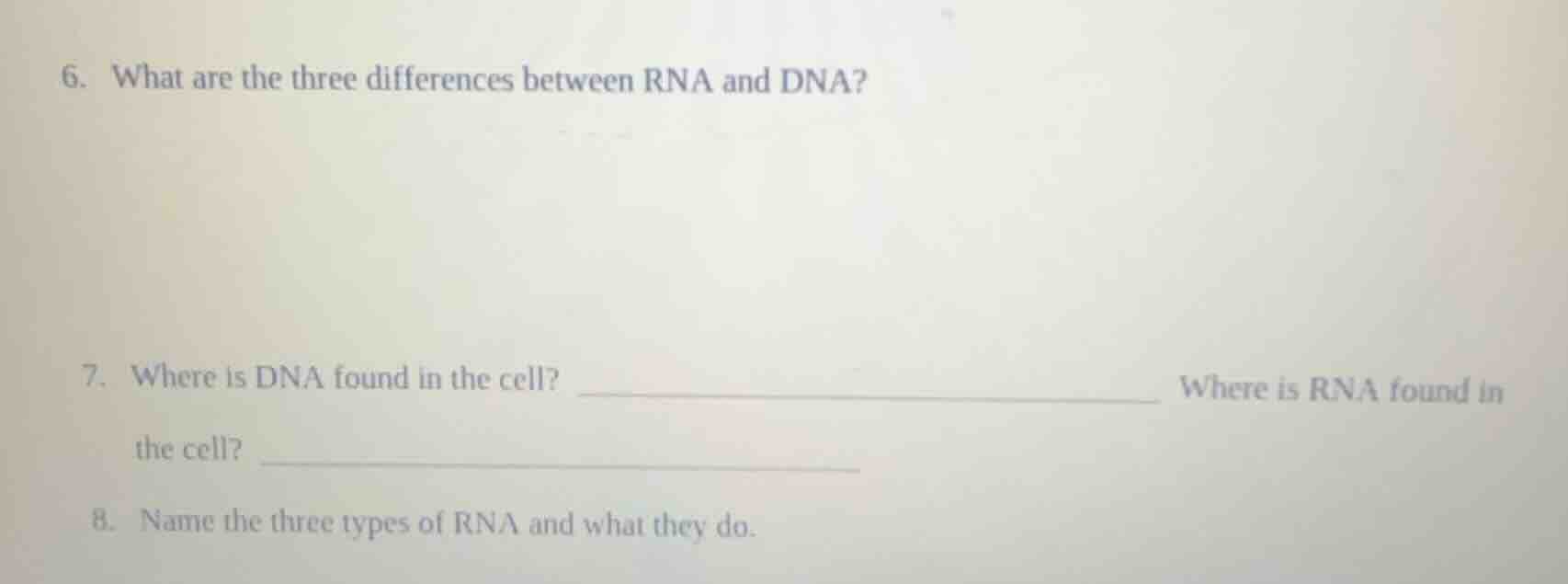
- what are the three differences between rna and dna?
- where is dna found in the cell?
where is rna found in
the cell?
- name the three types of rna and what they do.
Response
Question 6
Brief Explanations
To identify the three differences between RNA and DNA, we consider their structural and compositional aspects.
- Sugar Component: DNA contains deoxyribose sugar (lacks an oxygen atom on the 2' carbon of the pentose sugar), while RNA contains ribose sugar (has an oxygen atom on the 2' carbon).
- Strand Structure: DNA is typically double - stranded, forming a double - helix structure, whereas RNA is usually single - stranded.
- Nitrogenous Bases: DNA has the nitrogenous base thymine (T), and RNA has uracil (U) instead of thymine. The other bases (adenine, guanine, and cytosine) are common to both.
Brief Explanations
- Location of DNA in the cell: In eukaryotic cells, the majority of DNA is located in the nucleus, within the chromosomes. A small amount of DNA is also found in the mitochondria (and in chloroplasts of plant cells). In prokaryotic cells, DNA is found in the nucleoid region (a non - membrane - bound area in the cytoplasm) and also in plasmids (small, circular DNA molecules in the cytoplasm).
- Location of RNA in the cell: RNA is found in the nucleus (where transcription occurs, producing mRNA, tRNA, and rRNA) and in the cytoplasm. mRNA moves from the nucleus to the cytoplasm to be translated, tRNA is involved in translation in the cytoplasm (either free in the cytoplasm or associated with ribosomes), and rRNA is a component of ribosomes, which can be free in the cytoplasm or attached to the rough endoplasmic reticulum.
Brief Explanations
There are three main types of RNA, each with a specific function in protein synthesis:
- Messenger RNA (mRNA): It carries the genetic information from DNA in the nucleus to the ribosomes in the cytoplasm. The sequence of nucleotides in mRNA is complementary to the DNA sequence of a gene and provides the code for the amino acid sequence of a protein.
- Transfer RNA (tRNA): It functions as an adapter molecule during translation. Each tRNA molecule has an anticodon (a sequence of three nucleotides) that is complementary to a codon on mRNA. tRNA also carries a specific amino acid, and during translation, it brings the correct amino acid to the ribosome and pairs its anticodon with the corresponding codon on mRNA.
- Ribosomal RNA (rRNA): It is a major component of ribosomes. Ribosomes are the sites of protein synthesis. rRNA, along with ribosomal proteins, forms the structure of the ribosome and also plays a catalytic role in the formation of peptide bonds between amino acids during translation.

Snap & solve any problem in the app
Get step-by-step solutions on Sovi AI
Photo-based solutions with guided steps
Explore more problems and detailed explanations
- Sugar: DNA has deoxyribose, RNA has ribose.
- Structure: DNA is double - stranded, RNA is single - stranded.
- Base: DNA has thymine (T), RNA has uracil (U).