QUESTION IMAGE
Question
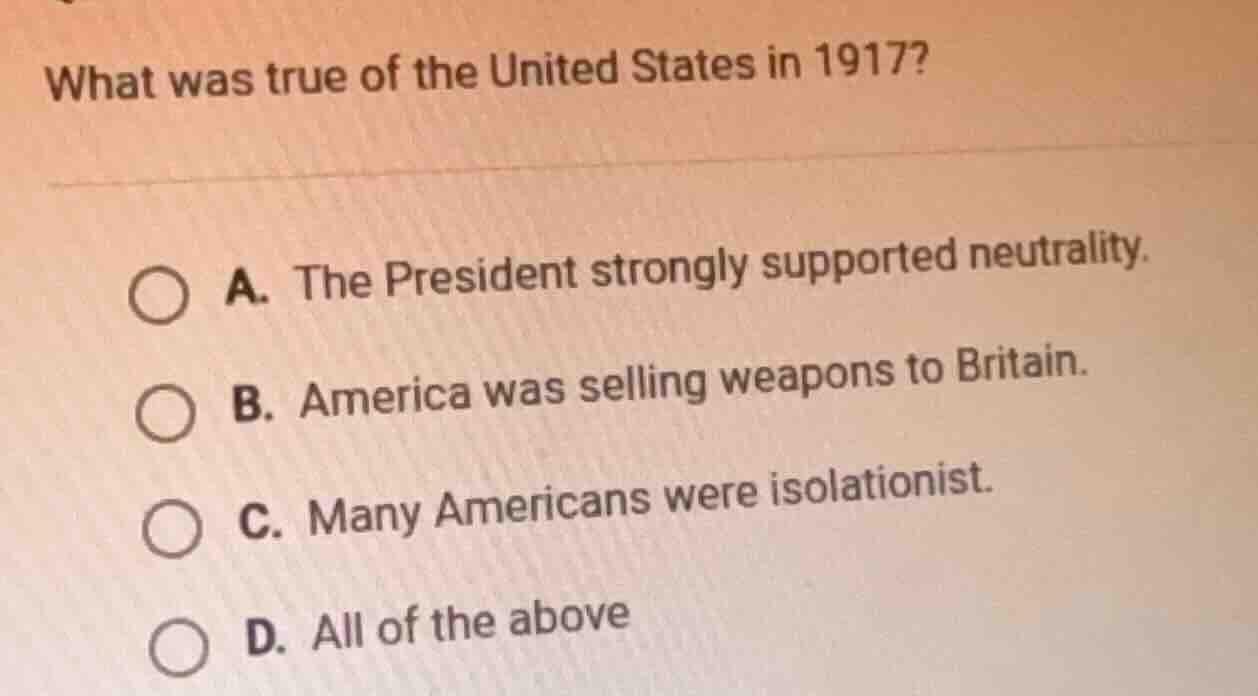
what was true of the united states in 1917?
a. the president strongly supported neutrality.
b. america was selling weapons to britain.
c. many americans were isolationist.
d. all of the above
Brief Explanations
- Option A: In 1917, President Wilson initially leaned towards neutrality but by 1917, the US was moving towards entering WWI, so the "strongly supported neutrality" is not accurate as the year progressed. However, earlier in the war (before 1917 fully), but in 1917, the shift was happening. Wait, no—let's re - evaluate. Actually, in 1917, the US was still in a phase where many isolationist sentiments existed (Option C), and the US had been selling weapons to Britain (Option B) as part of trade. Also, President Wilson, before the US entered the war, had a stance of neutrality, but by 1917, the situation was changing. Wait, no—let's correct. In 1917, the US was selling weapons to Britain (B is correct), many Americans were isolationist (C is correct), and President Wilson, before the US entered the war, had a neutrality stance (A: but "strongly" in 1917? Wait, maybe the question is considering the overall context. Wait, actually, in 1917, the US was still in a period where isolationism was strong (C), selling weapons to Britain (B), and Wilson's initial neutrality stance (A). Wait, but when the US entered the war in 1917, but before that, in 1917, the events leading up. Wait, the correct answer is D? Wait, no—let's check each:
- Option A: President Wilson, in the early years of WWI (before 1917), supported neutrality. In 1917, the US was moving towards war, but maybe the question considers the earlier part of 1917. But actually, by 1917, the Lusitania incident (1915) and other events had shifted, but many Americans still wanted neutrality, and Wilson's stance was changing. However, the question's options: B: America was selling weapons to Britain—yes, as part of trade. C: Many Americans were isolationist—yes, isolationist sentiment was strong. A: The President strongly supported neutrality—Wilson's initial stance was neutrality, and even in 1917, before the declaration of war, he was still in a neutrality - leaning position? Wait, maybe the answer is D. Because:
- A: Wilson's policy was neutrality (though with a shift), but "strongly"—maybe. B: US was selling weapons to Britain (part of economic ties). C: Isolationist sentiment was strong among many Americans. So all three (A, B, C) are true, so D.

Snap & solve any problem in the app
Get step-by-step solutions on Sovi AI
Photo-based solutions with guided steps
Explore more problems and detailed explanations
D. All of the above