QUESTION IMAGE
Question
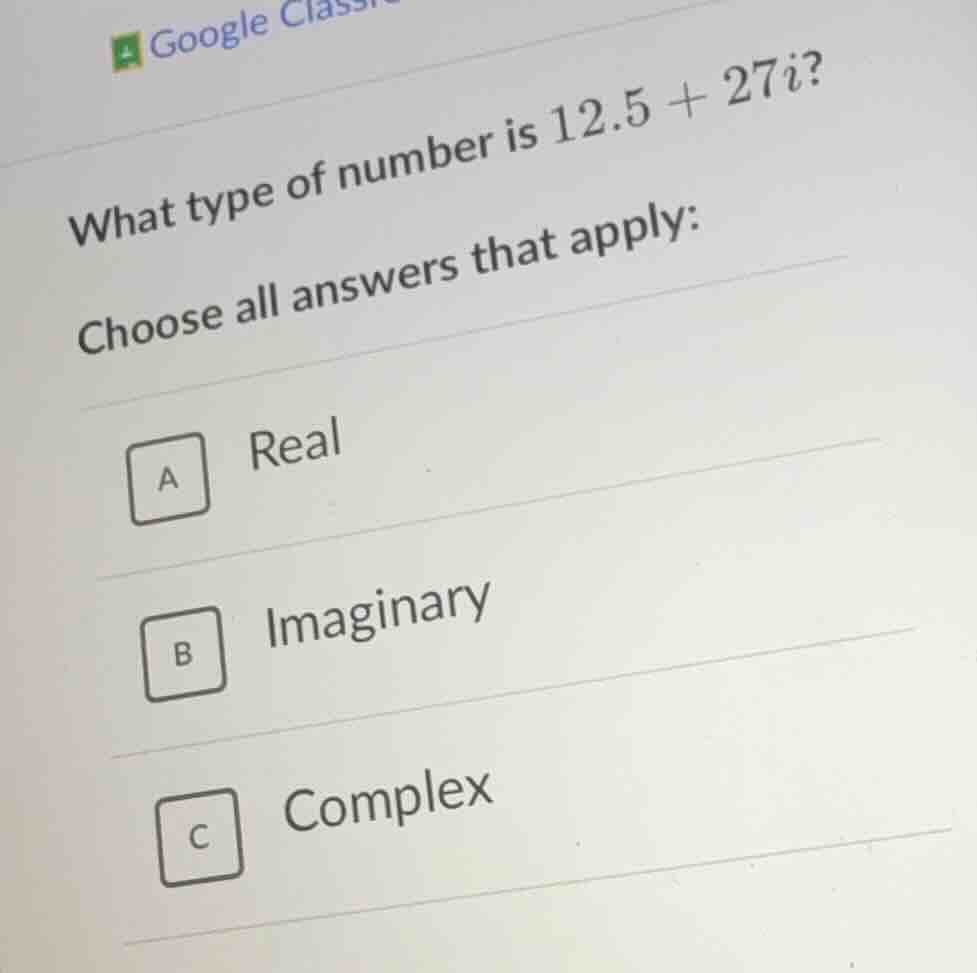
what type of number is $12.5 + 27i$? choose all answers that apply: a real b imaginary c complex
Brief Explanations
- A complex number is in the form \(a + bi\), where \(a\) is the real part and \(bi\) is the imaginary part (\(i=\sqrt{- 1}\)). For \(12.5 + 27i\), \(a = 12.5\) (real) and \(b = 27\) (imaginary coefficient).
- A real number has \(b = 0\), so \(12.5+27i\) is not real (A is incorrect). An imaginary number is of the form \(bi\) ( \(a = 0\) ), so \(12.5 + 27i\) is not purely imaginary (B is incorrect in the "purely imaginary" sense, but the term "imaginary" here can be a bit ambiguous, but the key is it's complex). Since it's in \(a + bi\) form, it is a complex number (C is correct). Also, the imaginary part exists, so it has an imaginary component (so "imaginary" as a component - but the main classification is complex. However, the options: complex is correct, and also, since it has an imaginary part, the "imaginary" option might be considered (but strictly, a purely imaginary number is \(bi\), but here the number has an imaginary component. But the standard: complex numbers include all \(a+bi\), real numbers are \(b = 0\), imaginary are \(a = 0\). So \(12.5+27i\) is complex (C), and it has an imaginary part (so B can be considered as the number has an imaginary component, and A is wrong. Wait, maybe the question's "imaginary" is not "purely imaginary" but just has an imaginary part. So let's re - evaluate:
- Real number: A number of the form \(a+0i\). Since our number has \(27i\) (non - zero imaginary part), it's not real (A is out).
- Imaginary number: A number of the form \(0 + bi\) (purely imaginary) or a number with an imaginary part. Sometimes "imaginary" is used to refer to numbers with a non - zero imaginary component. Our number has \(27i\), so it has an imaginary component (so B can be considered).
- Complex number: Any number of the form \(a + bi\) where \(a,b\in\mathbb{R}\). \(12.5+27i\) is of this form, so C is correct.
So the correct answers are B and C. Wait, but let's check the definitions again:
- Real numbers: Subset of complex numbers where \(b = 0\).
- Imaginary numbers: Numbers where \(a = 0\) (purely imaginary) or numbers with \(b
eq0\) (sometimes the term is used more loosely to mean having an imaginary part).
- Complex numbers: All \(a + bi\), \(a,b\in\mathbb{R}\).
So \(12.5+27i\):
- Not real (A is wrong).
- Has an imaginary part (so B is correct, as it's not real, it has an imaginary component).
- Is complex (C is correct, as it's in \(a + bi\) form).
So the answers are B and C.

Snap & solve any problem in the app
Get step-by-step solutions on Sovi AI
Photo-based solutions with guided steps
Explore more problems and detailed explanations
B. Imaginary, C. Complex