QUESTION IMAGE
Question
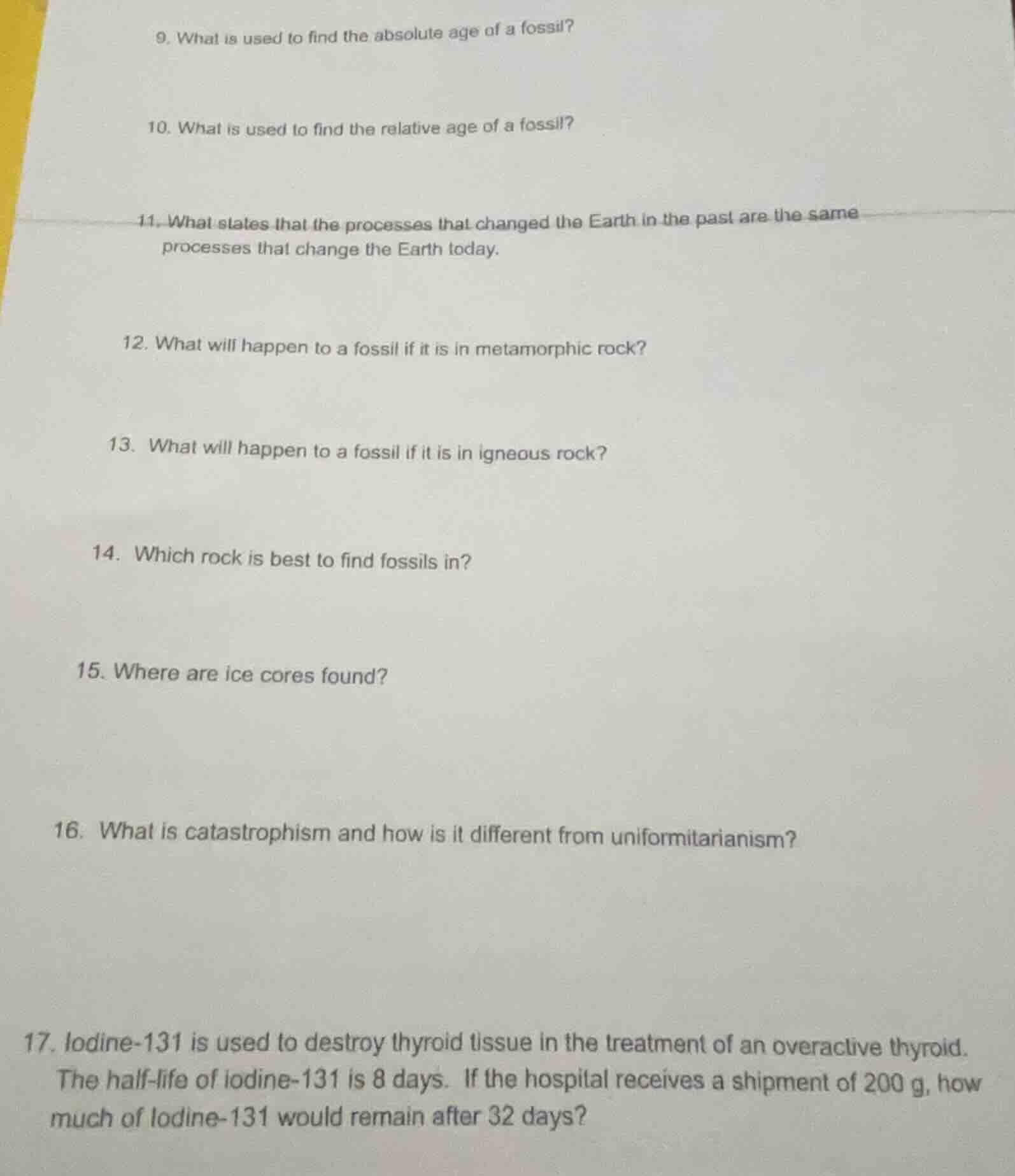
- what is used to find the absolute age of a fossil?
- what is used to find the relative age of a fossil?
- what states that the processes that changed the earth in the past are the same processes that change the earth today.
- what will happen to a fossil if it is in metamorphic rock?
- what will happen to a fossil if it is in igneous rock?
- which rock is best to find fossils in?
- where are ice cores found?
- what is catastrophism and how is it different from uniformitarianism?
- iodine-131 is used to destroy thyroid tissue in the treatment of an overactive thyroid. the half-life of iodine-131 is 8 days. if the hospital receives a shipment of 200 g, how much of iodine-131 would remain after 32 days?
Question 9
To find the absolute age of a fossil, radiometric dating (using radioactive isotopes like carbon - 14, potassium - argon) is used. These methods measure the decay of radioactive elements in the fossil or surrounding rock to determine the exact age.
To find the relative age of a fossil, the law of superposition (fossils in lower rock layers are older than those in upper layers), index fossils (fossils of organisms that existed for a short time and were widespread), and cross - cutting relationships are used. These help determine the order of events and the relative age of the fossil without giving an exact numerical age.
The principle of uniformitarianism states that the processes that changed the Earth in the past (like erosion, sedimentation, volcanic activity) are the same processes that change the Earth today. It was proposed by James Hutton and later developed by Charles Lyell.

Snap & solve any problem in the app
Get step-by-step solutions on Sovi AI
Photo-based solutions with guided steps
Explore more problems and detailed explanations
Radiometric dating (e.g., using radioactive isotopes like carbon - 14, potassium - argon)