QUESTION IMAGE
Question
what is the value of x? 20 units 15 units 25 units 12 units
Step1: Identify geometric theorem
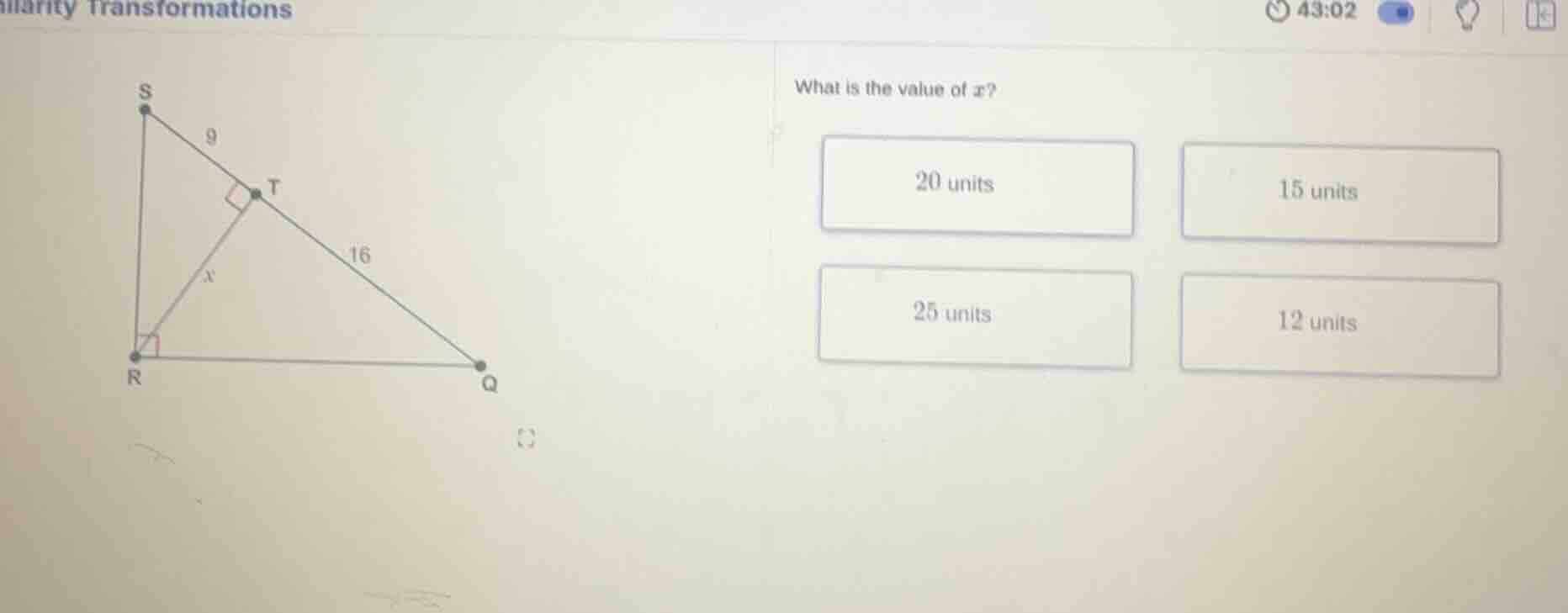
In a right triangle, the altitude to the hypotenuse is the geometric mean of the segments into which it divides the hypotenuse. Wait, actually, the length of the altitude \( x \) (which is the geometric mean of the two segments of the hypotenuse) or maybe we use the geometric mean theorem (altitude-on-hypotenuse theorem) which states that \( x^2 = 9\times16 \)? Wait, no, wait. Wait, the hypotenuse is \( 9 + 16=25 \)? Wait, no, the segments are 9 and 16? Wait, no, the triangle is right-angled at \( R \), and \( RT \) is the altitude to hypotenuse \( SQ \). So by the geometric mean theorem, \( RT^2 = ST\times TQ \). Wait, \( ST = 9 \), \( TQ = 16 \), so \( x^2=9\times16 \)? Wait, no, that would be if \( RT \) is the altitude, but wait, actually, the geometric mean theorem says that the altitude to the hypotenuse of a right triangle is the geometric mean of the lengths of the two segments of the hypotenuse. So \( x = \sqrt{9\times16} \)? Wait, no, that gives \( \sqrt{144}=12 \)? But wait, maybe I mixed up. Wait, no, the hypotenuse is \( SQ = ST + TQ = 9 + 16 = 25 \). Then, in a right triangle, the length of the leg can be found by geometric mean, but wait, \( RT \) is the altitude, so \( RT = \frac{SR\times RQ}{SQ} \), but maybe another approach. Wait, actually, the three triangles \( \triangle SRT \), \( \triangle RTQ \), and \( \triangle SRQ \) are similar. So \( \frac{ST}{RT}=\frac{RT}{TQ} \), so \( RT^2 = ST\times TQ = 9\times16 = 144 \), so \( RT = \sqrt{144}=12 \). Wait, but the options include 12 units. Wait, but let's check again. Wait, the hypotenuse is \( 9 + 16 = 25 \), so the length of the altitude to the hypotenuse is \( \frac{SR\times RQ}{SQ} \), but also, by geometric mean, \( RT = \sqrt{ST\times TQ} = \sqrt{9\times16}=12 \). So \( x = 12 \) units.
Step1: Apply Geometric Mean Theorem
In right triangle \( SRQ \) with altitude \( RT \) to hypotenuse \( SQ \), the theorem states \( RT^2 = ST \times TQ \).
Given \( ST = 9 \), \( TQ = 16 \), so:
\( x^2 = 9 \times 16 \)
Step2: Calculate \( x \)
Simplify \( 9 \times 16 = 144 \), so:
\( x = \sqrt{144} = 12 \)

Snap & solve any problem in the app
Get step-by-step solutions on Sovi AI
Photo-based solutions with guided steps
Explore more problems and detailed explanations
12 units