QUESTION IMAGE
Question
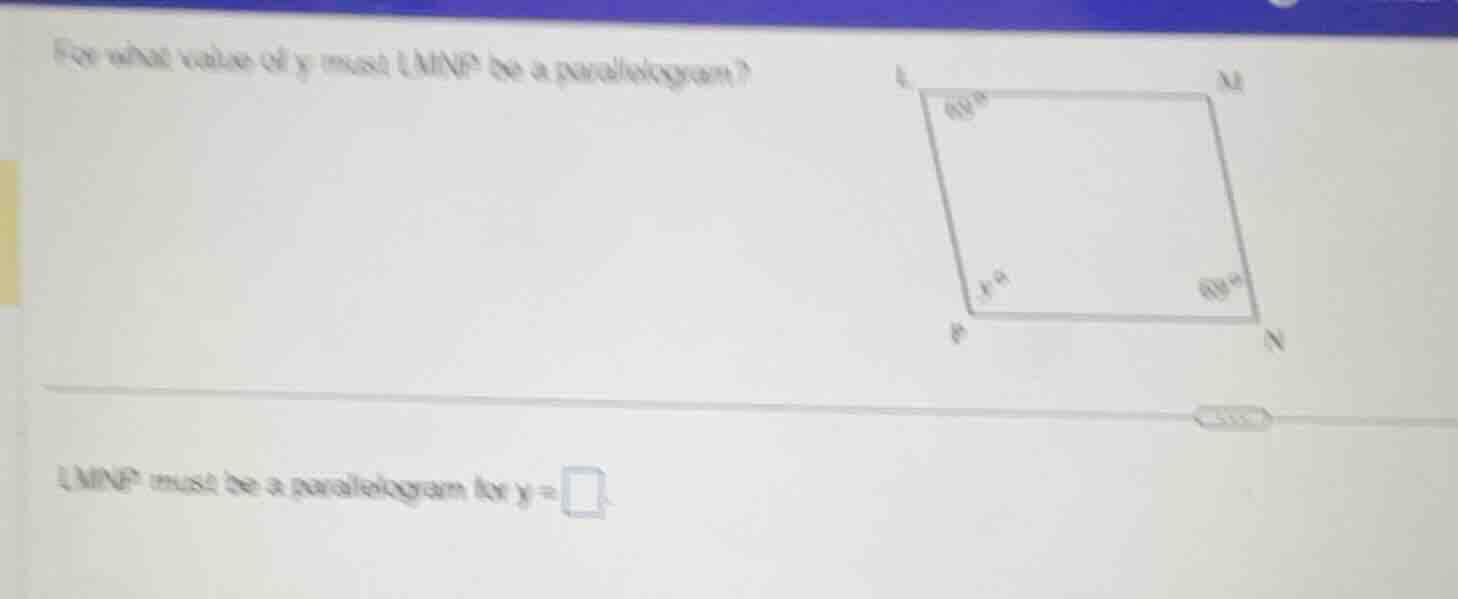
for what value of y must lmnp be a parallelogram?
lmnp must be a parallelogram for y = \square.
Step1: Recall parallelogram angle property
In a parallelogram, consecutive angles are supplementary (sum to \(180^\circ\)), and opposite angles are equal. Also, consecutive angles along a side should satisfy the supplementary property. But here, looking at the angles, we can use the property that consecutive angles between parallel sides are supplementary. Wait, actually, in a parallelogram, adjacent angles (consecutive angles) are supplementary. But also, opposite angles are equal. Wait, in the figure, angle at L is \(68^\circ\), angle at N is \(68^\circ\), so they are opposite angles (since in parallelogram LMNP, L and N are opposite vertices, M and P are opposite? Wait, maybe the sides are LM, MN, NP, PL. So angle at L and angle at N: if LM is parallel to NP and LN is a transversal? Wait, maybe better to use the property that consecutive angles are supplementary. Wait, no, let's think again. In a parallelogram, consecutive angles (e.g., angle at L and angle at M, angle at M and angle at N, etc.) are supplementary. But also, opposite angles are equal. Wait, in the given figure, angle at L is \(68^\circ\), angle at N is \(68^\circ\), so they are opposite angles (so that's consistent with opposite angles equal). Then angle at M and angle at P (which is \(y^\circ\)) should be equal? Wait, no, maybe angle at L and angle at P are consecutive? Wait, maybe the sides are L to M, M to N, N to P, P to L. So angle at L (between L-P and L-M) is \(68^\circ\), angle at N (between N-M and N-P) is \(68^\circ\), angle at M (between M-L and M-N) and angle at P (between P-N and P-L) should be equal. But also, consecutive angles: angle at L and angle at M should be supplementary, angle at M and angle at N should be supplementary, etc. Wait, maybe I made a mistake. Wait, the problem is to find y such that LMNP is a parallelogram. So in a parallelogram, consecutive angles are supplementary. Wait, angle at L is \(68^\circ\), angle at P (which is \(y^\circ\)): if LP is parallel to MN, then angle at L and angle at M are supplementary, angle at M and angle at N are supplementary, etc. Wait, maybe the correct approach is: in a parallelogram, consecutive angles are supplementary. Wait, no, let's look at the angles. The angle at L is \(68^\circ\), angle at N is \(68^\circ\), so they are opposite angles (so that's good, opposite angles equal). Then angle at M and angle at P (y) should be equal, and angle at L and angle at M should be supplementary. Wait, angle at L is \(68^\circ\), so angle at M should be \(180 - 68 = 112^\circ\)? No, that can't be. Wait, maybe I got the angles wrong. Wait, the figure: L, M, N, P. So sides: LM, MN, NP, PL. So angle at L: between PL and LM, angle at N: between MN and NP. So if LM is parallel to NP, then angle at L and angle at P are consecutive angles (since PL is a transversal), so they should be supplementary? Wait, no, PL and MN are parallel? Wait, maybe the correct property is that in a parallelogram, consecutive angles (adjacent angles) are supplementary. So angle at L (68°) and angle at P (y°) are consecutive? No, angle at L and angle at M are consecutive. Wait, maybe the problem is that angle at L and angle at P are same-side interior angles? Wait, maybe I need to re-express. Let's recall: In a parallelogram, opposite angles are equal, and consecutive angles are supplementary. So if angle at L is 68°, then angle at N (opposite) is 68°, and angle at M and angle at P (the other two angles) are equal, and each is supplementary to 68°. Wait, no, consecutive angles: angle at L and angle at M are consecutive, so they should…

Snap & solve any problem in the app
Get step-by-step solutions on Sovi AI
Photo-based solutions with guided steps
Explore more problems and detailed explanations
\( 112 \)