QUESTION IMAGE
Question
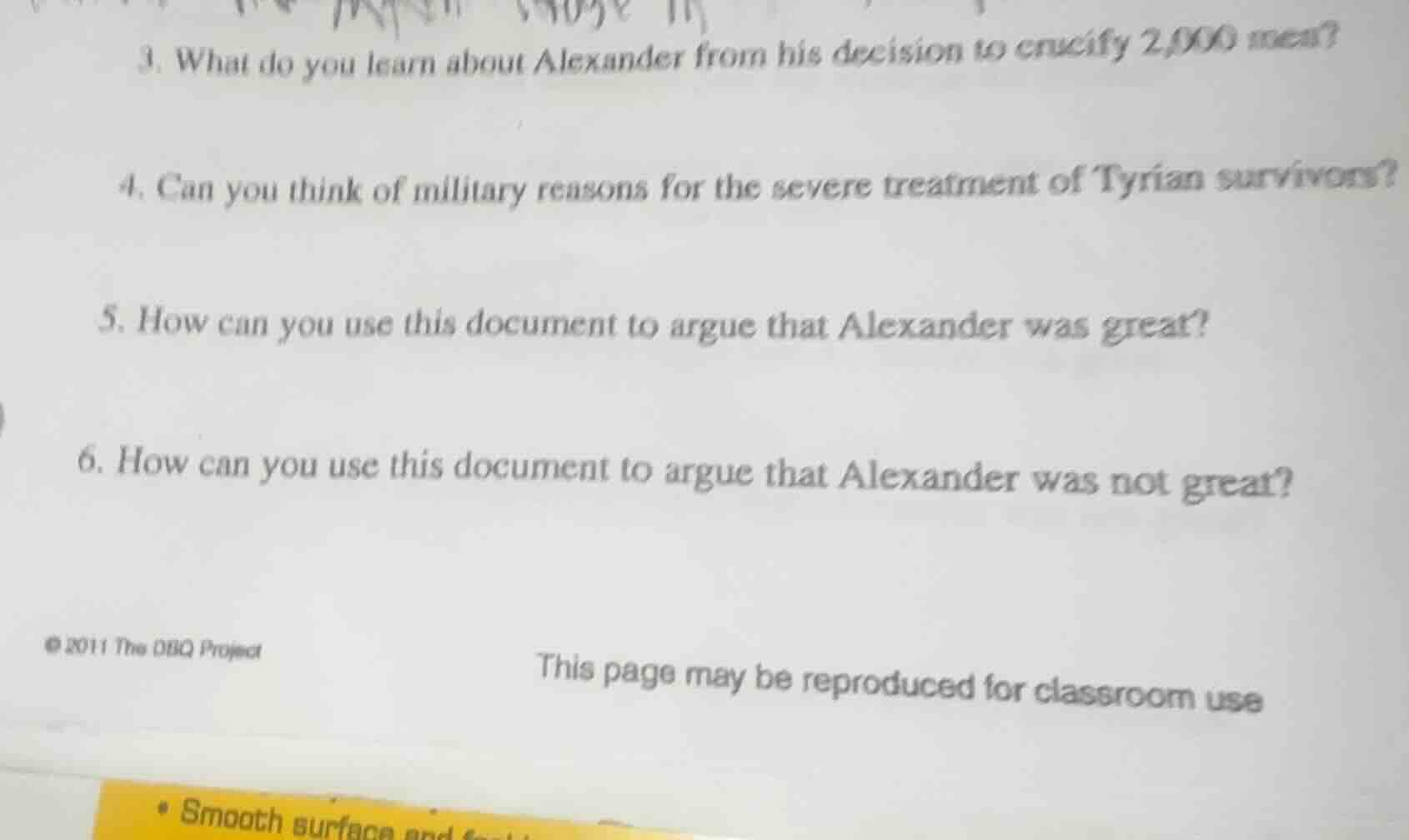
- what do you learn about alexander from his decision to crucify 2,000 men?
- can you think of military reasons for the severe treatment of tyrian survivors?
- how can you use this document to argue that alexander was great?
- how can you use this document to argue that alexander was not great?
© 2011 the dbq project
this page may be reproduced for classroom use
Since the document content related to Alexander and the Tyrian situation is not fully provided (we only see the questions, not the document itself), I'll provide general guidance on how to approach these questions assuming it's about Alexander the Great and the siege of Tyre:
Question 3: What do you learn about Alexander from his decision to crucify 2,000 men?
To answer this, we analyze the action. Crucifixion is a brutal, public punishment. It suggests Alexander was ruthless, willing to use extreme force to assert control, deter rebellion, or punish resistance. It shows his harsh leadership style and lack of mercy toward enemies.
Military strategy involves deterrence, resource control, and sending messages. Severe treatment could deter other cities from resisting (so they surrender quickly, saving Alexander's troops' lives and resources). It could also eliminate potential Tyrian guerrilla fighters or resisters, secure the city (and its resources like the port) fully, and show his army's resolve, boosting morale while demoralizing enemies.
To argue "great," frame his actions as strategic leadership. The severe treatment (e.g., crucifixion) could be portrayed as a necessary, decisive move to unify his empire, establish order, and ensure long - term stability. It showed his strength as a leader, ability to make tough (if harsh) decisions to achieve his goals (like creating a vast empire), and his effectiveness in subduing resistance to build a lasting (albeit through fear) realm.

Snap & solve any problem in the app
Get step-by-step solutions on Sovi AI
Photo-based solutions with guided steps
Explore more problems and detailed explanations
From his decision to crucify 2,000 men, we learn that Alexander was ruthless and willing to use extreme, brutal measures to assert his authority, punish resistance (like from Tyrian defenders), and potentially deter future rebellions. His actions show a lack of mercy toward those who opposed him and a desire to establish dominance through fear.