QUESTION IMAGE
Question
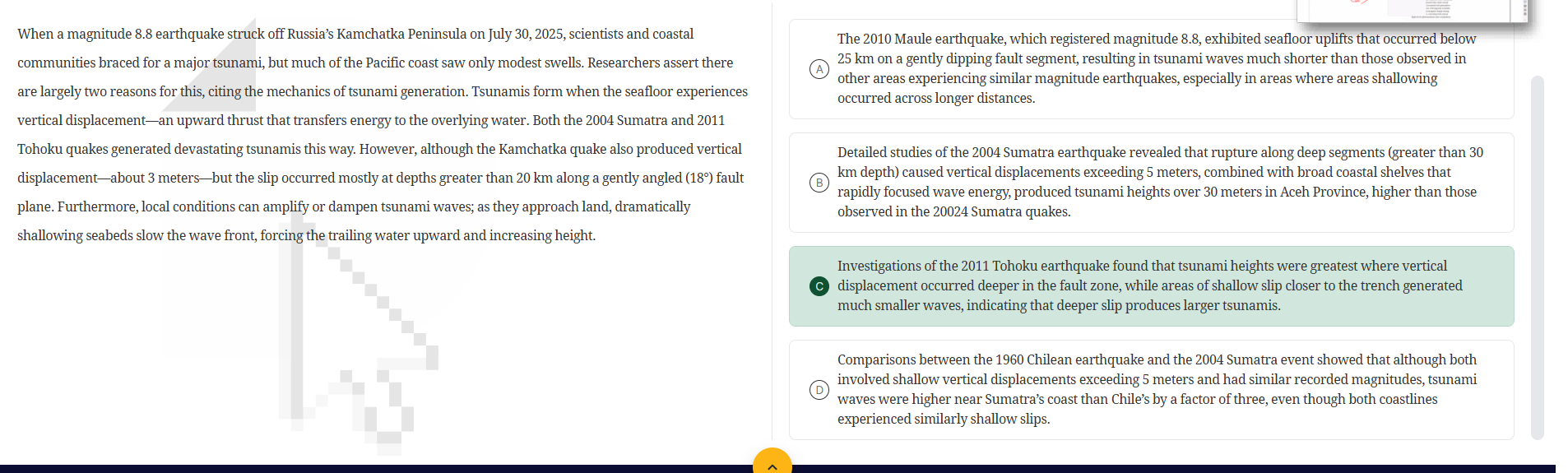
when a magnitude 8.8 earthquake struck off russia’s kamchatka peninsula on july 30, 2025, scientists and coastal communities braced for a major tsunami, but much of the pacific coast saw only modest swells. researchers assert there are largely two reasons for this, citing the mechanics of tsunami generation. tsunamis form when the seafloor experiences vertical displacement—an upward thrust that transfers energy to the overlying water. both the 2004 sumatra and 2011 tohoku quakes generated devastating tsunamis this way. however, although the kamchatka quake also produced vertical displacement—about 3 meters—but the slip occurred mostly at depths greater than 20 km along a gently angled (18°) fault plane. furthermore, local conditions can amplify or dampen tsunami waves; as they approach land, dramatically shallowing seabeds slow the wave front, forcing the trailing water upward and increasing height.
a the 2010 maule earthquake, which registered magnitude 8.8, exhibited seafloor uplifts that occurred below 25 km on a gently dipping fault segment, resulting in tsunami waves much shorter than those observed in other areas experiencing similar magnitude earthquakes, especially in areas where areas shallowing occurred across longer distances.
b detailed studies of the 2004 sumatra earthquake revealed that rupture along deep segments (greater than 30 km depth) caused vertical displacements exceeding 5 meters, combined with broad coastal shelves that rapidly focused wave energy, produced tsunami heights over 30 meters in aceh province, higher than those observed in the 20024 sumatra quakes.
c investigations of the 2011 tohoku earthquake found that tsunami heights were greatest where vertical displacement occurred deeper in the fault zone, while areas of shallow slip closer to the trench generated much smaller waves, indicating that deeper slip produces larger tsunamis.
d comparisons between the 1960 chilean earthquake and the 2004 sumatra event showed that although both involved shallow vertical displacements exceeding 5 meters and had similar recorded magnitudes, tsunami waves were higher near sumatra’s coast than chile’s by a factor of three, even though both coastlines experienced similarly shallow slips.
To solve this, we analyze the passage and each option:
Step 1: Understand the Passage’s Key Points
The Kamchatka quake had vertical displacement (~3m) but slip mostly at depths >20km along a gently angled fault. Local conditions (e.g., shallowing seabeds) also affect tsunami waves. The passage explains tsunami generation via vertical seafloor displacement and how depth of slip + local conditions influence wave size.
Step 2: Analyze Each Option
- Option A: Discusses the 2010 Maule quake’s seafloor uplift <25km, resulting in shorter tsunamis (due to shorter-distance shallowing). The Kamchatka quake’s slip was >20km, but this option focuses on depth of uplift (not slip) and a different quake. Not directly supporting Kamchatka’s case.
- Option B: Talks about 2004 Sumatra’s deep rupture (>30km) causing >5m displacement + broad shelves amplifying waves. Kamchatka’s slip was >20km (not >30km) and displacement was ~3m (not >5m). Irrelevant to Kamchatka’s “modest swells.”
- Option C: Investigations of 2011 Tohoku found deeper slip (in fault zone) produced larger tsunamis, while shallow slip produced smaller waves. Kamchatka’s slip was mostly at depths >20km (deeper), but it had modest swells. Wait—no, Kamchatka’s displacement was ~3m (smaller) and slip depth >20km. Wait, re-express: The passage’s Kamchatka quake had deeper slip (but smaller displacement) and modest swells. Option C says “deeper slip produces larger tsunamis”—but Kamchatka’s deeper slip did NOT produce large tsunamis. This seems contradictory? Wait, no—maybe I misread. Wait, the passage says Kamchatka had vertical displacement (~3m) but slip at >20km. The 2004/2011 quakes (which had devastating tsunamis) likely had shallower slip? Wait, no—2004 Sumatra: the passage says “rupture along deep segments (greater than 30 km depth)” in Option B. Wait, maybe I confused “slip depth” with “rupture depth.” Let’s re-express: The key is that depth of slip (where the fault slips) affects tsunami size. The Kamchatka quake’s slip was at >20km (deeper), but it had modest swells. Option C says “deeper slip produces larger tsunamis”—but Kamchatka’s deeper slip did not. Wait, no—maybe the passage’s explanation is that both slip depth and displacement size matter. Wait, no—let’s re-express the passage:
The passage states:
- Tsunamis form via vertical seafloor displacement (energy to water).
- 2004/2011 had devastating tsunamis (via this mechanism).
- Kamchatka: vertical displacement (~3m) + slip at >20km (deeper) + gently angled fault → modest swells.
Option C: “deeper slip produces larger tsunamis” (from Tohoku). But Kamchatka’s deeper slip did NOT produce large tsunamis. Wait, this seems conflicting. Wait, no—maybe the passage’s Kamchatka quake had deeper slip but smaller displacement (3m vs. 2004’s >5m). So displacement size (not just slip depth) matters. But Option C says “deeper slip produces larger tsunamis”—which would contradict Kamchatka’s case. Wait, no—maybe I made a mistake. Let’s check again.
Wait, the question is to support the researchers’ assertion (why Kamchatka had modest swells). The researchers’ reasons: (1) mechanics of tsunami generation (vertical displacement + slip depth) and (2) local conditions.
Option C: “deeper slip produces larger tsunamis” (from Tohoku). But Kamchatka’s deeper slip did NOT produce large tsunamis. So this would contradict the researchers’ assertion. Wait, no—maybe the passage’s Kamchatka quake had slip at >20km (deeper), but the Tohoku quake (in Option C) had deeper slip producing larger tsunamis. But Kamch…

Snap & solve any problem in the app
Get step-by-step solutions on Sovi AI
Photo-based solutions with guided steps
Explore more problems and detailed explanations
A. The 2010 Maule earthquake, which registered magnitude 8.8, exhibited seafloor uplifts that occurred below 25 km on a gently dipping fault segment, resulting in tsunami waves much shorter than those observed in other areas experiencing similar magnitude earthquakes, especially in areas where areas shallowing occurred across longer distances.