QUESTION IMAGE
Question
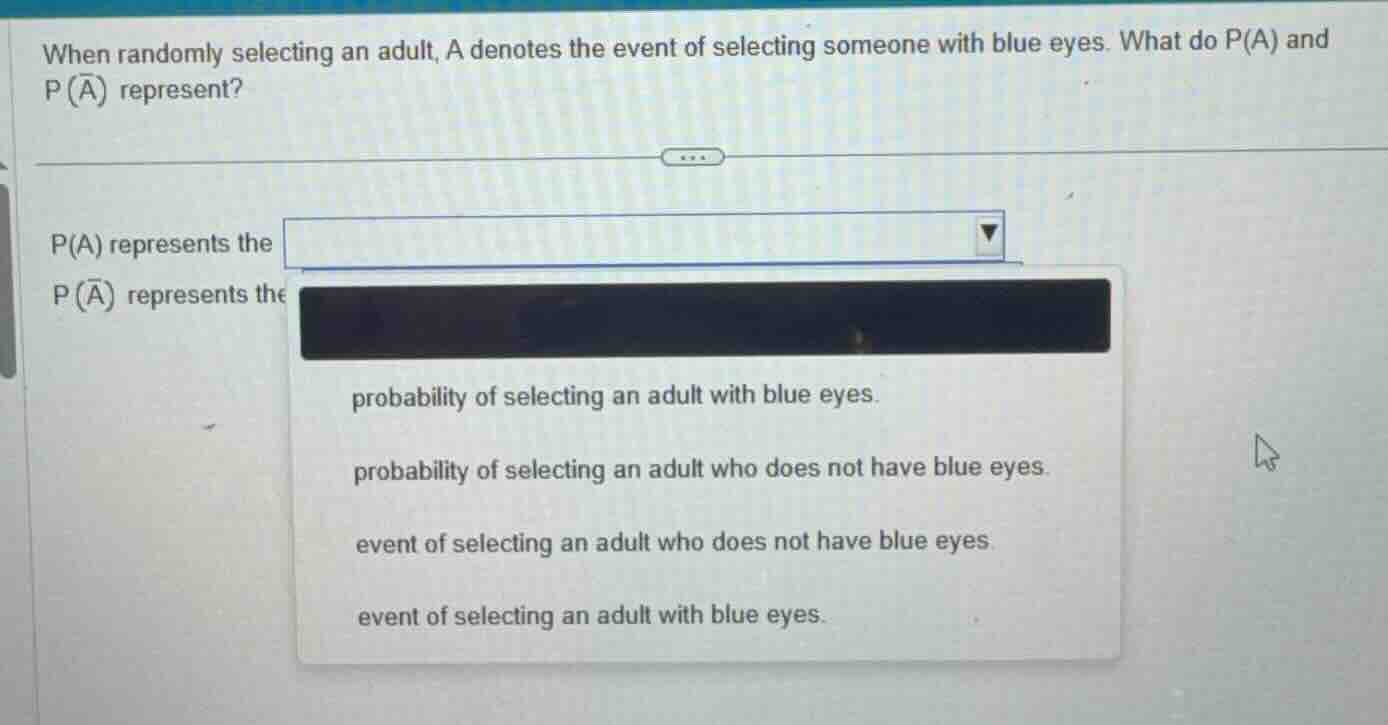
when randomly selecting an adult, a denotes the event of selecting someone with blue eyes. what do p(a) and p(\\(\bar{a}\\)) represent?
p(a) represents the
p(\\(\bar{a}\\)) represents the
probability of selecting an adult with blue eyes.
probability of selecting an adult who does not have blue eyes.
event of selecting an adult who does not have blue eyes.
event of selecting an adult with blue eyes.
Brief Explanations
- For \( P(A) \): In probability, \( P(\text{event}) \) represents the probability of that event occurring. Here, event \( A \) is selecting an adult with blue eyes, so \( P(A) \) is the probability of selecting an adult with blue eyes.
- For \( P(\overline{A}) \): The notation \( \overline{A} \) (read as "A bar") represents the complement of event \( A \), which is the event that \( A \) does not occur. So \( P(\overline{A}) \) is the probability of the complement event, i.e., the probability of selecting an adult who does not have blue eyes. Also, note that \( P(\overline{A}) \) is a probability (a number), not an event (the event is \( \overline{A} \) itself).

Snap & solve any problem in the app
Get step-by-step solutions on Sovi AI
Photo-based solutions with guided steps
Explore more problems and detailed explanations
\( P(A) \) represents the probability of selecting an adult with blue eyes.
\( P(\overline{A}) \) represents the probability of selecting an adult who does not have blue eyes.